
Introductory remarks
This paper represents 'work in progress' as part of the collective effort of the Food Socioscope Project, funded by the NOMIS Foundation. Over the past two years, we have organized, with the help of partner organizations, an international team of interviewers to carry out qualitative fieldwork with some 700 local initiatives in 35 countries on all continents. One of the aims of the Socioscope Project is to build a new method for qualitative social science research at an unprecedented scale (Lahlou et al., 2024). It relies on AI-based data collection and analysis and includes the full documentation of every step in the process. We have now entered the second phase of the project, primarily devoted to the analysis, which is carried out on an experimental basis, probing the potential and the limitations of LLMs. The main research question addressed is how processes of transition towards greater sustainability happen. We have decided to tackle this overarching question by a deliberate focus on 'what happens on the ground', starting from the micro-level where local initiatives operate.
Inevitably, by following the interactions and transactions of local initiatives, we soon were led to the meso-level and to engage further with the entities we found there, the meso-entities and meso-structures. This paper is intended to describe in greater detail their role and function. Meso-structures may facilitate or block micro-initiatives; they may evolve in response or as a result of engaging with the micro-level and become a pathway to stimulate others through learning. But they may also stifle incipient movements or action coming from below. In our view, the meso-structures play a major role in generating or blocking processes of transition. The interactions that emerge between the micro- and the meso-level and the space in which they occur are key to understanding the mechanisms of the evolution that may lead to transformation.
In the following sections, the space between these levels and the evolving dynamics will be given their due, based on reflections that arise from a dialogue with the voices of those whom we interviewed. We have data based on the literal transcripts of what our interviewees told us, filled with their perception and perspectives, their experience, aspirations and disappointments, their values, and the sense of belonging to a community. As the interviews were accompanied by video, we also see the faces and the physical as well as social environment in which the interviewees live and work. This direct contact with agents of change in the field creates a lively sense of understanding them and their situation, a phenomenon well-known to anthropologists. But 'understanding' in this context is an illusion, and social science research requires a careful balance between engagement and distance. All we can do is to follow what they tell us, while grasping what motivates them, and to carefully listen to their experience and aspirations. As we are only at the beginning of the analysis of the data we have collected, it would be premature to expect more than glimpses of what has emerged from the fieldwork. Thus, we cannot yet provide the kind of empirically validated research results that we are still working on. If we give an example, it is just that, an event or a story told at one point in time.
We are fortunate that our research coincided with the greater public availability of the latest developments in Artificial Intelligence, especially the most recent LLMs. In the ongoing analysis, we are using them to help us extract patterns across 700 initiatives distributed over different geographies and operating in very diverse economic, political, and cultural contexts. Depending on what we find and after having carefully validated the results, we will work intensely to put together the different strands, hoping that a coherent picture will emerge. For the following pages, we must ask the reader for indulgence as we can only present our personal reflections, based on incomplete and preliminary findings.
1. Pathways towards the Next Major Transformation
Agriculture, or farmed food, undoubtedly is an indispensable part of human 'worldmaking' – the ways in which humanity over thousands of years has not only kept going and growing enormously but has also shaped, and depleted, the natural environment on which our food and the material substance of our scientific-technological civilization depend. Across the globe, with its multiple and repeated division of scarcity and abundance, of novelty and traditions, we find similar organizing principles, bundled in 'foundational packages' that are recognizable across the human past. This is the claim made by Walter Scheidel, a historian of ancient history who traces the coalescence of these foundational innovations, which arose independently and repeatedly with great variation in timing across the globe (Scheidel, 2025). Beginning with targeted intervention in the reproduction of plants and animals by altering their genetic traits to make them more useful to humans, a whole bundle of innovations converged, the 'foundational packages'. Apart from innovative practices in cultivation and domestication, material infrastructures, like solid housing, walls, roads, and canals, appeared as corollaries of food production. The domestication of animals and plants extended to humans, imposing timed work-regimes on them. Finally, improved energy capture and innovation in the material culture enabled demographic expansion and larger social organizations.
Dependent on environmental constraints, location, interconnections, and factors tied to the evolution of social organizational capabilities, our species inherited – or became locked into – a particular mode of existence and development which became virtually unassailable. The arrival of agriculture was the first big transformation, which brought changes in material culture but also between people: novel inequalities, from labor to religious belief systems, crept into everything, and patriarchy became entrenched. Social differentiation paved the way for the rise of more complex social organizations, from early city-states to territorial federations to astonishingly long-lived and large empires.
When the industrial revolution began to radically transform also agriculture, its largely path-dependent and long-term development became engulfed in the accelerated mechanization of modernity. Industrialization of agriculture brought with it an increased use of land coupled with a radical decrease in the workforce in agriculture. This translated into more yields per land due to greater efficiency in production by using fertilizers, pesticides, and fossil fuels. The distance between producers and consumers increased with the entry of cooling technology, canned food, and other technologies for preservation, processing, and storage, leading to changes in consumer habits. In short, the mechanization of agriculture took over. This 'full package' became dominant and ever since, we have been living in a turbo-charged mode of how food is produced and consumed, stored, processed, transported, and disposed of.
Yet, as more and bigger is believed to be better, the efficiency-driven exploitation of natural resources has led to the predicaments we face today. Production at a global scale has its price, with monocultures displaying greater vulnerability to pests and longer supply-chains exposed to frequent disturbance. Food security is threatened by climate change and wars; many regions experience acute and rising water shortages, soil erosion, and rapidly spreading desertification. Arguably, local food production in the global South underwent a dramatic transformation from the 1950s onward through the "Green Revolution" when high-yielding crop varieties, synthetic fertilizers, chemical pesticides, and large-scale irrigation enabled more than a doubling of wheat production between the mid-1960s and mid-1970s. Yet, also here, the longer-term negative consequences appeared.
The ecological and social costs that came with mechanization, pumped irrigation, and especially synthetic nitrogen-based fertilizers, such as urea and ammonium, are high. Since many of these fertilizers are derived from natural gas, what was initially celebrated as a path-breaking revolution established a close link between food production and the fossil fuel industry. With 70% of the world's ammonium used to produce fertilizers, the enduring dependency on hydrocarbon inputs creates new vulnerabilities. Food production and food security, especially in countries of the Southern hemisphere, are at great risk through the disruption of supply chains as painfully demonstrated by the recent closure of the Strait of Hormuz (Hanieh, 2026).
Critics have questioned the sustainability of a fossil-fuel-based food system for a long time, together with a chorus of voices from consumer associations and environmental groups that point to the mounting pressure of the food system on the environment and biodiversity increasingly at risk. How food is currently produced and consumed accounts for roughly 30% of global greenhouse-gas emissions, and about 70% of the world's yearly freshwater use is for agricultural purposes. Agriculture is also a leading driver of nutrient pollution and biodiversity loss, shrinking land use, and high exposure to climate change and the disruption of supply chains. Unsustainable land conversion, particularly deforestation, biochemical flows such as nitrogen and phosphorous, are among the planetary boundary transgressions showing worsening trends. Combined with other fast-moving drivers, they highlight the interdependence between the various crises that threaten further escalation and irreversible and abrupt environmental change.
In response, attempts to offer solutions at global, regional, and national levels continue to produce an abundance of reports and policy recommendations. Many concerns coalesce and are reinforced by the worrying state of health and its close interdependency with the food system. More than half of the world's population struggles to access a healthy diet, and obesity rates continue to rise due to an increase in the consumption of ultra-processed food and the switch from plant to a meat-based diet. No solution is feasible without changing how global food systems function. The 'One Health' approach (healthy environment, healthy animals, healthy humans) promoted by the WHO and other international agencies is based on recognizing the interdependence between health and the food system. Its central position becomes increasingly affirmed. A food system comprises much more than agriculture. It sits at the center of the nexus with human (and animal) health and a sustainable environment.
One of the more recent reports from October 2025, highlighting this trend, is by the EAT-Lancet Commission on healthy, sustainable, and just food systems. It builds upon a series of previous international encounters, reports, and recommendations, but its analysis expands the scope with a strengthened evidence basis and modeling exercises to explore different scenarios. As food is the single largest cause for five of the six already breached planetary boundaries transgressions, it argues that a less resource-intensive food system transformation is needed to supply a healthy diet for up to 10 billion people. This has profound implications for what, how, and where food is produced and consumed, and for the working conditions of those involved in these processes. For the first time, the social dimension in driving such a transformation is highlighted through the lens of social justice, which is needed to unlock and accelerate the transformation. It addresses power asymmetries, the lack of voice, precarious livelihoods for food workers, and the importance of regulation and limiting market concentration, and improving other impactful actions (Rockström et al., 2025).
The cornerstone is the planetary health diet (PHD), based on substantial evidence of the health benefits of a largely plant-based and balanced diet. Multiple processes converge in this direction, and detailed recommendations by many other international agencies include the reduction of environmental pressure on climate, water, pollution, soil health, and more. They emphasize the importance of context-specific practices enabled by equitable access to land and water resources, the strengthening of public advisory bodies, addressing structural imbalances between producers and dominant agribusinesses, and public and private investments to support farmers in shifting towards more sustainable practices.
The members of the EAT-Lancet Commission come from an impressive array of well-known academic sustainability research and policy institutions and call for cross-sectoral coalitions and close alignment with existing and emerging global frameworks, such as the Paris Agreement, the Convention on Biological Diversity, and the post-2030 Sustainable Development Goals agenda. As unprecedented levels of action are required to shift diets, improve production, and enhance justice, coalitions with actors from inside and outside the food system must be built, bundles of actions identified, national and regional roadmaps for implementation developed, and finance for the transformation must be unlocked to put joint plans into action. The goals are clearly spelled out, as are some of the pathways to attain them.
A transformation entails the change of an entire system, its structures, functions, and relations to other systems. Transforming food systems, as the international consensus states, must be approached by transforming them into healthy, sustainable, and just food systems. This is a huge undertaking. Looking back at the foundational innovations bequeathed by our ancestors thousands of years ago and following the industrialization of agriculture as the second major transformation, we are faced with nothing more and nothing less than instigating and shaping the Next Major Transformation - this time, prepared to meet the challenges that our scientific-technological civilization encounters in the 21^st^ century.
2. 'Finding a formula to feed the world': the Socioscope Project
Sustainability has become a ubiquitous goal for every activity and sector in society. It is a label, a promise, and a signal of hope for humanity to survive and build a better future. Many laudable efforts continue to be undertaken to strengthen international conventions, and binding regulations are decreed at the national and regional levels, in the hope that they will percolate down and lead to alignments. But a huge gap exists between the efforts to increase awareness and to do things differently as described above, while realizing that change does not happen at the desired pace, breadth, and depth. This is where the Food Socioscope project enters and why it is relevant – by putting the spotlight on local stakeholders. What is happening on the ground? What can we learn from the arduous efforts of people who are highly motivated by their vision of what a sustainable future should look like – be it for themselves, their community, for like-minded others, for the nation, or for the planet. Seen from the macro-perspective, their efforts appear negligeable, either to be ignored or paid lip-service. If we want to understand the mechanisms leading to change in the desired direction, we need to include the micro-level and bring it back into the 'big picture'. We need to bridge the gap between the micro- and the meso-level, which will eventually help to connect with the macro-level.
Thus, the Socioscope project aims to explore the local initiatives in the domain of food sustainability. Who started them and why? What are the underlying values that keep them going, and which relationships with other stakeholders, especially with meso-entities, embed them in the larger context? The Socioscope has been designed to reveal, among other, the nitty gritty of transition processes, consisting of the many mundane efforts undertaken on a daily basis by ordinary people. They work on a farm, set up a soup kitchen to empower women, and launch a small business to produce and sell their product, which aligns with their vision and guiding values directly to consumers. The Socioscope method offers what can only be partial views, as seen and perceived from the perspective of micro-level agents, but it enables a glimpse of the local eco-systems that emerge through their activities and interactions. This perspective is complemented by interviews with organizations and institutions like municipalities, consultancies, larger firms and businesses, banks, and administrative-political units, in short, the meso-entities. Partly, they shape the regulatory framework that grants access, controls, or implements policy measures and provides the indispensable financial support. Together, these micro- and meso-entities are engaged in the transition processes, the mechanisms of which the Socioscope project seeks to identify and better understand (Science Custom Publishing/AAAS, 2026).
Transition is a non-linear journey, and our interviewees move in the direction indicated by their values. They follow a guiding vision, although there is no clear and guaranteed pathway ahead. Starting from a more traditional agricultural background and/or business model, they transition to sustainable practices, either gradually or more often, triggered by a crisis or another event. They continue to learn by trial and error, facing many challenges such as market fluctuations and a lack of access to the resources they need. They connect with various stakeholders with whom they regularly exchange in a give and take – but of what exactly? Far from being restricted to monetary transactions and the exchange of tangible material like seeds or tools, the exchange involves intangibles: one party offers visibility and receives legitimacy, another gives a product and gets information in return.
"We have partnerships with two Catalan firms with whom we co-brand: we put our brand on their products and they put theirs on ours. They give us visibility in Europe, we give them legitimacy from a regenerative producer in Patagonia. Beyond the commercial side, it's an exchange of credibility – what one of us cannot offer alone, together we can." (Case AR-006)
Extending the lens to include as many of these transactions as possible has led us to identify a variety of stakeholders who, together with the local initiative, constitute the micro eco-system. It consists of reciprocal as well as of a-symmetrical relationships and ties that bind. (Lahlou et al., 2024). They range from transactions with other producers to those that directly connect with consumers, be it single households or high-end restaurants. Stakeholders can be those who supply seeds and cooling machines, but also those who give precious advice and information. Relations with schools and technical experts play an important role, as training and exchange of knowledge and information are crucial. Every local initiative is embedded in a specific local and national policy context with its regulatory framework. They depend on receiving some kind of financial support in the form of subsidies, loans, and other monetary and financial assets, without which no local initiative would be able to survive, forming an essential link with the meso-level, but not the only one.
"Our productive capacity is already exhausted, and at the same time the subsidies are in decline. Without that support we simply wouldn't be here. The bank loan we are now negotiating is the only way to keep growing – and even that requires that someone at the meso-level vouches for what we do." (Case AR-040)
We systematize the collection of these interactive relationships of the ecosystem in what we call the 'transaction grid'. It is a matrix of all stakeholders with whom the initiative regularly interacts. It tells us who the stakeholders are, with whom they interact on a regular basis, what they give, and what they get in these exchanges. By asking the interviewees, in addition, how they think the other party perceives what it gets and how it perceives what it gives, we add another layer of reflection that reveals the asymmetries inherent in the transaction.
Example of an extract from a transaction grid of a small company producing with an insect farm fertilizer and insect protein from agricultural waste.
Figure 1: Example of an extract from a transaction grid of a small company producing with an insect farm fertilizer and insect protein from agricultural waste (Case KE-015).
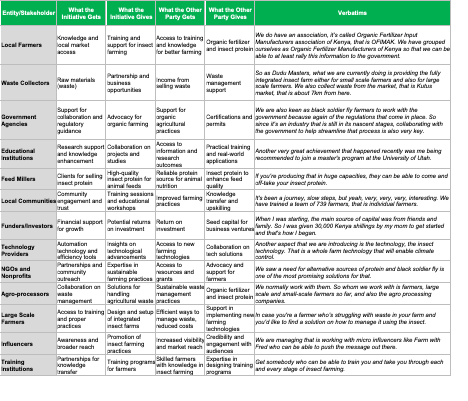
We soon realized the necessity of following the links that connect the micro- and the meso-level and began to include some of the meso-entities as well: municipalities and governmental offices; firms and businesses, some international corporations; banks; local, national, or international donors; larger cooperatives and associations; NGOs of various kinds and sizes; philanthropic trusts and other organizations. What do these stakeholder entities receive in return? What are their motivations to support local initiatives, and what are their expectations? Obviously, they too must have a stake in the pursuit of a transition towards more sustainability, guided by values and motivations. Often, they provide money and indispensable financial support, but what exactly do they hope to achieve? How do these stakeholders channel the activities of local activities in the direction they define? If so, how do they decide whom to support and based on what criteria? In the case of public money, how is accountability practiced, both in political terms by spending the famous "taxpayers' money" as well as in the actual administrative practice of who is eligible, selected, and favored as a worthy recipient?
"We do not give donations, except very exceptionally for education or culture. Our shared-value programmes aim to secure the wellbeing of communities around our plants – but above all, to guarantee raw materials, traceability, a chain that holds. None of this is philanthropy. It is the company's risk management." (Case CO-307)
By following the transactions in which the local initiatives are engaged, our approach differs from many of the approaches taken by the burgeoning literature on sustainability transition research. It begins with distinguishing between transition and transformation, both of which are often used interchangeably and inconsistently in the literature. For us, transformation entails a change of form and function of a system or an entity in its entirety. What comes after a transformation differs significantly from what existed before. This is not confined to the level on which it occurs, nor is it correlated with agency or temporality. Transformation can be the radical transformation at the macro-level, the culmination of a long-term, historical epoch-defining process that emerges either gradually or after a catastrophic collapse. It can also happen at the micro-level when, for instance, as a result of de-industrialization, firms either go bust, adapt, or transform in the sense of completely changing what they produce and how.
Transition processes are part of these dynamics of change. Transition entails a change of state, moving from temporal state 1 to temporal state 2. In physics, this is known as a phase transition and, despite its chaotic messiness, is well understood in mathematical terms. It says nothing about whether state 1 is better or worse than state 2. If we speak about sustainability or energy transition, however, we mean a transition that will achieve an improved state, which can be defined in terms of quantifiable objectives. In recent years, sustainability science has progressed mainly in two areas: measuring sustainable development according to set targets or specified end results, and to understand how significant transitions come about in complex adaptive systems that humanity uses to advance its well-being (e.g., the global food, energy, transport, and health system) by showing how transitions work (Clark & Harley, 2020). Seen from a long-term historical perspective, several transition processes must coalesce and join forces to determine the direction of change of the entire system. Many small transformative steps will occur on the way, entities will cease to exist, and new ones will arise, but the Next Major Transformation is a rare event, and whether or when it will occur remains unknown.
One of the best-known frameworks in transition research is the theory of multi-level perspective (MLP) on sustainability transitions by Frank W. Geels (Geels, 2002; 2019). By following how radical innovations emerge in small niches that form protected spaces sheltering them from competition with mainstream practices, they become institutionalized by 'regimes' of shared rules. Later, they are stabilized by techno-economic, social cognitive, and political lock-in mechanisms (Fuenfschilling & Truffer, 2014). According to MLP, niche-innovations are subject to selection pressure from regime-level developments, which, in turn, are influenced by macro-level trends that are largely exogenous. In this, MLP research follows historical examples of socio-technical innovations which, in our view, do not fit what real-world observations reveal about transition processes in the food system. Innovations in the food system are not captured by one specific technological innovation, be it a product, process, or instrumental device, let alone a radical innovation in the strict technological sense. Rather, they consist of multiple, often ill-defined practices that respond to everyday needs of survival but seek to better fit with environmental constraints without depleting natural resources, replacing wastefulness with circularity or increasing the benefits for human health by bio-organic production methods.
Instead of emphasizing competition and a Darwinian variation and selection process, we observe significant cooperation and alliances among agents. The willingness to cooperate with others and the ability to organize turn out to be crucial factors in securing the continuation of every local initiative and its further evolution. The early transition literature often viewed agents in an abstract or simplistic way, either as incumbents in a capitalistic system or as advocates for sustainability. It is often assumed that system change happens through substitution rather than through reconfiguration. Our data shows that many initiatives are navigating simultaneously between the dominant market system and a system of nascent and diffusing sustainability practices.
"What we try to do is help a transition, not a substitution. It is better that the two systems coexist than that one replaces the other – because the conventional one still feeds the country today. We work with farmers who keep one foot in the old model while gradually building the new." (Case AR-045)
We see co-existence and reconfiguration, rather than substitution, seeking to balance survival in the current market while moving towards a more sustainable economic system that achieves some kind of ecological balance. Thus, the Socioscope project is in line with more recent research on sustainability transitions in consumption-production systems that has shifted from future goals and targets to real-world change processes that could help to meet them (Geels et al., 2023). We agree with extensive work that has been done to bring together the two major strands of how societies interact with nature and how they interact with the technologies they have created. Yet, the scope of our research goes beyond consumption and production systems as we focus also on values and motivation as drivers of human behavior and of collective action. We are open to technological innovations wherever they occur or are adopted, but equally keen to highlight the importance given to education and training that we encounter in almost all our interviews. We are not attempting to assess how deliberate policy interventions fare, but register their positive or negative effect as seen through the eyes of the interviewees.
Instead of adopting a multilevel perspective where each level has clear-cut boundaries and is easily defined by its location in a hierarchical structure, we opt for a systemic and relational approach connecting the various levels (Ostrom, 2009). Starting from the relational assumption that every activity, regardless of where it occurs, is local, a systemic approach is based on the dynamics of networks and the relationships that constitute it. Here comes an important caveat, however:although we start from the transaction grid, it is impossible to follow all interactions. We cannot include every bank, firm, restaurant chain, municipal office, or organizers of an annual festival with whom a local initiative interacts. All we can obtain is a partial view of the system, focusing on the relationship between local initiatives and meso-entities. As the short story 'On Exactitude in Science' by Jorge Luis Borges describes so well, only a map on the scale of the system itself would suffice (Borges, 1946). Or, put differently: welcome to the empirical desert of the real, welcome to the little we know of what exists.
3. The interaction space between meso- and micro-initiatives
A multi-level perspective approach assumes that there are clear-cut boundaries that demarcate the hierarchical structure of multiple levels and that transition processes follow a delineated sequence. The systemic approach we have adopted tries to capture the multifold and repeated interactions that take place iteratively between entities by moving up-, side-, and downwards, regardless of where they are situated. The boundaries between the hierarchically ordered levels thus become blurred, but the question remains what distinguishes an entity at the micro-level from a meso-entity. What obviously first comes to mind is size, but it is a tricky distinction.
For instance, in the case of a municipality, the meso-entity turns out to be a small office staffed by a few employees. They deal with a specific program designed to assist farmers under specified conditions and for a limited duration. The office is part of a larger administrative-political structure with its fixed place in the organization and follows the general rules it represents. This limits the autonomy of individual agents but provides them with the legitimate power to act on behalf of the organization. Similarly, a meso-entity engaged in a business interaction with a local initiative may be a small unit with delegated power which is part of a large firm or an international corporation. It deals with the micro-entity as a subcontractor or oversees the allocation of resources under the umbrella of the company's social responsibility program.
"We have eight functionaries, nine with me. By statute we should have two specialised units. We don't, so everyone does a bit of everything: norm-setting, control, inspector coordination, equivalence negotiations with the EU and the US. We are the national regulator of organic production, and we are nine people." (Case EC-073)
"Éden is a syndicat mixte, a public establishment competent over a watershed. We are a small team of eight agents, but we sit inside a much larger administrative funnel: the more general you go, the more it narrows into operational objectives. There are always tensions of adaptation, because we have to stay coherent with the supra-level – the SAGE of the Loire estuary, which sits above us."(Case FR-002)
However, despite or because their power to act has been delegated, the individual agents in charge do matter. They are accountable within their organization as they act in its name. In practice, they often enjoy a substantial leeway in accordance with their own values or vision.
"Sometimes my work goes against my own personal interest as a consumer – because the food industry has to do better, even if that means more controls on what I myself buy. I sit in a public institution, but the way I push the agenda inside it comes from my own conviction about what food should be." (Case AR-002)
The activities of meso-entities are performed within a more extended organizational structure, network, chain, or complex assembly. This means that they have greater systemic reach and more resources at their disposition, but these resources are intertwined with other resource streams. Meso-structures open opportunities for access to other networks or organizations under their control. As will be shown later in more detail, meso-entities in the public or private sector can play an important role in bridging - or failing to bridge - the formal and informal sector of the economy, which are characteristic of food systems. The space between the micro- and the meso-level is filled with manifold and multilayered connections. Exploring these relationships with empirical data reveals a far richer and more complex picture than simply following linear arrows between abstract boxes representing theoretical concepts located at different levels.
"Our agronomist is from the company that sells us the inputs, but he has become almost a partner – there is no paper, no contract, just confidence built over the years. He knows our soil better than the textbook does. That kind of relationship is not in any organigram, but without it nothing would actually work." (Case AR-022)
The resources that meso-entities allocate for supporting micro-level initiatives can be financial, organizational, legal or scientific-technical; they can be given directly and in kind or indirectly through facilitating access and thus constitute the most visible and indispensable link between micro- and meso-levels. Meso-entities, and the entrepreneurial founders we meet there, have their own vision of sustainability. They are driven to leave their mark and to have an impact, wherever they can. Granted, they have far more resources and of greater variety, which they can deploy more strategically than their counterparts at the micro-level. This offers them the advantage of having a higher impact. But they, too, operate under constraints that shape their behavior. Monetary support requires other conditions to unlock the potential for transition than offering technical training or strengthening collective capabilities. They too interact with their stakeholders at meso-level, sometimes expecting reciprocity or financial gains. The resources they allocate to micro-initiatives must be strategically deployed and their effectiveness carefully monitored and, if needed, corrected. The effective use of resources is never guaranteed, and the relationship between input and outcome remains subject to leakage and inefficiencies.
"We are not necessarily a doer. The strategy on wetlands says we must inventory and act over six years, but who actually does it – the communes, the intercommunalities, us – is not yet resolved. The objective is set above us; the execution is somewhere below; and we sit in between with no certainty of who carries it out." (Case FR-002)
One function, however, distinguishes meso-entities from others at the micro-level. It derives from the social organizational complexity of which they are part and which they represent. Depending on their position in an organization and the position of their organization in the larger networks of interdependencies, the main function of a meso-entity can be summarized as the ability to organize others. It can activate, mobilize, and create access to connect others in a strategic pursuit of a sustainable activity. But support of a local community is never one-sided, never top-down only.
"The work has to come from the field, from the need outwards – not the other way around. If we sit in Buenos Aires and design a programme for Red Puna, it fails. If we sit with Red Puna for two years and the programme slowly emerges from what they are doing, it works." (Case AR-002)
"When we sign the agreement with the recyclers' associations and with the fruit growers, we make it clear from the start: this is a collaboration agreement, not a donation. I am not giving you anything for free. You give me what you have – the fruit, the recyclable material, the traceability – and we respond with what we have. It is a transaction. We want loyalty, not dependence." (Case CO-307)
Meso-entities give something with the expectation to receive something in return when engaged in transactions. Some quantity of a special 'currency' of exchange is generated by these transactions: meso-structures create a value that can be exchanged against other currencies. The most visible currency is money, but legitimacy and trust are also important currencies. The ultimate is the currency that provides the power to get things done for the matter at hand.
Transition processes need the active participation of the many agents involved, the stakeholders. They depend on feed-back, iteration, learning by trial and error, critical evaluation and leadership. The transaction grid of the Socioscope method provides a rare instance to understand what is involved in the transactions between agents, and especially between micro- and meso-entities. It tells us also something about its effectiveness. Analyzing in detail the costs and benefits of the transaction between a meso-entity that supports local farmers to organize themselves reveals the effects and effectiveness of different forms of being organized.
We had the opportunity to carry out a comprehensive study of two sustainability programs of a large beverage company in Colombia, Postobón, including a full cost evaluation of these programs. One secures a stable provision of fruits for drink production, the other improves the recycling of containers and packages used by the company. Both were initially triggered by external crises. Interestingly, while economic benefits were not the original goal, they turn out to be economically profitable for all stakeholders involved, at least as long as the economic calculations underlying the partnership endure. Even more interesting is that these investments are done in cooperation and in the spirit of empathy. What began as socially motivated programs has revealed a profound business insight: in volatile, fragmented, and conflict-affected contexts, investing in the health and capacity of stakeholders is not charity – it is sophisticated risk management and value creation. Caring for others has become strategic for the company to keep, at least for now (Lahlou et al., 2026)
Organizing others begins by connecting them. A good part of the activities of meso-entities consists of coordination and mediation, of building bridges between the public and the private sector or between producers and consumers, linking them to financial organizations or administrative offices, showing them how to organize training, obtain counsel, and, above all, how to forge alliances. In the case of Postobón, we were able to interview also some of the stakeholders they supported at the micro-level. It turned out that their relationship with Postobón started in the wake of a major crisis in coffee production in which many of them were engaged before. As a result, they were forced to find something else to grow instead of coffee. Switching to coca was no longer an option as its production had become illegal in the meantime. The farmers settled on wanting to grow blackberries or a similar fruit, but soon realized that they could not create a market for such a product on their own.
"With the blackberry growers – and mora is one of the most unstable markets in the country, with very volatile prices – we sign a guaranteed minimum purchase price. We do all the cost-of-production studies, present the figures to the producer, and commit to buying at least at that price. Above it, we move with the market. So when the producer sells to us, they don't lose. They don't lose, the way they do with other fruits." (Case CO-307)
Working on a contractual basis for Postobón would guarantee them a certain annual income, with obvious benefits for both sides. The company assisted them in organizing themselves accordingly, as it wanted to deal not with individual farmers but with an association that consisted of individual members. Interestingly, one group of farmers decided on the more arduous path to form a cooperative. This is a legal entity that provides not only greater organizational stability but also enables them to obtain bank loans. Gaining a higher capability to organize themselves put them into a stronger negotiation position vis-à-vis Postobón. Their rewards were accordingly higher.
"With Hit Social we ask the producers: how much fruit can you deliver this year? We don't decide it for them. Their technicians have trained them, they know their plants, the climate, the roads. They tell us, and we project the entire year around that. Everyone plans from their number, not from ours." (Case CO-307)
"L'Olivera is a worker cooperative. What we collectivise is our labour force – not consumption, not purchasing power. It is a small distinction, but it determines everything: who decides, who shares the risk, who benefits." (Case ES-043)
Administrative-political meso-entities possess another powerful asset designed to channel, monitor, and enforce behavior: regulation and its implementation. The food system, at least its formal side, is highly regulated. At international, national, and even municipal levels, a dense legal and administrative framework exists along the entire chain from production to consumption via transport to waste disposal. It covers land use and zoning, hygienic conditions in soup kitchens, the obligatory labeling of food ingredients, and regulatory provisions for plastic recycling. Regulation is a powerful tool for every sustainability transition, but its effectiveness depends on two additional requirements: it must fit into the existing system by taking externalities into account without losing sight of the overarching goals, and it has to ensure that implementation actually occurs with sufficient flexibility in view of achieving change as intended.
The function of overseeing implementation gives administrative-legal entities the power of shaping reality through leeway in the design and interpretation of the numerous steps involved in monitoring and enforcing the rules. Administrative entities can also give valuable feedback for regulators, which in turn should influence future regulation to shape and channel behavior. Interviews with administrative-political entities offer glimpses of the complex decision-making processes underlying regulation. They reveal an intricate network of relations between different administrative departments, ministries, and administrative units which require continuously compromises and trade-offs between agents. Politics is never far away, and power struggles are ubiquitous as different interests must become aligned in these negotiations.
"For water and sanitation, for waste, for energy – by law, the municipality is the guarantor. We have regulatory power, sworn officers, even police power. For food, none of that. We have none of those tools. So when we explain this to our elected officials, they are destabilised: they wanted to act and impose their political project, as we do for water. That is why we stick to the role of facilitator – we have no legal or regulatory power on food." (Case FR-156)
Seen from the perspective of the micro-level, regulations are perceived primarily as a dense and often confusing bureaucratic maze that renders the existence of micro-entities more difficult. On the other hand, they offer points of entry into the formal economy, which may be considered desirable or, if no alternative exists, inevitable. The requirements are often tied to obtaining certificates, permits, or access to procedures to assert their rights, which are obligatory for securing any benefit. Traceability of food ingredients, modes of production, provenance, transportation, and disposal are subject to complex layers of rules and regulations, not all of which have been set up in view of sustainability. Micro-initiatives must identify their entry points and calculate the costs their admission carries, in balance with the expected benefits. Micro-structures must learn how to navigate the formal system, which is replete with bureaucratic requirements they have difficulty in fulfilling and even in understanding. In addition, encounters with bureaucracies are never free of arbitrariness in terms of the person in charge one meets. In the worst case, this means corruption.
"In a way, it falls on us to replace the State and its responsibilities in these territories – but without these programmes, our communities would simply remain in those conditions. We see it, we don't pretend otherwise." (Case CO-307)
Thus, instead of sharply demarcated boundaries between micro- and meso-levels that shape transition processes, we find an in-between space bustling with iterative, reciprocal, and non-reciprocal transactions, setting up multiple layers of relationships. It opens access to assets of various kinds, to networks that help to advance sustainability goals. The price to be paid requires learning to play by the rules of a formalized regulatory system. Those who are neither able nor willing to tick the boxes have to find other pathways to endure and to advance their vision.
In the interviews, we meet the founders of initiatives, both at the local and at the meso-level. We listen to their origin stories and accompany them along the narratives of their evolutionary trajectories. They all have a vision of a better world in common and, at least in broad contours, some shared understanding of what a sustainable future should look like.
"I am a farmer's daughter. I grew up seeing the cost of chemical fertilisers, of feeds. When I was about eight years old I said a small prayer that I would go to university and learn so that I could help farmers never have to buy fertiliser again. That prayer is what came to life." (Case KE-015)
"My definition of sustainable development is community-determined development: the community designs, controls, manages, evaluates – they are the beneficiaries, they shape the project. Our role is to build partnerships with public, private, civil and university groups to help that community determination come through." (Case MA-022) – contrast with: "In one week we wrote down our values, and we have not moved from them since. We wanted to produce something that we ourselves would feed our children – no high-fructose corn syrup, no shortcuts – and to grow a profitable company on that basis. The two are not in contradiction; they are the same vision." (Case AR-005)
They are motivated to take the steps they deem necessary to move in this direction, but are aware of their limited resources and the multiple constraints under which they operate. Levels of ambition fluctuate in accordance with expectations and the reality encountered. All are determined to persist and to overcome the obstacles they meet. Some will succeed, while others are unable to prevail when faced with adversities that turn out to be too big for them to overcome. A few will resign in bitterness, while many will be satisfied with what they have been able to achieve so far.
To better understand the varying outcomes, we could analyze the differences in the initial conditions of each initiative, how they develop over the years, and fare later. We could look deeper into how they deploy the resources they had to begin with and the ones they acquired along the way. We could ask who makes the better investments and the skills are needed to do so. In short, we might be tempted to find out which factors determine success. But how should one define a successful outcome? Success can be measured by comparing the results with the many existing indicators for sustainability, established by governments, expert panels, international or other consultative bodies. Success can also be determined from an individual point of view, comparing the outcome with one's initial goals. It can be gauged in terms of the achieved wellbeing for the local community, comparing it to the prior situation or their aspirations.
"Our pretension is not to get rich. Our pretension is to maintain a circuit of access to healthy food, for producers and for consumers, that holds together over time. If by the end of the year we have not made anyone rich but the circuit is still standing and a bit wider than the year before – that, for us, is success." (Case AR-043)
But whatever criteria we would adopt, we can only identify the temporary location of a point on a curve, which can go either way.
We have resisted doing so, mainly because it will not tell us what we would like to know: which are the mechanisms involved in a transition process that enable the entities to endure and to evolve further. We have settled for a pragmatic solution: the 'success' of an initiative is affirmed by the mere fact that it continues to exist after a couple of years, in pursuit of its vision through its activities. Being part of a transition process means that, as a minimum, their motivations were strong enough to guarantee their survival. But have they been able to evolve further? Have they consolidated or fragmented? What does their ability to evolve further entail?
We explore the topical map of systemic dependency of economic agents from a theoretical point of view. This situates their motives at different levels of control over their conditions of existence, both in the short and long term. These motivational levels correspond to ensuring the conditions of existence. The basic motives are to maintain the immediate flow of resources indispensable for survival. Every agent wants to ensure its existence in the future. Next comes the logistic level at which the agent strives to maintain the flow of basic resources by acting on their source, thus gaining control over the causes of resource procurement. At the strategic level, the ability to control the cause of the control is extended further upstream. Finally, agents start to explore and act outside of what they have already brought under control. They can consider engendering changes that would expand their mode of existence, the resources they strive for, their goals of development, in short, what they want to achieve (Lahlou, 2010).
An idealized scheme never captures the messiness of reality. Observations of the motivations of micro- and meso-entities in our data confirm its applicability, but the motivations overlap. Survival means more than covering basic existential needs, as every organization is strongly motivated to survive. Agents move between motivational levels depending on the context and the kind of resources at their disposition which influences their motivation in turn. While they manage to control some resources, others remain outside their command. Nevertheless, the scheme highlights the importance of motivations as a powerful enabler or constraint of action, channeled through the control over resources.
This can only be the start to identify the mechanisms involved in a transition by connecting the micro- and the meso-level. Administrative-political entities constitute a major player at the meso-level. Typically, they are offices in municipalities, ministries, governmental departments, as well as organizations tasked to assume functions outsourced by the government to them. Depending on their rank, function, and status in the political-administrative organization, founders perceive their role as instigator or mediator, as integrator or federator who can initiate innovative program lines or oversee their implementation in innovative ways. In many countries, the top officials in ministries and municipalities are elected political representatives whose tenure time is limited by election cycles. For the implementation of their political programs, they rely on permanently employed administrative functionaries. Each party is aware of this institutionalized mutual dependency, and intriguing trade-offs and negotiations follow over the means and goals that can be achieved by whom and when. Moreover, ministries, departments, and other political-administrative structures are subject to the political change of election cycles. The administrative personnel know that ministers come and go, but they see themselves also in a competitive situation with other ministries and administrations. This poses special challenges for meso-entities operating in this context, which we hope to explore further in the future.
Mechanisms of transition are anchored in the how in which individuals and organizations achieve what they set out to do. They compare what was achieved and what impeded the wished for outcome. Transition processes are never a linear function leading from a given input to a determined output. They are messy, complex, and unpredictable. By following the relationships and transactions that connect entities at micro- and at meso-level, we hope to discover some of the structural elements that shape the space in between and which mechanisms function to favor or hinder a transition. Relationships are instigated and activated by people, and people will inevitably be part of the transition stories as they unfold. Relationships can be purely instrumental or personal when they create or deepen communal bonds between those who share values and/or goals. They can operate as an open invitation for others to join or in an exclusionary way to keep others out. In their manifold and dynamic variety, they are the building elements of human communities and of increasingly complex social organizations. Interactions based on relationships make up what constitutes the space in between the micro- and meso-levels as the strategic site for transformation, the space where transitions take place.
4. Distributed innovation and value-driven competition
The mechanization of agriculture that began with the Industrial Revolution has not halted. Technological innovation, geared to maximize yield and to boost volume over variety, and quantity over quality, continues in Big Agrobusiness, adding larger new equipment, chemical pesticides, more GMOs, and lately, digital technologies. But the limits posed by geography are pushing technological innovation also in opposite directions. Labs begin to experiment with synthetic food production, seeking to replace meat with plant-based solutions. Ever more visible, harmful consequences from climate change have spurred actions calling for regenerative agriculture. They show first results with EU-instigated regulation for land recovery and reforestation. A more radical vision of what can be achieved by harnessing technological innovation is articulated by the Regenesis movement, advocating the transition from the current use of land for farming to food production entirely based on fermentation technology. The ultimate vision is that of 'farm-free-food' (Montbiot, 2022). Meanwhile, the attractiveness of 'Small is Beautiful', the slogan of the 1970s at the beginnings of the environmental movement to which we owe the concept of sustainability, has not lost its shine, even if it is obvious that it cannot be scaled up. Nor has the wish to reconnect with Nature.
These visions represent very different versions of 'how to feed the world' and 'how to save the planet', with many gradients between. Some of them play out in the ideological contrast of 'natural' versus 'artificial' that permeates debates about how food is produced and how good or bad it is for our health. Competing visions at the systemic level clash on a wide ideological spectrum that ranges from unregulated exploitative capitalism to communal sharing. Along with it, the concept of sustainability takes on a multitude of meanings, many of which are contradictory as they are rooted in a different definition of what striving for betterment entails.
"We didn't start with a passion for agriculture – I don't believe in those words. I spent six months reading history, geography, sociology, and realised food and agriculture are cornerstones of civilisation. Wars have been fought over them. So we built a platform that grows vegetables without soil, with the root in the air. We look at it from a research perspective: how to grow more, using less land, less water, less time." (Case IN-017)
"For us, sustainability is not a technology to add on top – it is the soil itself, the grass, the animals moving in cycles. Regenerative grazing means we work with the landscape, not against it. The cow is part of the solution, not the problem; we just need to put her back where she belongs in the cycle." (Case AR-035)
"We are a triple-impact company – economic, social, environmental – and we don't accept that these are in tension. The minute you say profit and sustainability are opposed, you have lost. We left corporate finance to come back to this small Patagonian town precisely to show that a profitable regenerative business is possible. Otherwise nothing scales." (Case AR-006)
"We work biodynamically, in the Steiner tradition. For us the farm is a living organism – the soil, the plants, the animals, the people, the cosmos are all part of one body. This is not a productive technique you bolt onto agriculture. It is a worldview. Production follows, but it is not the starting point." (Case AR-026)
Competing values orient the behavior of actors and infuse innovative practices and the ways in which novel elements are either enthusiastically taken up or contested. The Socioscope allows us to observe how these value-driven visions and their enactment collide in local arenas in a myriad of small confrontations that, in the end, also determine whether transformation will occur.
They highlight a tension that pervades all efforts towards sustainability in the food system. It originates from our understanding of what innovation in the food system is and how it works. As always, radical technological innovation is extremely rare, and the use of new technologies is concentrated and monopolized by Big Agrobusiness. In the overwhelming part of the food system, innovation is distributed. It occurs incrementally, through small improvements of daily practices, proceeding at a relatively slow pace. Similar constraints and facing broadly similar opportunities tend to come up with broadly similar solutions, and variations in developmental paths are not infinite. Innovation starts before planting and ends long after the leftovers of what has been consumed are disposed of. Innovation arises in the different parts of the food system and is distributed across it. It responds to different constraints and adapts to different needs and opportunities. Distributed innovation covers consumption and what we consider to be healthy; it ranges across what is prepared in line with the traditional ways of working closely with nature, and as ultra-processed food that has undergone highly industrialized physical, chemical, or biological alterations. It consists of following environmentally sustainable practices that avoid soil erosion, minimize the use of water, and adapt to climate change. But innovation also means to grow plant-based meat in the laboratory and to experiment with 'scientific gastronomy'. Digital technologies, especially digital apps, have entered, but for local initiatives, their role remains subordinate.
The distributed nature of innovation arises from food as a complex system. As long as agricultural production remains tied to a particular place, it must match the conditions of soil, seasons, and climate with the nature of plants and animals that are raised, in accordance with the availability of water, sunshine, and means of waste disposal. But there is more to it. It is strongly dependent on the legal ties that bind it to the land to be cultivated - land that may be owned, rented, or illegally occupied by those who work on it. There are chains of transportation, depending on infrastructure, distance, and whether cooling is needed or not. This is followed by ways of storage, the use of packaging material and its recycling. Exchange of information and access to knowledge, opportunities for education and training, weave these different strands together.
One example of how distributed innovation occurs and how it is tied to the local level, where the visions and values are tested against one another, is through the transfer of cultivation practices from a rural farm to urban gardening and to experiments in urban living labs. When, as is increasingly the case, urban sprawl absorbs what before was rural land, some engaged citizens who call themselves neo-rurals, decide to return to their native villages. They bring back skills, experience, and knowledge they acquired in the city to be invested in the regained rural territory.
"We left the city to come back to the family farm. We had spent years in audiovisual production, in editing rooms, and we brought those tools back with us. Today we film what we plant, we tell the story of the food, we connect it to the consumer directly. The rural we returned to is not the rural our parents left." (Case AR-025)
This is an illustration of how continuous efforts are undertaken at the local level, each following the principle of betterment, guided by their respective value systems. Another example comes from the involvement of consumers in the food system. They play an increasingly important role, at least in highly industrialized countries, where health-conscious consumers campaign against ultra-processed food and carefully study the labelling of food for provenance and composition of ingredients in supermarkets and in restaurants.
"The consumer today reads labels in a way that did not exist ten years ago. They look for ingredients they recognise – things their grandmother would have had in the pantry. That is the standard we set ourselves: if it would not have been in my grandmother's kitchen, it does not go into our product. The market is catching up to that demand faster than people think." (Case AR-005)
Through a chain of regulation, the mandatory traceability of food ingredients has huge repercussions for local farmers in the Global South, many of whom are directly or indirectly involved in the food export sector of these countries.
The preferences of consumers and their value systems are both drivers and results, as people do not eat what they like but come to like what they eat. On the side of consumers, we see new trends emerge, with the widely propagated healthy food in the lead. In the wake of the rising interest in longevity research and pushed by some celebrity figures, the medical supplements industry is reaping unprecedented profits. This is supported by the growing adoption of digital apps that tell users what and when to eat, with detailed feed-back on their state of health and issue warnings about food. A personalized precision diet is in the making, heralded and accompanied by scientific experimentation, such as to discover which combination of the chemical make-up of the most viable plants will yield the greatest health benefits. Experiments in what is called Synecoculture expose different edible plants to compete against each other in a small plot of land under variable environmental conditions (Funabashi, 2018). Meanwhile, on the low-tech end of the spectrum, local initiatives interviewed by the Socioscope, for instance in Latin America, anticipate or follow the healthy food trend by producing medical dietary supplements based on indigenous plants prepared in accordance with ancestral knowledge.
Does this strong anchoring of food in values connected to different world views turn food into a belief system, as one of our interviewees claimed? The culture of eating mediates the tension between Nature and Technology, the natural and artificial. It thrives on intangibles like taste and the joy of being in good company. It connects and constantly exchanges with other eating cultures around the world, giving rise to new tastes and culinary fusion. It moves across national borders, not least with the swelling numbers of migrants the world continues to see. It spawns a wide range of distributed innovation, from refined gastronomy to changing dietary habits; from insisting on hygienic standards to animal welfare; from spreading health-consciousness to the joys of cooking. Food is not so much a belief system but the arena in which belief systems confront one another. Does health win over profit? How to mediate between the rights of vegetarians and those of hunters? None of these confrontations can be settled by appealing to principles accepted by all. Rather, these are empirical issues, to be constantly negotiated with the outcome dependent on many factors and power struggles.
This is why the functions exerted by meso-structures in the food system are so crucial. They select and channel, mediate, and align the efforts based on diverging values and try to render them more compatible. They are in a position to address contradictions and competition between micro-initiatives and are willing to exert their power and efforts to bridge them.
"What we facilitate, as a local authority, is the expression of a consensus. The interests are divergent by nature – the farmer who sells to industry, the industry that sells to mass distribution – they don't have the same interests. Our role is not to arbitrate, we don't have the means; we are the guarantor. We bring them into the same room, around the same table, and we help a consensus emerge that none of them would have reached alone." (Case FR-156)
The meso-structures are typically the vehicle or channel through which such competing world views emerge in a systematic way. The main instrument at their disposal is regulation, although the market also plays a role. In turn, meso-structures are guided by their own visions, often made explicit and enacted in official policy declarations or mission-statements. But regulation never simply descends from the top-down. It is driven by demands and expectations coming from below, be it from the electorate, engaged citizens, or social movements, and its gestation is accompanied by many compromises, trade-offs, and negotiations in the political arena. An interesting way of channeling such competing visions, values, and interests is the Montpellier Process, an experiment in deliberation that seeks to align different values and bridge conflicts of interest among various stakeholders (Caron et al., 2022; Caron, 2025; Caron, 2025).
Thus, our view of transformation is that of the emergent result of a vast number of mechanisms of transitions at the local level, enacted in value-driven activities. Meso-structures select, direct, and shape the competition between these initiatives, while being subject at the same time to selective pressure themselves that comes from competing with one another and from the macro-level. Because transformation is emergent, it cannot be planned, nor does it have a global vision. In the end, it remains unpredictable.
The Socioscope offers a more detailed view of the mechanisms involved in the selection and shaping processes between meso-structures and the micro-initiatives. We can analyze the conditions that enable some micro-entities to endure and to thrive, while others remain stuck somewhere mid-way, either because they are unable or unwilling to move forward. In case they receive the encouragement and the support they need at a given time, they are more likely to be well prepared to move forward. All founders of initiatives display an entrepreneurial spirit, yet at some crucial moment, some are unable to overcome the obstacle they meet. The obstacles are well known – lack of sufficient financial resources when required; the inevitable defection of volunteers on whom they rely as a workforce; lack of technical equipment badly needed; obtaining the certificate, license or permit for the next official step to take, and innumerable bureaucratic hurdles that control their activities. 'If only' the support had been there when needed, distinguishes what enables some to move on, while others stay stuck mid-way. In these moments, meso-structures play a decisive role.
Arguably, entrepreneurs at the core of initiatives could have foreseen the impasses and prepared better for them. But this misses the point of what transition means. These are not linear processes that follow a predictable path or a conventional career. Entrepreneurial activity always contains an element of chance, of surprises on the way, and moments when opportunities or threats pop up when least expected.
"A fire destroyed our packing shed. We thought it was the end. A Bolivian evangelical pastor who happened to pass through convinced us, in the middle of the disaster, to switch to drip irrigation – something we had resisted for years. We rebuilt with the new system. Today the farm is twice as productive as before the fire. None of that was in any plan." (Case AR-022)
Certainly, the more knowledge and information, previous experience and expertise, access to networks and back-up options that entrepreneurial founders can muster, the better they can shield from defeat or getting stuck. This is precisely what some micro-initiatives do not have, not yet, not sufficiently, or not in the right mixture. These are the situations where the interaction with meso-level entities becomes literally a matter of being able to continue, giving up, or remaining stuck midway.
The data gathered by the Socioscope shows that not all initiatives wish to grow further. Especially among local initiatives, some have decided that they have reached their limits of growth, even if they remain economically dependent on additional economic support from meso-structures or are exposed to other vulnerabilities. They have entered a stage they consider to be 'satisficing': a relative degree of autonomy from the dominant economic system that allows them to engage in activities of their choice, including an alternative lifestyle. They justify their refusal to grow as opposing the capitalistic ideology of unlimited growth, which has led to the ruthless exploitation of natural resources and has brought humanity to the brink of environmental collapse. They are adamant to consolidate the niche they succeeded in constructing for themselves. Meso-entities that function as intermediaries view these consolidating, quasi-autonomous local niche constructions as a valuable contribution to sustainability transitions that deserve additional support. Even if their environmental impact is small and locally concentrated, they exemplify a model of sustainability, especially when demonstrating that a circular food economy is possible*.*
"Respect – that is the word. My father fished with hooks, with very simple methods. We sell the same fish today. The market wants more, but if we take more, in ten years there is nothing. So we hold the line. That is the whole business model." (Case CR-068)
"There is a point at which projects collectivise, companies grow, and they lose a bit of their essence. We are not at that point yet. But if we suddenly opened many markets, it could happen. It is not the same with a small team in one market as with three markets, a bigger structure, more staff. You inevitably change." (Case MX-006)
Meso-structures occupy a position that is much more extended in space and time compared to the micro-level. A change in scale brings with it a vaster and more diverse environment to interact with. It offers the possibilities to extend existing networks and to create new ones, with access to more resources. New functions come into play. Seen from a historical perspective, the extension of the niche occupied at the meso-level began when the first cities and city-states arose thousands of years ago in the fertile lands of Mesopotamia. Agricultural production in the surrounding land enabled growing numbers of urban dwellers, and their social differentiation became the basis for innovation, eventually leading to the emergence of more complex social organization.
Today's meso-environment is part of well-organized and highly complex societies, held together by dense legal-regulatory frameworks that cover every facet related to food production, consumption, processing, transport, packaging, and waste disposal. It extends and overlaps with health and hygiene provisions, environmental regulations that cover reforestation laws, land use and zoning laws, and multiple other ways of mitigating and adapting to the negative fallouts of climate change. All of this is upheld by and dependent upon a financial sector and the international financial transactions that are part of the world economy, which impacts everything down to the local level.
The meso-entities of the Socioscope occupy only a tiny location in this vast and complex landscape. The entrepreneurial founders we meet there are driven by a vision of how to construct their extended niche. Its larger size allows them to adopt a longer time perspective, and they are eager to reconfigure their immediate environment. Although they have more resources at their disposal, they also must acquire additional assets and find additional ways to gain control over their environment. This translates into finding partners, forging alliances, and mobilizing the networks of which they are a part for goals that are not necessarily those shared by that network. They work within the dominant economic system, yet their vision and values push them towards another, more sustainable one that does not yet exist.
"We are competitive on the shelf – we sit next to the big brands in Carrefour – but we do not negotiate on our values. They asked us to add high-fructose corn syrup to lower the cost; we said no, and we kept the listing anyway. You can stay inside the system and still hold a line. You just have to know which lines are not for sale." (Case AR-005)
They know how to play by the rules of the old system, and try to manipulate, circumvent, or subvert them whenever they deem it necessary. Entrepreneurial founders are careful not to jeopardize their current position, yet keen to use it to find allies whom they can coopt.
The Socioscope's transaction grid captures the relations that entrepreneurial founders at the meso-level engage in, whether they come from business, finance, or administration. These transactions work horizontally and vertically. Horizontally, by forging alliances with like-minded individuals in pursuit of their vision. This can be to initiate, support, or push through a piece of legislation or a regulatory framework.
"When the bioethanol law was first passed, the mandatory blend was two percent. With others in the sector, we pushed – through technical reports, through alliances with provincial governments, through patient lobbying – for twelve percent, then fifteen. The law did not change because someone in the capital had a good idea; it changed because a coalition of producers, scientists and provinces kept showing up with evidence." (Case AR-031)
It can be to influence how the municipal administrative office favorably decides in a case that matters for sustaining funding for a local initiative. It can mean to find donors to support the causes they stand for.
"When we began, the relationships were what we had – alumni of the Peace Corps, the Moroccan ambassador in Washington, annual gatherings at his residence for seven or eight years. From those evenings came enough money for our first staff member. Twenty-five years later, the network is wider, but the principle is the same: donors come because they trust the people, not because they discovered the cause." (Case MA-022)
Vertically, and true to their function to organize others, they establish as many connections between the micro- and the meso-level as possible, opening access for local initiatives otherwise not available to them. They are the integrators, mediators, and federators without whom whatever happens at the micro-level would remain there, cut-off and left on its own.
An extended time horizon means that the time for expecting a return from their transaction can also be longer. Their relationship with stakeholders serves as the starting point for longer chains of interaction that are intertwined with other interaction chains.
"We have been working with Cooperativa Obrera for fourteen years. There is no exclusive contract, no signed protection – just a relationship that has held. We are gears in a system that, year after year, keeps turning. The return on that trust is not in any single transaction; it is in the fact that, when something goes wrong on either side, we pick up the phone before we look at the contract." (Case AR-022)
Here we encounter the dynamics of a complex system. New links are continuously established, strengthened, or cut off, changing the system in a dynamic way. This raises the question of what the entrepreneurial founders at the meso-level hope to achieve. What does it tell us about the transition processes involved and the mechanisms at play? By organizing others, entrepreneurial founders extend their capability to change their environment. The stronger and the more resistant these links become, the more those who are now interlinked become capable to organize themselves. Then, a more robust organizational structure emerges, and a local initiative thus strengthened can widen the radius of its activities. It can process the feedback it receives productively and begin to invest in future activities. One of the most crucial mechanisms in a transition is to enable entities to evolve further and to persist. By organizing other entrepreneurial founders instill and transfer to them some of their own organizational skills, their knowledge of gaining access to relevant networks, and the capability to use resources better by minimizing avoidable losses. They learn that power comes from aligning with others and how to align.
Thus, entrepreneurial founders contribute significantly to the spread of organizational capabilities in wider society, be it by reaching those at the micro-level who lack other opportunities to acquire them, be it by connecting local initiatives with each other, and/or by connecting them with the meso-level.
"Every Saturday we run trainings. Last Saturday we had ninety women; this Saturday a hundred and fifty men are coming. We have trained seven hundred and thirty-nine farmers so far, individually. We don't only teach them how to farm insects – we teach them how to set up the unit, how to source the waste, how to connect to feed millers, how to register their own business. The technology is the easy part; the network around it is what we actually transfer." (Case KE-015)
Strengthening the organizational capacities is a precondition and a consequence of the increase in societal organizational complexity. It confers the ability to endure and to evolve.
This puts a sharp spotlight on those who are mid-way in a transition. They are the vast majority. Undoubtedly, some of them will make it in the sense that they will acquire the structure and functions to evolve further and to endure. Others will settle for what they have, be it deliberately or out of necessity. By shining the light on their travails, we can identify what keeps them from overcoming the next hurdle. An assembly of factors is at work which are difficult to disentangle. Some initiatives give up, because they have lost confidence in their ability to make it. Others resign without being bitter about it, when they realize that they lack leadership or other qualities required of them. It would be futile to give statistical estimates about the distribution of these groups as the Socioscope is not based on a representative sample. What can be done is to identify the crucial points in time when the next step was to be taken, and what enabled some to do so and others not. In other words, by tracing the evolutionary trajectories in greater detail.
5. Gatekeeping: between the formal and informal systems
The stakes for the Next Major Transformation are high, and the road ahead is long and arduous. The data collected through the Socioscope shows some of the complex and messy relationships between the micro- and the meso-level to be the crucial site and highlights moments in the transition. But every transaction that takes place, every link in the interactive network to a node that is decisive for the process to continue, is enwrapped and embedded in a dense and intricate web of regulations and legal arrangements that span the entire food chain. This web seems to govern everything along the pathways of transition towards greater sustainability. Organically produced food, to take but one example, must be certified as such, and traceability is required, whether food is to be exported or to be put on the table of a restaurant. The recycling of plastic waste has, rightly, become a regulatory requirement within the EU, affecting countries in other continents with whom it has trade agreements. As the distance between producers and consumers becomes ever longer or more demanding in freshness and transportability, its impact on the food system grows proportionally. Health certificates for workers and workplaces, be they farms, kitchens, or storehouses; for the labelling of food ingredients and monitoring animal health; form another regulatory ensemble. So does regulation on the use of fertilizers, the ban of certain pesticides, and mandatory regulation regarding reforestation, which amounts to a re-zoning of land on which food can be grown.
The origins and legislative as well as political motives underlying these laws, regulations, and ordinances are as diverse and administratively dispersed as are the goals they try to address. Within a single country, the administrative-political competence to issue, amend, and implement the regulatory frameworks governing the food system is unequally spread between different administrative levels, ministries and offices within, which are often under the influence of different political parties. Every government official is aware of the limitations to their competence imposed by that of other ministries, departments, or units. As a rule, laws and regulations are not drawn up in line with a whole-of-government approach and therefore brim with contradictions. Inevitably, they are not uniformly enforced either.
"It is traumatic. You finish the municipal qualification and you discover you need a provincial one. You finish that and there is a national one. Each level asks for something different, sometimes contradictory. We are a small operation, and we spend more hours on paperwork than on the field. And the rules are not even applied the same way to the producer next door." (Case AR-040)
This creates many messy situations putting the function of meso-entities as integrators, mediators, federators, but also as gatekeepers of obligatory regulation, to a test. This function implicates not only the administrative-political entities issuing guidelines or in charge of implementation, but other meso-level entities as well that seek to connect and organize local initiatives in their transitional practices – be it to link groups of producers with consumers; assist local initiatives to get access to a plot of land or a permit for market stalls; obtain permission to produce and sell special plant-based supplements for medical purposes; and so on.
In all these instances, local practices aiming for sustainability must pass a formal threshold: they need a certificate that ascertains that they comply with the existing regulatory framework. In practice, the largely informal economy of the food system encounters the formal economy and, through it, the official and highly regulated food system, in a myriad of instances and in whatever they do. The formal system covers not only the economic activities in the strict sense, where the state is keen to apply its taxation laws, but a wide range of other activities, like professional qualifications to offer training courses and educational activities, to open a business or become a licensed operator for tourists in search of a novel organic-agricultural experience, all of which fall under the regulatory power of the state.
Even in countries where the state is weak, appearances are upheld. Although the formal economy has many loopholes and bypasses, especially when it comes to taxation, it must uphold the legal framework that regulates the legality of the activities carried out in its domain. In practice, this amounts to distinguish between those who are admitted and who is excluded. The divide between the formal and the informal sector of the economy is real, and in countries with a high unemployment rate, the informal sector tends to be huge.
One of the 17 Sustainable Development Goals adopted by all United Nations members in 2015 for the 2030 Agenda for Sustainable Development is SDG 8. It calls for the integration of the economic, social and environmental dimensions of sustainable development and argues for a broad policy approach to balance them more closely. An official report written in 2023 states that despite efforts to advance, progress on SDG 8 has been lagging, with the outlook for future progress not encouraging. The same report highlights the critical role of collective capabilities and societal learning, which should serve as a framework for the effective implementation of SDG 8. Policymakers are called upon to promote collective capabilities and recommend 'to promote learning which facilitates transition of the local communities into the formal economy', which is referred to as 'learning to formalize'.
This raises an important question sidestepped in the report, namely, under which conditions a formal economy is ready, willing, and able to absorb and integrate the communities and individuals working in the informal sector. How can learning be promoted and how can people be prepared 'to formalize' when the positions for which they might apply are too scarce and the requirements for carry out certain activities on which their survival depends, are too high, or too complicated for them to comply with? Where is the movable boundary between what can be expected from those who should become integrated and when are these expectations simply unrealistic? And who decides? After all, 'learning to formalize' is an unending process, as shown by the proliferation of rules for all kinds of admission, how to apply for an official call or to fill out the necessary forms, even if they are not yet digitalized, and which of a sheer endless list of certificates, papers, and proofs to submit for the administrative process, even to begin.
The hurdles can become extremely high, and gatekeeping turns out to be a crucial lynchpin for transition. Yet, without tackling the thorny problem of the relationship between the formal economy and the informal sector - which comprises more than economic activities - moving from transition to transformation is woefully incomplete. The gap is huge, and the question of who is integrated into society, under which conditions and with which rights and obligations, stares at us. If integration applies only to citizens, what about migrants and migrant workers, without whom the agricultural sector would come under severe duress? The visible and invisible walls between the formal and informal segments of a society act as a selective filter that promotes or hinders integration. If a sizeable part of the population cannot or is not absorbed into the formal economy, they will remain excluded, not only economically, but also socially and politically. How can the Next Major Transformation be achieved without them? Would it be reserved for the wealthy and healthy few on this planet?
The local initiatives that speak in our data are populated by highly motivated individuals and communities who see themselves as part of a larger process of transition towards a comprehensive transformation of society, its relationship to Nature, and redefining the place of humans in it. Following the interactions with their stakeholders through the transaction grid has compelled us to focus also on the meso-structures with whom they interact and through whom they receive support, advice, access to services, and fresh opportunities – or not.
This highlights the problem of societal integration, which can never be a one-sided process. Micro-level initiatives who strive to become part of the formal system are not willing to become integrated at any cost. They insist on bringing their values and vision with them.
"We are pragmatic. We don't refuse to put money in the bank, we don't refuse to take a subsidy, we don't refuse to register the company. But we do refuse to do those things if they require us to give up what we are. We will play the game of the formal economy – we will just not let it change why we got into it in the first place." (Case AR-040)
Many of their daily activities compel them to move between the formal and the informal economy, and they have learned to astutely switch sides or combine the best of both worlds in ways when advantageous for them. They do not wish to be integrated under conditions over which they have no say. To navigate the boundaries is tricky, as it entails to navigate between what is defined as legal on one side and illegal on the other. This is among the problems that integration must solve.
The food system is composed of a unique blend of the hard realism dictated by survival and the aspiration to thrive and to endure, upheld by an assembly of values and visions. These configurations are played out in different arenas in the space between micro- and meso-entities. There, different belief systems and their underlying values confront each other or align; they fight to influence legislation and are challenged to compromise; they follow their vision along an evolutionary trajectory and learn through trial and error how to adapt it in what amounts to a series of reality tests. Food sustainability turns out to be about much more than about food. The food system is at the center of the nexus with the future of health and the environment. It is also a test for the will and ability of society to integrate those on whose contributions its endurance and further evolution depend.
Acknowledgements:
The Socioscope project (co-PIs Helga Nowotny and Saadi Lahlou, co-investigators Paulius Yamin, Stephan Turner and Mirta Galesic) is funded by the NOMIS Foundation. The data collection phase of the Socioscope involved about 100 staff, with 80 investigators on the field (including the authors). The data collection pipeline was managed by Juan Pablo Caicedo and Valentine Fournand, and the IT system was designed by Antoine Cordelois.