
Acknowledgements
This paper was written during a one-month residency at the Paris Institute for Advanced Studies. My warmest thanks go to the staff and the other visiting fellows for creating such a friendly, supportive and creative academic environment.
Introduction
There have been plenty of excellent studies of the tools and techniques of Russian propaganda (Audinet & Gérard, 2024) and on the narrow EU definition of FIMI - Foreign Information Manipulation and Interference (Integrity et al., 2023). There has been less analysis of what Russians actually think or (in private) say they are doing. This paper argues that Russian foreign operations are conducted by what was at origin a domestic but is now outward-facing political technology service industry. Most of its playbook was originally developed at home, particularly in achieving total Kremlin control of home politics in the 2000s and 2010s; but political technology has since expanded into other areas – history, church affairs and foreign policy (Wilson, 2026). Political technology is therefore mature. It has metastasised and developed new techniques. It is goal-oriented, with political 'curators' to set its tasks. Currently the main curator is Sergey Kiriyenko, deputy head of the presidential administration since 2016. The Presidential Directorate for Strategic Partnership and Cooperation set up in August 2025 is the core home for all such operations.Political technology is also lucrative: Kiriyenko controls billions in budget and 'special funds' money (spetsfondy) for operations. Political technologists are political entrepreneurs, who claim a pseudo-scientific basis for their expensive services. Kiriyenko is also a 'methodologist' (see below), with a utilitarian cost-benefit approach to manipulation services.
Political technology is a uniquely Russian métier, more grandiose than political consultancy or spin doctoring; about much more than importing management consulting or advertising into politics, or about the mediatisation of politics. It aims for systemic operational control, here defined as 'the supply-side engineering of the political system for partisan advantage' (Wilson, 2023, p. 3). Political technologists define politics as smyslokratiya, rule over/through/of meaning (Kholmogorov, 2005), "a competition for the rights to programme public opinion" (Markov, 2007). Their core method is inventing, cloning or creating political subjectivity, and then scripting your creations; setting up parties, think tanks, and NGOs. Narrative control is built up in the same way: from individual 'add-ins' to overall dramaturgiya (dominant narrative). One sub-type of political technologist is the stsenarist (scene-setter). Political warfare is the use of similar methodologies against other states, attempting to manipulate their political systems (Shekhovtsov, 2023).
This paper starts by looking at Russian FIMI operations in Moldova during elections from 2023 to 2025: identifying the primary actors in Russian FIMI against Moldova, and showing, comparatively, that the Moldovan case was a full-spectrum Russian operation. The Moldovan case is chosen because there were so many techniques backed by several pseudo-sciences on display. Russian operations in other countries show a narrower range of actions, here described from leaked Kremlin documents as, in tellingly affected terms, 'international conflictology'.
Russian Operations Against Moldova: 2023
There was a direct military threat to Moldova when Russian forces were advancing on Odesa in Spring 2022. Once they were pushed back, Russia concentrated on a political warfare 'second front' to undermine Moldova and undermine Moldovan support for Ukraine. According to one high-ranking Moldovan official in 2025, "we are in the third year of a medium-term [Russian] plan" (Interview, 2025a), accumulating from 2023. The point of which was simply to destabilise or take over the country. 'Kiriyenko was curator [of this operation] and from him down the lines. Russian intelligence activity was in sync with political technology. They acted like one.' (Interview, 2026). In domestic Russian politics, political technology was progressively scaled up from controlling individual elements in the 1990s to overall coordination by the 2000s – from what were called 'projects' or 'tosses' to what can be called 'virtual political geometry' (Wilson, 2023). Russia now attempted to do the same in Moldova, at least on their side of the political spectrum normally called 'the left' (the Socialist and Communist Parties of Moldova being pro-Russian). The main channel of Russian influence was through exiled Moldovan oligarch Ilan Šor, whom they had previously enriched in a $1 billion bank scandal in 2014; who then attempted to defend himself in Moldovan politics, before fleeing to Israel in 2019.
The first round was local elections in November 2023. The authorities semi-successfully played whack-a-mole with an artificial proliferation of new pro-Russian parties and media. Before 2022, Moldovans watched a lot of rebroadcast Russian TV: Channel One, RTR and NTV-M, plus two Moldovan oligarch-owned channels. Six television channels, owned by or with links to Ilan Šor, now had their licenses suspended, and access to 23 Russian-managed websites (including RT and NTV) was blocked. The eponymous Šor Party was banned in June 2023, and Šor was sentenced in absentia to fifteen years in prison for fraud and money laundering. Just two days before the elections, the authorities also banned its rebranded successor, the Chance Party. Though individuals from Chance were able to stand independently, while some moved to a third home in the Revival Party, which also has close links to Šor.
On the other hand, the authorities were caught out by upgraded local vote-buying techniques, known as 'grechka'; meaning buckwheat, free money or free goods, organised by Šor, as it was he who had pioneered a network of cheap shops in his name, when he was active in domestic politics before 2019. Vote-buying was therefore highly organised and professional, quasi-contractual even, including mechanisms like the transfer of voting slips to controllers in a 'carousel' to ensure that voters voted the way they had been bribed. An estimated $55 million was spent on voter bribery: plus friendly parties, the astroturfing of anti-Western protests and disinformation (Court, 2023). Money was moved in via cash mules and bank cards issued in the Gulf States.
Russian Operations Against Moldova: 2024
But this was only a dress rehearsal for the presidential election in autumn 2024, which was paired with a referendum on the same day, making Moldova's desire for EU membership part of the constitution. Just before the vote, security services exposed a network of 130,000 individuals engaged in vote-buying – organised in a pyramid scheme with layers of commanders and distributors. Bank cards from Russia's Promsvyazbank and 'tourists' flying in bags of cash were the preferred methods of delivering money. According to then Prime Minister Dorin Recean, the price of a vote reached as much as €200, a huge sum in Moldova, while total operations came to €200 million or a staggering two per cent of Moldovan GDP (Interview, 2024). The Moldovan Police (2024) accused Šor himself of spending $39 million on vote buying. Some prosecutions began, but Moldova's legal system was (then) overwhelmed by the scale of Russian operations.
The Šor parties were bundled together as the Victory Bloc in April 2024, but at a congress in Moscow, which was too obvious. Victory soon gave way to a new NGO-hoping-for-victory called Eurasia (Evraziya). Indicatively, according to the sardonic cynicism of Moldovan officials, it was "designed to act like the Soros Foundation" (Interview, 2025a). Or, rather, to act like how the Kremlin thought that George Soros's Open Society Institute acted or Elon Musk thought USAID acted - a giant political technology holding company for running full-spectrum influence operations (starting with former Soviet countries, that at least being clear from the name Eurasia).
Russia has used this political technology wholesaler or holding company model before: in its heyday in the 2000s, the Foundation for Effective Politics manipulated elections and had an online and publishing empire. Wagner was not just a mercenary group; it also provided political, electoral and propaganda services. 'NGO' was obviously the wrong label. So perhaps was 'GONGO', meaning 'Government Organised Non-Government Organisation'. The point wasn't about who ran Eurasia, but that it existed solely for political technology purposes. Through Eurasia, chosen political parties in Moldova were linked to Russia's ruling United Russia party and their political technologists – Moldovan operations were headed by Russian MP Alena Arshinova – which also brought contacts with Russian oligarchs who traditionally sponsor the main Russian parties.
Eurasia funded a string of 'NGOs' to attract activists and youth to Russia: Know Russia, Territory of Childhood, Eurasia - Continent of Possibilities, Ambassador of the Friendship of Peoples. The trips had a double purpose: to propagandise the idea of Russian World, and to train activists for ground operations back in Moldova. Just how muscular this was can be seen from the presence of Konstantin Goloskokov, who had trained hireling 'activists' on the storming of government buildings in east Ukraine in 2014 (His War, 2023); plus Mikhail Potepkin, fresh from Wagner's operations in Africa. Russian intelligence officer Alexander Bezrukovni was responsible for training activists in direct action in Bosnia and Herzegovina (Huseinovic, 2025). Eurasia instructed all of its proxies via call centres and chatbots on Telegram. Another key interface and recruitment mechanism was #StopEU on Telegram. As well as churning out propaganda and disinformation, it offered payment in exchange for the (seemingly organic) production of anti-EU material.
Russia also tried to propagandise through the Moldovan Orthodox Church. Between August and September 2024, nine hundred priests went on sponsored 'pilgrimages' to Moscow organised by political technologist Dmitriy Chistilin, where they were offered cash and trained on how to use social media to influence their flock (daily, not just on Sundays). Priests were also trained by Eurasia in Serbia
One point of such wide-ranging operations was to create a 'virtual chorus' – to astroturf support for your point-of-view to make it seem widespread. Eurasia also backed 'NGOs' like the Moldovan Cultural-Educational Centre and Chamber of Commerce for Moldova. Russia has added think-tanks to this mix elsewhere, though in Russian they are called 'factories of thought' (fabriki mysli), implying creating and selling ideas rather than merely gestating them. This time, Vocepentru posed as a neutral research organisation (Kubś, 2025).
For the Presidential election, Russia hoped to beat incumbent Maia Sandu in a straight fight. Instead of multiple candidates who might have segmented appeal, Russia encouraged its long-time favourite, Socialist Party leader Igor Dodon, who served as President before Sandu, to step aside in favour of a faux moderate Alexandr Stoianoglo, who could also consolidate pro-EU but anti-Sandu votes in the referendum (though the referendum was also itself arguably political technology by Sandu's party PAS, an attempt to bandwagon votes in her favour). A host of other candidates were supposed to run a political technology 'relay race', passing their votes over to Stoianoglo in the second round: former head of the ethnic enclave of Gagauzia Irina Vlah with 5.4%, Victoria Furtuna's 4.5%, Vasile Tarlev's 3.2%, Andrei Nastase's 0.6% and Natalia Morari's 0.6% - all of whom were by Russia-Šor. Which almost worked: Sandu was behind in the Moldovan homeland on 49%, but won overall with 55%, thanks to the vote of 82% of Moldovans abroad.
The Russian campaign against the EU referendum was based much more on online disinformation, and that did shift opinion: with the referendum passing by the smallest possible margin of 50.4%. Russian vote-buying operations seemed to have some success in Chișinău too – normally safe Sandu territory. Turnout in the capital went up by 65,000 or 24%, but these were not Sandu voters, as her 'home' vote was falling, down by 41,000 from 2020.
Russian World
Here, an apparent diversion is necessary. Probably better known than political technology is the idea of 'Russian World' (Russkii mir). But the idea of Russian World was created by one branch of political technology, or its predecessor faux science, known in the late Soviet era as 'humanitarian technology' or 'methodology'. The methodologists were followers of the philosopher Georgiy Shchedrovitsky (1929-1994) and his son Petr Shchedrovitsky (born 1958). Kiriyenko also claimed to be one. The methodologists preached a highly elitist Soviet version of what the American sociologist James Burnham (1905-1987) called 'managerialism', using control of the rules and frameworks of communication for social engineering. If political technology manipulates politics, humanitarian technology therefore manipulates people. According to its precepts, 'a group of specially trained and organised intellectuals could develop and carry out, in line with developed algorithms, any large-scale transformation of the social environment' (Kukulin, 2022). The methodologists advocated organising and programming a mega-community to compete with the West: 'It is through the virtual space that the retaliating Kind Strike against the West can be conducted. It is here that the great State has a chance for revenge. Revenge in the Cold War.' (Ostrovsky, 2006).
The 'Russian World' therefore was not about finding or identifying Russians. It was to be built by humanitarian technology, by manipulating signs and symbols to attract target audiences. 'Russians' abroad were to be programmed to be Russians. And this was one Russian aim in Moldova; adding to Russian World wherever possible.
Russian Operations Against Moldova: 2025
Moldova would prove smarter at resisting vote-buying for the key prize of parliamentary elections in 2025 (Moldova is a parliamentary republic). But Russia's virtual political geometry was much more ambitious in 2025. The traditional left-centre vote was supposed to be consolidated by the Patriotic Election Bloc (BEP). But there was also a spread-bet: what Russians call a 'many-layered pie'. New projects Alternative and Our Party posed as 'pro-European' alternatives to Sandu's party PAS, trying to misdirect the middle ground between PAS's rating and the 60% to 70% of Moldovans who were normally in favour of the EU (East, 2025). Several 'spoiler' parties existed as 'flies', just to take small bites out of PAS's vote.
Media operations were rebuilt, now mostly online and on social media. Moldova24 (MD24), an online broadcaster set up in July 2024, evaded restrictions by 'operating from Russian servers and leveraging a coordinated network of mirror domains' (Olari, 2025). REST media gained millions of views, but was shown to be linked to Russian media, particularly Rybar on Telegram (Kubś & Buziashvili, 2025). General networks like Sputnik and Portal Kombat found a way in. Clone sites, like pas2025.eu, sought to discredit the authorities. Eufiles.com was a fake news hub. Amongst global platforms, 'TikTok is most toxic and the biggest territory for Russian FIMI' in Moldova, while 'Telegram is more an entry point to mass media' (Interview, 2025b).
Money was again moved in huge amounts, this time more via cryptocurrency. Amongst the network of Šor companies, A7 cooperated with the Russian Promsvyazvbank and Exim International with Vneshekonombank. Huge amounts were moved via apps and crypto wallets. According to one source, $8billion passed through Šor companies, which was not all for Moldova, indicating even bigger amounts of illegal and shadow transactions (Kulakova, 2025). The pseudo-science this time, at which Ilan Šor was increasingly at the centre, was sanctions evasion.
Moldovan countermeasures were robust and successful. But arguably Russia was only one move short of success in the parliamentary elections, or one or more of its strategic moves underperformed. PAS scraped a majority in the 101-seat parliament.
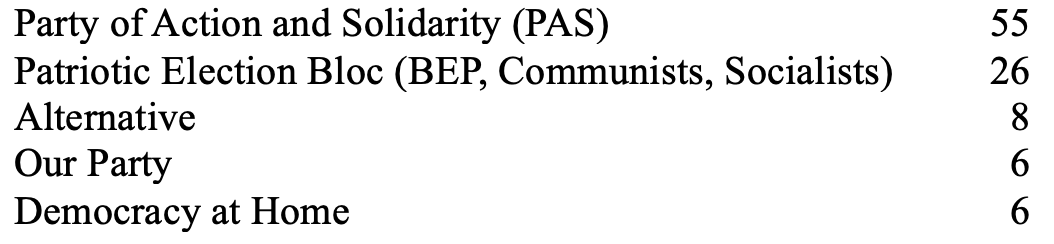
To sum up, Russian operations against Moldova were of many types: in kinetic circumstances, it was possible to construct both virtual political geometry and a virtual chorus, at least on one side of the political spectrum, where Russia also used propaganda to recruit for 'Russian World'. Operations were channelled through an empire of influence centred on a Russia-friendly oligarch. And Russia seems to have thought it was a good idea to use a highly visible organisation like Eurasia.
Export of the Oligarch Model and Eurasia Model to Armenia
It is worth pointing out that Russia thought it was worth trying very similar things to influence elections in Armenia in 2026, after elections in Moldova in 2023-5 (Olari, 2026). It tried to work through Russia-independent oligarchs, who could sponsor parties and media. It placed most of its bets on one (Strong Armenia, backed by oligarch Samvei Karapetyan, which won 23.5%), but also backed other parties in a 'many-layered pie' (Gagik Tsarukyan and Prosperous Armenia, 4%) and former President and informal leader of Armenians from Artsakh or Nagorno-Karabakh, Robert Kocharyan (his Armenia Alliance won 10%). Eurasia's activities included grechka vote-buying dressed up as charity (helpartsakh.ru) and a disinformation site posing as a grassroots initiative to help the Armenian Apostolic Church, which soon developed into a general political news and disinformation portal, armspyurk.com. These Russian efforts possibly helped bolster a losing position; but, as in Moldova, the incumbent party, which had just shifted towards the EU, won again.
Russia's operations against Ukraine since 2022
Russian operations against Ukraine are run by many of the same people, under Sergey Kiriyenko. But the use of Russian political technology in Ukraine has been progressively restricted since 2014, and especially since 2022. Before the Revolution of Dignity in 2013-14, it was possible to use full-spectrum virtual political geometry, though there was competition with US, Israeli, and domestic Ukrainian political consultants. After 2014, restrictions were placed on Russian media, TV in particular, and, less successfully, on social media. But it was still possible to use a similar method to the Šor Network; in Ukraine the equivalent was centred on generously funded oligarch Viktor Medvechuk in 2018-21. For the 2019 elections, new parties were set up (Opposition Platform – For Life or OP-ZZ on 13.1% and the Shariy Party for younger voters on 2.2%). They were sold on Medvedchuk's new TV empire (NewsOne, Zika, 112), amplified in a virtual chorus of social media and 'think tanks', all staffed by an army of local Ukrainian political technologists. This model was successful: the Medvedchuk empire was dismantled on national security grounds in 2021, because it was propelling OP-ZZ to the top of the polls. Deplatforming then worked: the audience was effectively diminished. Medvedchuk was arrested in 2022, then swapped in a prisoner exchange. Further restrictions on oligarchs and media after 2022 made old-style-political technology no longer possible.
Medvedchuk set up a new network in exile, called the Other Ukraine (OU), to propagandise for a "Ukrainian peace alternative" in Europe, particularly in Germany and France. In March 2025, the Security Service of Ukraine (SBU) arrested Kyrylo Molchanov, who provided information on OU's 'media propaganda... coordination of street protests in EU countries, and the use of Telegram and YouTube networks to disseminate disinformation aimed at discrediting Ukraine internationally and weakening Western support for Kyiv' (Shekhovstov, 2025). The operation was run by the Operational Information Department of the FSB's Fifth Service.
But in Ukraine itself after 2022, Russia could not set up a party or an obviously Russian or pro-Russian media platform, or relaunch the Medvedchuk model. Russia was largely confined to the secondary infection model, feeding existing social media networks; though Russia was helped by the fact that social media is now Ukrainians' number one source of information.
Russian online political influence operations were of four types. First were feeder sites. Usually these are junk sites, with links posted on Facebook and TikTok. Second was exploiting the grey zones on global platforms like YouTube and Telegram, where there were a range of commentators, some anonymous, some not, some real, some not, from Russophile to war-weary to fake nationalists with murky origins. (Zelensky's Office of the President uses the same tactics on Telegram, so keeps the app open). Some of these routes into Ukrainian information space involve recruited or Russia-backed local voices; others were circular and international, with feedback loops: anonymous Telegram channels (Resydent, u_now, ZeRada), via Western sites (The Gateway Pundit, Redacted), X Accounts (UkraineTruthDaily), and YouTube and TikTok accounts(#ZelenskyDictator, #UkraineProtests, #WeWantPeace).
Third was providing political technology content for both local 'grey' platforms and global platforms, often with AI. Russia's main propaganda theme since 2022 has not been building Russian World – except in the Temporarily Occupied Territories. In large part thanks to Russia's full-scale invasion, Ukraine has become a consensus society on key issues of national identity and wartime national purpose (Wilson, 2024). But Russia can also work with this grain: its main current propaganda theme is that national purpose cannot be met and/or that the Ukrainian authorities are betraying the war effort. Russia's most popular theme in the last two years has been conscription videos, which may use real elements, but are also staged by actors, and AI changes where they are set – so the message is universalised to claim this is happening everywhere all the time, in viewers' hometowns. A second theme is fake anti-government protests. Russia has long been accused of wanting to stage or provoke a disorderly 'Third Maidan' to undermine the government ('Maidan' means a revolution in Kyiv's central square). Russia has not managed to do so, so stages fake Maidans instead; even videos claiming a coup d'etat has taken place. A final type of fake content is fake talking heads. TV commentators, YouTube posters and podcasters and TikTok influencers are all popular in Ukraine. So, they are impersonated, now usually with AI.
International Conflictology
In June 2024 and May 2026, two big leaks of emails, notes, and documents were obtained by a European news consortium. They identified a Russian FIMI network and its modus operandi, namely the Social Design Agency (SDA) led by one Ilya Gambashidze, working directly for the Kremlin. The US Treasury had already sanctioned Gambashidze in May 2024 ('Treasury Sanctions Actors', 2024). In September 2024, the US Department of Justice indicted him with many of the leaked documents as appendices (Case No.: 24-mj-1395, 2024). SDA was an independent company, but integrated into the Kremlin working system, even sharing the same files.
The documents include a handbook for the pseudo-science of 'International Conflict Incitement', or in Russian 'International Conflictology'. A range of countries are mentioned for planned operations: the U.S.A., Germany and France. 'The [overall] objective of the "International Conflict Incitement" project is to escalate internal tensions in the countries allied with the United States in order to promote the interests of the Russian Federation in the international arena' (Case No.: 24-mj-1395, 2024, p. 202). Two subtypes of International Conflict Incitement are identified. One is an 'algorithm for working with real conflicts', defined as follows: 'identify a conflict-generating factor, parties to the conflict', identify 'type' and 'scale', followed by 'assessment of the potential for using the conflict to implement Russia's foreign policy objectives'. 'If necessary, an artificial shift in the rhetoric of the conflict is made in order to further introduce/embed narratives that are beneficial to Russia'. Finally, 'escalation of the conflict situation through the use of available tools (traffic redirection, work with comments, work with influencers, analytical articles, augmented reality, media mirror outlets, fakes etc.) in order to destabilize the social situation' and 'information support for the side of the conflict whose position is more consistent with the interests of the Russian Federation' (Case No.: 24-mj-1395, 2024, p. 203). The second sub-type is an 'algorithm for artificial generation of conflicts', the formula for which is, first, 'identify "pain points" and hotbeds of increased social and political tension', the 'development of a conflict situation "scenario", narrative lines, a strategy of misinformation and further "instigation" of the conflict using available means and neutralization of counter-propaganda'... 'further stirring up the conflict and spreading additional false narratives' (Case No.: 24-mj-1395, 2024, p. 204).
This 'artificial generation of conflicts' model includes 'analysis of conflict development results for further use'. Below the two models, so presumably applicable to both, are lists of 'Instruments'. Under '1. Creatives' are fake videos, documents, social media content and 'augmented reality' materials. Under '2. Delivery channels' are 'media mirror outlets, foreign and Russian influencers, bots and work with comments, groups on social media, Telegram channels, YouTube and other video hosting sites' (Case No.: 24-mj-1395, 2024, p. 205).
In its precise 'methodological' way, the project planned 'to increase the percentage of Americans who believe that the US "has been doing way too much to support Ukraine" to 51% from 41%, and 'to raise the number who believe the war should be ended soon even if it means Ukraine surrenders territory from 43% to 53%' (Dyer, 2024).
'International conflictology' had some roots in domestic (Russian) conflictology, in so far as Russian political technology in the 1990s and 2000s was based on strategies of artificial polarisation or divide-and-rule. But these were usually short-term, or the regime would have to live with the consequences. Mature Russian political technology relies on Carl Schmitt's 'friend-enemy' distinction politics, with the enemy safely abroad. But 'International conflictology' could be safely based on the 'war' in information war. The language of reality, fakes, and adjectival reality (called 'pre-reality' and 'augmented reality') cannot be separated. There is no binary, other than us versus them. All tactics are justified in times of war. And that war is cognitive war. The key phrase in the 2026 leaks was 'delivering successive cognitive strikes' against the West (Blau, 2026).
But it is also important to look at what 'international conflictology' was not doing. There was no universe of artificial subjects (yet), only some tentative elements of virtual political geometry. International conflictologywas mainly indirect: encouraging an 'artificial shift in the rhetoric of the conflict' and its intensity. Most of the strategies listed were variants of an old Soviet and Russian term: namely 'secondary infection': 'injecting' elements to be used by the primary conflict participants. But there was a constant itch for more direct political technology methods and more direct entry into target political and media systems.
Many operations were given Western labels, which risks classifying as different what may in fact be the same or overlapping Russian agents and operations. The leaked Kiriyenko documents show that the Russian perspective on its many operations was that they were part of an interlocking 'International Comprehensive Counter-Campaign', supposedly rebutting Western propaganda (Pamment & Tsurtsumia, 2025, p. 59).
Spetsfondy
After his death in 2023, Yevgeniy Prigozhin's propaganda operations dispersed: the notorious giant troll factory, the Internet Research Agency (IRA) and its operations against the U.S.A., were dispersed. Some projects ended. Some were absorbed by the state. Some were relaunched by others (Audinet & Gérard, 2024).
Many were reinvented. Kiriyenko now developed a successor system much closer to the Kremlin, with three main parts: his favourite think tank, a huge budget and the service industry that now fed off it. Money was channelled through the Social Research Expert Institute (EISI) to recruit propagandists: 12 billion roubles ($142 million) in its first six years from 2017 to 2023, largely from companies linked to Kiriyenko, like Rosatom subsidiary Techsnabexport (Arenina & Korostelev, 2023). One purpose of the Nashi youth group set up in 2005 was to provide the next generation of propagandists. Now you can study it at university: at 'Department 4' at Bauman University, long linked to the military (Sauer & Walker, 2026). There were many other spetsfondy or 'special funds' to feed the service industry. A Presidential Fund for Cultural Initiatives (PFKI) was set up in May 2021. 'Over two and a half years (from mid-2021 to the end of 2023), the PFKI received more than 61,000 grant applications, of which it supported 7,202 projects for a total of 25.4 billion roubles' or $301 million (Kozhekina, 2024). The Foundation for Civil Society Development spent half a billion roubles a year. The Institute of Internet Development concentrated on patriotic online propaganda. In 2023 it had a budget of 20 billion roubles, 17 billion ($202 million) of which was 'for creating "pro-government content" focused on "civic identity" and "moral and spiritual values"' (Reiter et al., 2023). Russia-Land of Opportunities doubled up NGO funding. There were also the National Traditions Foundation and Breakthrough Foundation, and the Centre for Public Education.
State funding of the Russian propaganda machine was increasing by around 30% annually (Smagliy, 2018). In the build-up to and since 2022, increases have been much more. Debunk.org estimates that Russia spent $1.9 billion on propaganda in 2022, overrunning a planned spend of $1.5 billion. In 2023 the planned budget was $1.6 billion (Michałowska-Kubś & Kubś, 2023). According to Ukrainian court documents, after he was briefly arrested in 2022, Russia's right-hand man in Ukraine, Viktor Medvedchuk, was accused of receiving $1 billion from Russia to prepare for war, mainly for his propaganda empire in 2018-21 (Taranenko, 2022). (It is not clear how much overlap there might be in the above figures). Leaked documents indicated a total spend of €600 million per annum (Pamment & Tsurtsumia, 2025, p. 50), in addition to the official propaganda budget.
Gambashidze
The main replacement for the IRA seems to have been the empire of young political technologist Ilya Gambashidze (born 1977), about whom a lot was known thanks to 2.4 gigabyte of internal documents leaked to the Washington Post and a European media consortium. Gambashidze's team fitted the established template of political technology wholesalers, 'responsible for providing GoR [the Government of Russia] with a variety of services' (Case No.: 24-mj-1395, 2024, p. 11), and working directly for Kiriyenko, via Aleksandr Kharichev, Sofiya Zakharova and Tatyana Matveyevaat the Presidential Directorate within the DPD. For his information war work, Gambashidze had jackets with 'Team I' (for Ilya), 'Russian ideological troops' and 'Commander of special forces' (Center, 2024). He seemed to coordinate several companies: the two most important being Struktura and the Social Design Agency (SDA), as well as working for Viktor Medvedchuk's exile project 'Other Ukraine' (and seemingly the website golos.eu). Gambashidze was certainly effective at selling himself. 'Between 2021 and 2022, the year the operation was launched, Struktura's revenues and assets surged 595% and 487%, respectively, while... [SDA's]'s grew 309% and 8%' (Audinet & Gérard, 2024). Just as significantly, all operations had metrics, with largely achievable targets and numbers (Laine & Morozova, 2024).
Pre-reality
The Gambashidze leaks show how, in all their operations, the discussants and their documents mix up the languages of the real and the fake. They talk of 'real facts to complement fake facts'. They speak of how their targets are 'expecting fake news from us every day.' Gambashidze's team admit to 'spreading additional false narratives' and talk about 'our fakes': 'we need a separate department for fakes - a factory!' They advocate 'a minimum of fake news and a maximum of realistic information. At the same time, you should continuously repeat that this is what is really happening, but the official media will never tell you about it or show it to you'. They talk of 'bogus stories disguised as newsworthy events' and 'false reworked project narratives supported by facts'.
Their purpose is much clearer when they speak of their ownership of 'the Russian side' and 'our narratives'. 'Fake' and 'non-fake', on the other hand, are not really their terms of reference. Gambashidze and his team use the Russian terms 'augmented reality' and dopreal'nost' or 'pre-reality' (Case No.: 24-mj-1395, 2024, pp. 23-30). Meaning is created in the act of creating meaning. Gambashidze's team also see themselves as engaged in 'targeted social engineering based on information trends and users' emotional attitude towards them'.
Doppelgänger
One operation was dubbed Doppelgänger. In order to reach a wider audience, Gambashidze's team created fake websites, 'sophisticated cybersquatter domains' that looked like real equivalents, such as washingtonpost.pm and foxnews.cx (rather than the real washingtonpost.com and foxnews.com), complete with the 'impersonated site's cookie acceptance page'. Traffic was driven to them through the hyperlinks posted by fake social media personae. 'Russian Reliable News' was sensibly rebranded as 'Recent Reliable News' to act as 'a content repository for most of the operation' ('What is the Doppelganger Operation?' 2024). In the U.S.A., their purpose was to spread negative information about Ukraine carefully crafted to appeal particularly to Republican voters. Anti-Ukrainian sites like avisindependent.eu, tribunalukraine.info and truemaps.info also fed the network.
CopyCop
The Gambashidze campaigns after 2022 coincided with the increased availability and power of AI tools. Its 'online bot network... produced nearly 34 million comments from January to April' 2024 (Schemes, 2024). Another scheme fed fake sites of plausible-sounding local news channels (The Miami Chronicle, The Boston Times, DC Weekly) with AI-generated deepfakes. The operation was channelled through a former Florida deputy sheriff, John Mark Dougan – hence the name 'CopyCop'. Much of its output was hit-and-miss, but with occasional big successes, like the story that Ukrainian President Zelensky had bought two yachts with US aid, quoted directly by Republican members of Congress (Robinson et al., 2023) - indirectly helping frame the 'corrupt Ukraine' narrative. NewsGuard counted 167 Russian disinformation websites in Dougan's network (and fifteen videos on a now removed YouTube channel). Other stories, including a U.S. bioweapons lab in Ukraine and Zelensky buying an estate in the UK belonging to King Charles, received 37 million views, including 1.3 million for the Zelensky story (Dimitriadis & Labbe, 2024). There was a further surge in such disinformation after the notorious Trump-Zelensky meeting in the White House in February 2025 (Klug & Ghaedi, 2025).
Dougan's network was linked to aspin-off from the Internet Research Agency, with many of the same personnel and methods, dubbed 'Storm-1516', which was responsible for an average of 3.6%, but on key stories up to 30%, of negative online coverage of Zelensky (Warren et al., 2024). There were elements of a virtual chorus. Storm-1516 was linked to the carefully named 'FBI', the Russian Foundation to Battle Injustice, a fake human rights NGO, trained by the Gambashidze-linked 'PR agency' ANO Dialog. According to Poliakoff et al (2025), this meant a 'shift from outsourced grassroots opinion manipulation towards centrally managed information control, overseen by the presidential administration'. Unlike earlier "troll farms," ANO Dialog operates openly, reporting directly to the presidential administration and maintaining a nationwide presence'. Both organisations had links with the BRICS Journalist Association, set up to 'respond to [Western] information attacks', i.e. undermine the truth. Another Prigozhin hangover was the Wagner Group's PR agency, another political technology NGO whose main purpose was to 'feed' global media with disinformation, the Foundation for National Values.
Overload
Also known as Matryoshka and, according to Microsoft, Storm-1099 and Storm-1679, Operation Overload first targeted the 2024 French elections and the Paris Olympics before moving on to the 2024 US presidential election and Kamal Harris in particular. Supposedly, 'it involves creating fake news sites, false fact-checking resources, and AI-generated audio that mimics legitimate media outlets' (Group, 2024). The project also attacked real fact-checkers 'flooding them with spam-like requests and fake fact-checking leads', seeking 'to overwhelm their resources' (Group, 2024).
Undercut
Operation Undercut ran from late 2023, though whether it was distinct from CopyCop was unclear. Insikt Group (2024b) argues it was 'distinct but running in parallel with Doppelgänger. In contrast to Doppelgänger's use of inauthentic websites, Operation Undercut primarily used artificial intelligence (AI)-enhanced videos and images impersonating major news organizations to amplify its narratives, which it amplifies using trending hashtags in target countries'. A disinformation video claiming that Hollywood movie stars were paid by USAID to visit Ukraine was shared by Elon Musk (Robinson, 2025).
Tenet
After direct propaganda channels RT and Sputnik were banned in many countries in 2022, Russia has sought to work through proxies wherever it can, especially in the U.S.A. RT and Sputnik have tried to circumvent bans with 'clandestinisation', the production of 'mirror sites', and by reorientation towards new audiences (Audinet & Gérard, 2024). In the USA, they hopped onto Rumble, with 23 million American users, after Peter Thiel, JD Vance and Vivek Ramaswamy invested in 2021 (Gadzynska et al., 2024). Other refuges included Odysee and Gab.
The biggest attempt at secondary infection seems to have been two RT employees, Kostiantyn Kalashnikov and Elena Afanasyeva, indicted for channelling $9.7 million to right-wing influencers with substantial followings at Tenet Media in Nashville to produce would-be viral video content. The six leading influencers had over 7 million subscribers on YouTube and over 7 million followers on X. The plot was quickly exposed, but Elon Musk had already 'engaged with content from Tenet Media and its creators at least 60 times' (Ingram, 2024).
Pravda Network - LLM Grooming
The Pravda network (aka Portal Kombat, launched April 2022) 'leverages cross-platform, multilingual influence operations and manipulates Wikipedia, large language models, and X to amplify pro-Kremlin narratives' (DFRLab, 2025). One portentous operation involved gaming AI, which is already feeding off disinformation online. The operation dubbed 'LLM Grooming' saturated the web with fake websites in order to saturate AI searches. 'An audit' by NewsGuard 'found that the 10 leading generative AI tools advanced Moscow's disinformation goals by repeating false claims from the pro-Kremlin Pravda network 33 percent of the time'. 'By flooding search results and web crawlers with pro-Kremlin falsehoods', the report claimed that 'massive amounts of Russian propaganda - 3,600,000 articles in 2024 - are now incorporated in the outputs of Western AI systems' (Sadeghi & Blachez, 2025). AI collates what is online. Fed properly, therefore, this was a frightening means of multiplying the future impact of disinformation. Though one study (Alyukov, 2025) has argued that this only works in the case of 'data voids', where there are narrative or knowledge gaps that Kremlin alternative reality can fill.
Bad Grammar
Less successful was the project dubbed 'bad grammar'. 'The network used [OpenAI's] models and accounts on Telegram to set up a comment-spamming pipeline'. 'Typical Russian-language comments on Telegram accused the presidents of Ukraine and Moldova of corruption, a lack of popular support, and betraying their own people to Western "interference"' (OpenAI, 2020). Using the 'Breakout Scale' (Nimmo, 2024) – assessing the degree of secondary infection of other media – this was assessed as low impact.
Good Old U.S.A.
Another operation was labelled as 'Guerrilla Media Campaign in the United States'. It was not clear if this was the same as the operation named in Kremlin documents as 'Good Old U.S.A.', and therefore the overall name of the project. The project identified other key pressure points by depicting the Democrats as 'far left globalists', and Republicans as victims, 'normal people whose priority is to preserve traditions of the American way of life', but who were the losers to immigration and 'victims of discrimination by people of color'. The US should focus on its own problems rather than Ukraine. Divisions were also exacerbated by 'effective proxy participation' (Case No.: 24-mj-1395, 2024, p. 33), running campaigns posing as Mexicans and Israelis directed back at the US. Doppelgänger's campaign in Israel from 2023 sought to inflame internal divisions, shift Israel away from the U.S.A., and shift Jewish voters in the U.S.A. towards voting Republican (Rakov, 2024).
This campaign was very effective at secondary infection, also targeting MAGA media and think tanks – precisely because such networks had grown since Trump's temporary deplatforming from the likes of Twitter in 2021. Twitter was effectively targeted once Elon Musk rebranded it as X and shifted it in a much more partisan direction (Hutchinson, 2025). A Ukrainian analysis by texty.org.ua looked at influence over '30 think tanks and over 80 experts, including academics, veterans, political consultants, and former politicians. Many of the experts advocate U.S. isolationist policies and represent think tanks, anti-war, and climate initiatives'. The Russian operation targeted this 'wide range of groups opposing support for Ukraine' and strengthened 'the ecosystem of mutual support among those who hold this position' (Gadzynska et al., 2024). Moreover, according to Journalist Julia Ioffe (2025), 'What you see these fake accounts amplifying are arguments' circulating on and around Trump's very own network Truth Social, 'the only place they can spread this information without any censorship'.
The overall aims were shifting US opinion on the war against Ukraine, helping Trump win the 2024 election, and linking the two. In at least the first case, this was successful. In its precise 'methodological' way, the project planned 'to increase the percentage of Americans who believe that the US "has been doing way too much to support Ukraine" to 51% from 41%, and 'to raise the number who believe the war should be ended soon even if it means Ukraine surrenders territory from 43% to 53%' (Dyer, 2024). Democrats and Republicans were not too far apart when the invasion started. In March 2022, only 9% of Republican voters said the US was doing 'too much' to help Ukraine, 23% said 'about right' 49% said 'not enough'. But by April 2024, 49% said 'too much', 21% said 'about right', and only 13% said 'not enough'. The figures for Democrat voters moved much less: the 5% saying 'not enough' crept up to 16%, 'about right' was reasonably stable from 39% to 31%, as also 'not enough', 38% to 36% (Wike et al., 2024). The Gambashidze documents were highly specific about supporting 'Party A' (the Republicans) against 'Party B' (the Democrats); and making 'a maximum effort to ensure that U.S. Political Party A point of view (first and foremost, the opinions of Candidate A supporters) wins over the U.S. public opinion' (Case No.: 24-mj-1395, 2024, p. 216). 'Candidate A' was Trump. Polls show some recovery in Republican support for Ukraine in 2025-6; but by then some damage had been done.
Conclusions
This paper has sought to show that Russian political warfare may start on any level; but normally seeks to build up to the level of subject or proxy control. In the layers of pseudo-sciences, smyslokratiya (rule through thought control), can be considered as the target aim. Political technology and humanitarian technology (methodology) offer more advanced possibilities of kinetic political warfare. Secondary infection and international conflictology are more indirect. The paper only makes a limited assessment of impact. At the least, it can be said that limited impact, failure or reversal only encourages Russia to double up its tactics – indicating how ingrained they now are.