
Acknowledgments
This essay emerges from the research and reflections developed within my ERC-funded project Innovation Residues. Modes and Infrastructures of Caring for our Long-durée Environmental Futures [grant number: 101054580]. The project explores the often-overlooked left-behinds of innovations — innovation residues — across three major fields of innovation that have shaped our world since the second half of the 20^th^ century: nuclear, plastic, and digital. The following reflections and conceptualizations are a first effort to outline why we need to reconsider responsible innovation to acknowledge the complexities and messiness of the futures residues bring about, and how we should do so. I am deeply grateful to each of the inspiring project collaborators who are walking alongside me on this journey — one that is marked by a shared commitment to reading innovation differently; to posing the difficult, sometimes uncomfortable, questions it demands. For more on the project, see: https://innovation-residues.eu.
This paper was written during a 1-month residency at the Paris Institute for Advanced Study under the "Paris IAS Ideas" program, to which I am thankful for the stimulating intellectual and social environment.
History teaches, but has no pupils.
— Antonio Gramsci
It does not seem to me that we have been as quick, in academia, to prepare ourselves for new threats, new dangers, new tasks, new targets.
— Bruno Latour, 2004
... learning to inherit without denial and stay with the trouble of damaged worlds.
— Donna J. Haraway, 2016
A diagnosis to start with
We live in what I would describe as innovation societies — social formations in which the imperative to innovate has become a dominant norm and organizing principle in nearly every domain of life. Not only in Europe but across all other industrialized regions, the drive to technologically innovate has become a central concern, no longer framed as desirable but as existentially necessary. The prevailing narrative is that failing to innovate risks stagnation, decline, or even obsolescence. Indeed, today's underlying assumption of the societal necessity for a constant flow of innovations echoes the underlying belief identified by Barbara Adam and Chris Groves (2007, p. 1): "standing still means falling behind."
From policy strategies that aim to "future-proof" our economies and our societies to new corporate agendas and research in academia and beyond, innovation has gradually become both a means and an end — a self-reinforcing imperative that shapes institutional priorities, funding mechanisms, and everyday decisions. Innovation is celebrated as the key to solving global challenges, ensuring competitiveness, supporting sovereignty, and shaping desirable futures (Godin, 2015; Irwin & Pfotenhauer, 2024). This is particularly visible in Mario Draghi's (2025) recent report on The future of European competitiveness, in which the urgency to "close the innovation gap," and "accelerate the rate of innovation" was omnipresent, and "fast innovation" was perceived as the pathway toward "productivity growth." If this gap is not closed, Draghi warns, "Europe would face 'slow agony'."1
This insatiable hunger for innovation comes with a clear push for scaling up (and not only starting up) whatever we develop as novel technological possibilities — the success of innovations is often assessed by their capacity not only to spread globally but also to bring business into as many corners of life as possible. As anthropologist Anna Tsing (2012) reminds us, scalability has long been central to the modernist imagination. Those projects that could be expanded, replicated globally, and rolled out across diverse geographies were hailed as icons of progress and development. Scalability, in this sense, is more than a practical goal — it is a cultural ideal that shapes which innovations become seen as valuable and which ones are pushed to the background.
Positioning innovation at the core of societal development is not only a policy choice but a discursive choice as well. As Liotard and Revest (2024), and others observe, this centrality is reflected in the very language used to describe what our innovation societies have been confronted with and the new policy frameworks that have consequently been created to try and govern them. The repeated invocation of 'grand challenges' lies at the heart of this transformation. These 'wicked problems' are characterized by their complexity, high stakes, lack of clear solutions, and technical and social entanglement (as evident in European Commission R&D programs). Within these narratives, innovation is not simply one response among many; it is instead framed as — if not the only — then, at least, the most viable pathway to resolution.
This orientation is reinforced by a cluster of influential policy concepts that embody and promote a purpose-driven, future-oriented vision of innovation. "Mission-driven innovation" (Mazzucato, 2018), for instance, marks a shift toward strategically framed, societally embedded innovation agendas designed to tackle systemic issues through coordinated public and private efforts. In parallel, the European Union's "flagship initiatives" signal cross-sectoral, high-level projects aimed at catalyzing systemic transformation and economic growth. Meanwhile, the popular discourse of "moonshot projects" — exemplified by Google X's Moonshot Factory — celebrates high-risk, high-reward technological breakthroughs, emphasizing ambition, disruption, and the quasi-heroic pursuit of the extraordinary (for a critical discussion of these devlopments see Henrekson et al., 2024).
Together, these terms exemplify an emerging new language of innovation — one that reflects a shift in both ambitions and imaginaries of how innovation is framed and pursued. They encode a powerful narrative: that the future is a problem to be solved through innovation and that the most desirable forms of societal change are those that emerge from technoscientific ingenuity and the courage to implement innovations. This discursive reconfiguration not only shapes public policy and research agendas, it also conditions how problems are framed in the first place: who is seen as capable enough to address them and what counts as a legitimate solution.
There is a growing sense that research must not only be excellent but also useful, impactful, and, above all, scalable (Pfotenhauer et al., 2022). Societal transformation is increasingly viewed as a strategic operation involving coordinated innovation actions, which often promise to clearly demonstrate their impacts, allowing for replication and scaling. Most interestingly, as we will see below, even innovations firmly situated in the social domain — including, for example, participatory exercises, societal engagements or communicative measures, that, in the past, have often been conceptualized as strongly local and highly sensitive to cultural differences — are now commonly designed with the promise of becoming "best practice models" — thus "creating a zone of participatory standardization" that can be replicated, scaled and be efficiently put to use in many different settings (Chilvers & Kearnes, 2016, p. 45)
When one analyzes the discourses surrounding innovation, there is another striking pattern that will quickly become apparent: a specialized and energetic vocabulary pointing to the need to invest in maintaining a high degree of momentum for progress. Terms like "foster," "accelerate," "incubate," or "disrupt" have become the lingua franca of innovation societies. These words do not merely describe, they compel: they create a vision of tempo, a forward-driving movement that urges us toward a perpetually reinvented future shaped by novelty and frame innovation as an inherently desirable and urgently necessary process (Felt, 2015). Within the technopolitical regimes designed to support innovation, the imperative to innovate is rarely questioned; instead, it is assumed to be the foundational condition of contemporary life and societal survival.
Certainly, there are numerous critics of these trends. Hallonsten (2023, p. 1), for instance, has argued that the "signs abound that real innovation [... is] less valued in society and the economy, that the real or deeper contributions of innovation to our societies are seen as less important than the appearance of innovation, and that both innovation and entrepreneurship are treated as ends in themselves, or only means to achieve economic growth." Indeed, this societal commitment to relentless technological renewal comes with its own tensions, asymmetries, and blind spots. Many contemporary societies — for sure also in Europe — seem to follow what I would call "extended innovationism"2 (Valaskivi, 2020), under which the key values of competitiveness, technological progress, and economic growth have not only become unquestionable but have become an essential part of a standard master narrative of our societal development. In recent years, the European discourse has, however, complemented these values with an increasing emphasis on the importance of sovereignty, both as a form of strategic autonomy and as a means of resilience, i.e., the ability to anticipate, prepare for, respond to, and recover from crises. These extensions of innovationism have sought to articulate concerns about the security of populations, infrastructures, and values, as well as about dependencies, vulnerabilities, and systemic fragilities. However, what is most essential to reflect on from a responsible innovation perspective is that innovation is never seen as part of the problem, but always as a key component, if not the central component, in developing capacities to absorb shocks.
The push for novelty often eclipses wider and more fine-grained reflections, risks shifting the roles and self-understandings of researchers (Hallonsten, 2024), and steers pursuits of innovation as a normative obligation rather than as sites of open-ended inquiry. It also raises and complicates the question of what we regard as failures or negative disruptions, where, when, and by whom these assessments are made, and who might be ready to learn from them. In using the notion of "failure," I follow Appadurai and Neta, who define it not as a "self-evident property" but as "a product of judgments that reflect various arrangements of power, competence, and equity in different places and times" (Appadurai & Neta, 2019, p. 1). Innovation failures must therefore always be seen in "relation to memory, storytelling, and capital" (ibid., p. 2), something which will be essential when we examine how innovation residues are framed in relation to the innovation they emerge from. This investigation demands close attention to "which failures are being forgotten, and which failures enter the collective memory and reshape our understanding of the world" (ibid., p. 2) and how we can and should live in it.
If innovation is to take the frontstage of contemporary societal development, shaping the broader socio-political and cultural context, it is essential that we critically reexamine the very meaning of responsible innovation — not only as an ethical add-on to a transformation politics but as a potentially transformative response to the deeper logics and demands of innovation society. Such considerations around responsible innovation are not new: in both the European policy context and in the US, they have explicitly been on the agenda for more than a quarter of a century. It is therefore crucial to recognize the significant efforts that have been made to integrate considerations of responsibility into the conceptualization and practice of innovation (Hilgartner et al., 2017; Lubberink et al., 2017; Stilgoe & Guston, 2017). However, in light of the ongoing and profound transformations in how societies relate to innovation, there is a pressing need to take stock of the extensive body of thought on these issues and to critically reflect on them. This means we must consider not only how we define responsibility or how we structure responsibility relations, but also that we question our broader "responsibility conditions," or the socio-material spaces and frameworks that make it possible to engage with questions of accountability and ethical orientation meaningfully (Felt, 2017, p. 57).
What, then, are the questions at the heart of this essay that invite a critical reexamination of how we reflect upon, conceptualize, practice, and assign responsibility in an era shaped by shifting innovation logics and landscapes?

To address these questions, I draw on empirical work developed within my ERC-funded project Innovation Residues. Modes and Infrastructures of Caring for our long-durée environmental futures3, which explores the left-behinds of innovations — produced along its journey through society and often lingering long after the innovation has served its purpose. Rather than treating innovation as a singular and neatly bounded "object" — a discrete technology or clearly defined set of interventions — I propose a shift in perspective. I argue that we must understand innovation as deeply entangled within a dense meshwork of residues that emerge throughout the innovation's life course and beyond. Innovation residues accumulate, transform, and persist. Yet these residues often go unacknowledged, remaining invisible within dominant innovation narratives that are driven by a politics of futurity — projecting idealized, forward-looking visions of progress and utility. Reading innovation in reverse — through its residues — offers a radical shift in perspective. It brings to light alternative dimensions through which the value of innovation can be critically reassessed. This shift, in turn, invites us to reconsider how we understand and practice responsible innovation.
The remainder of this essay is structured as follows: it begins with a brief reflection on the rich field of responsible research and innovation (RRI) that has developed over the past two decades. I interrogate both how responsibility has been conceptualized and enacted, including the contexts in which questions of responsibility have been raised and by whom, when such questions are regarded as timely, and which actors are expected to respond. This lays the groundwork for a broader examination of what remains underexplored within our so-called innovation societies. A central concern driving my argument is the persistent tendency of research to focus considerations about responsibility at the front end of innovation — the moment of promise and projection (Horn & Felt, 2025; Muench et al., 2022) — while providing little space to follow how innovations traverse time and geography, leaving behind diverse forms of residues: overflows, fallouts, waste, and other traces of sociotechnical transformation. It is precisely this spatial and temporal dispersion of innovation's effects that demands renewed critical engagement. Despite their crucial role in shaping environmental futures, these residues remain largely underexamined. Attending to these residues is not only a methodological imperative but also an ethical one, as it requires us to broaden our analytic gaze beyond innovation's promised benefits to the life worlds it alters, the ecologies it unsettles, and the responsibilities it generates but rarely confronts.
Rethinking responsibility, then, involves identifying and addressing the various types of residues that accumulate along the journey of innovation. In this essay, I will distinguish three key categories: material, infrastructural, and epistemic residues. Drawing on empirical examples from the nuclear, plastic, and digital domains, I demonstrate how these different residues, despite their tangible and enduring presence, tend to be curiously made absent in hegemonic discourse and institutional responses (Law, 2004). These residual absences, using John Law's distinction, can manifest as explicit absence — i.e., being clearly missing or acknowledged as absent — or as absence through othering, where something is rendered invisible or irrelevant by being positioned as different, marginal, or outside the boundaries of what is considered legitimate or knowable concern.
This is why, in the next section of the essay, I address the regimes of (in)visibility, an empirically grounded concept that continues to be elaborated within the Innovation Residues project. These regimes shape what is seen, ignored, or actively rendered invisible regarding innovation residues. The concept explicitly includes a call for innovation societies to develop what Anna Tsing (2015) has described as "arts of noticing": a practice of attunement to the marginal, the residual, and the inconvenient.
The essay's final two sections turn toward a rethinking of responsibility. In doing so, I propose a conceptual reframing through the lens of entangled scapes of innovation, culminating in my articulation of a framework of spatiotemporal geographies of response-ability that is attentive to the distributed and ongoing nature of ethical obligation. In conclusion, the essay synthesizes four central propositions for rethinking what responsible innovation means in our rapidly evolving innovation cultures: (1) governing innovation responsibly requires us to examine the politics of valuation, (2) focus must shift from seeing innovation as a finished entity to understanding it as a journey that leaves residues, (3) the forms and procedures used to institutionalize ethics must be critically reassessed, and (4) developing our arts of noticing the marginalized residues of innovation is essential to cultivating new spatiotemporal geographies of response-ability that can be attuned to uneven consequences and collateral futures. These propositions will also require us to develop modes and infrastructures of caring — not just for innovations but, above all else, for the residues — to support a vision of truly sustainable futures.
Together, these propositions invite a more situated, reflexive, and relational approach to responsible innovation — one capable of engaging not only with what innovation promises and enables, but also with what it leaves behind, including any new form of long-term injustice that the innovation and its residues may create.
Responsible Research and Innovation: Origins, Critiques, and Structural Tensions
Over the past two decades, the concept of Responsible Research and Innovation (RRI) has become increasingly institutionalized, particularly within European science and technology policy discourse. As formulated in a European Commission document, "Responsible Research and Innovation: Europe's Ability to Respond to Societal Challenges" (E.C., 2012), a responsible research and innovation approach promises "a smarter, greener economy", in which "our prosperity will come from research and innovation." The latter should then "respond to the needs and ambitions of society, reflect its values and be responsible". The concept's formal adoption by the European Commission in 2014 — and its integration into the Horizon 2020 funding program — marked a significant turning point in the institutionalization of RRI. As Stilgoe and Guston (2017) point out, while the "(re-)emergence of the term responsibility" is, on the one hand, linked to the rising prominence of innovation in policy discourse, on the other hand, it could also be seen as "response to perceived governance crises." Ultimately, RRI has become to be perceived as a means to regain public trust and thereby to assure an "innovation-friendly climate."
This approach, however, was not entirely new. It emerged from critiques of earlier approaches to scientific and technological developments that had been referred to as Ethical, Legal, and Social Implications/Aspects (ELSI in the US and ELSA in Europe). This approach, which was initially mainly linked to the life sciences, prompted a deeper reflection on potential societal impacts through complementary research and public deliberation on the uses of new knowledge and technologies. (Hilgartner et al., 2017) Yet, while initially greeted as needed first steps, the approach was soon criticized for, as Jasanoff (2003) concludes, "not cover[ing] the whole range of social and economic realignments that accompany major technological changes, nor their distributive consequences, particularly as technology unfolds across global societies and markets" (Jasanoff, 2003, pp. 241--242).
Responding to some of these limitations, more integrative approaches emerged, emphasizing interdisciplinarity, early-stage engagement (upstream engagement), and reflexivity — both at the level of individual researchers and institutions. Influenced by traditions such as anticipatory governance (Barben et al., 2008), real-time technology assessment (Guston & Sarewitz, 2002), midstream modulation (Fisher et al., 2006), or value-sensitive design, these efforts aimed to embed societal concerns within the innovation process itself. RRI was then explicitly conceptualized as a mode of mutual responsiveness between science and society (von Schomberg, 2011), which would assure ethically acceptable, sustainable, and desirable innovation outcomes. "Collective care for the future through stewardship of innovation in the present" would be realized through supporting anticipation, reflexivity, inclusion, and responsiveness as guiding principles for both researchers and policymakers(Stilgoe et al., 2013). The increased popularity of RRI has also triggered the emergence of ever-new ways of engaging with societal actors, such as, for example, scenario planning and the exploration of socio-technical futures (Lösch et al., 2019), various co-creation approaches (Felt et al., 2023), as well as test beds and living labs (Engels et al., 2019). These approaches continued to develop, diversify, and expand into many realms with the aim of making innovation more socially responsive.
Yet, critiques persisted. Critics warned that such "programmed reflections" risked becoming ritualized, creating a "division of moral labor" (Rip, 2018) where researchers develop innovations and RRI researchers handle ethical and social concerns ex post (Felt, 2018). Some scholars have cautioned that such economic and political pressures for a continuous flow of innovations, risk reducing responsible practices to mere symbolic or procedural exercises — offering legitimacy without disrupting dominant trajectories (Fisher, 2005; Stirling, 2008). Both Jasanoff (2016) and Blok and Lemmens (2015) have also argued how such institutional applications of responsible research and innovation are at risk of becoming simple box-ticking exercises — formal compliance steps that only serve to establish new "bureaucracies of virtue" (Felt, 2017) instead of a genuinely responsible practice. Such an institutionalization of RRI, quite simply, would only reinforce the existing power structures that continue to assume that innovations alone will be the primary solution to our societal problems. What has also been particularly problematic when it comes to RRI principles has been its nearly exclusive focus on public-sector and academic research, leaving private-sector innovation — where much of today's technological development occurs — largely untouched (Saille, 2015). Indeed, as de Saille(2015) notes, grand visions of a "new social contract" have materialized most often as limited policy checklists. Indeed, by the time Horizon Europe (2021) launched, RRI had basically already become invisible in EU policy discourse. These developments raise critical questions about who holds responsibility for our technological futures and to what extent RRI is actually capable of reconfiguring power relations when it comes to innovations.
The disconnect between promise and reality is amplified by the ways in which innovations are communicated — or better say, advertised and 'sold' — to members of society. This reminds of Baudrillard's (1998 [1970]) observation around advertisement and consumerism. We observe that innovations are cast in a "prophetic language, in so far as it promotes not learning or understanding, but hope" (ibid., 127), hope that is grounded in a strong tech-solutionist master narrative related to contemporary grand challenges. The innovation is turned into a pseudo-event, which is expected to become real when members of society endorse its discourse and allow innovations to become real-world events. Visions of technological futures — smart, sustainable, efficient — are frequently promoted without any critical examination of their origins, beneficiaries, or exclusions. Questions about who imagines these futures, in whose name, and with what consequences are rarely posed. When adverse effects emerge or potential harms arise, they are often only framed as "unintended consequences," which diffuses responsibility and obscures the structural conditions that make such outcomes possible in the first place.
These tensions raise fundamental questions about the limits of responsibility in today's innovation systems, most directly: who is responsible and towards whom? Jasanoff (2016) captures the essence of these questions by asking whether anticipatory governance or RRI could have, for example, averted the negative legacy of the automobile. Her conclusion is sobering: the power to shape technological futures lies not in public institutions or democratic processes; instead, it remains concentrated in capital and industry.
Although a wide array of participatory mechanisms has proliferated and are quite present in today's innovation environments — mechanisms that are not only well-intentioned but have yielded important insights and practices themselves — I nonetheless argue that they constitute what might better be called 'punctual interventions of care.' Indeed, despite noteworthy efforts, the vast majority of these projects are temporally confined by the project logic through which they were organized and financed (Felt, 2025). As such, legitimate concerns about the institutional fragility and temporal fragmentation of RRI have often been left unanswered. Moreover, many of the efforts to consider ethical or social responsibility have only examined particular moments in the innovation process — typically focusing on design phases, funding calls, policy formulations, or public consultations — but are not sustained over time. Such efforts have thus often remained highly localized and rather context-specific, constrained by prevailing technopolitical cultures and lacking sustained financial institutional support. In other words, offering care that is episodic rather than systemic. The result is that while RRI interventions may have eased ethical tensions or have lent legitimacy to controversial technologies, they have much more rarely addressed the more pervasive, ongoing, and distributed responsibilities that innovation trajectories generate — treating care as a checkpoint rather than a continuous obligation.
I therefore argue that there is a pressing need to move beyond fragmented interventions and toward more embedded, continuous, and accountable forms of care that not only reshape the processes through which innovations emerge but also question the worlds we can imagine, the underlying power structures, and the related innovation governance. These forms of care may enable us to question not only specific innovations but also the underlying paradigms of growth, competitiveness, and sovereignty that dictate innovation pathways, and to ask how they could be reimagined. As de Saille and Medvecky (2016) posit, developing what they call "responsible stagnation," such a shift may "open the door for a reasoned discussion about resource consumption and pace of development in over-productive or too-risky sectors and technologies, as an intrinsic part of responsible innovation, rather than its opposite." Extending this reflection, we might also question the criteria by which we define successful innovation — for instance, whether the mere scaling up of a technology should be taken as a definitive marker of success. In other words, true critique must question not only the innovation itself, but also the underlying paradigms of growth, competitiveness, and sovereignty that shape innovation pathways. Examining innovations through their residues inherently renders such an approach a potentially important entry point.
The reflections above closely align with Latour's (2004) critique that assessments of innovation too often begin with "matters of fact": quantifiable metrics expected to yield definitive judgments about whether something is problematic and in need of regulation or not. This lens frequently shapes how innovation residues are framed and managed — as potentially problematic in the future, if they are considered at all. Yet, as Latour reminds us, reality is not defined by facts alone; instead, it emerges through "matters of concern": assemblages of ideas, interests, power relations, and actors that determine what becomes visible, debatable, or urgent in particular places and times. Building on Latour's critique, Puig de la Bellacasa (2011; 2012; 2017) and others (Kenney, 2024; Lau, 2022; Lindén & Lydahl, 2021) have taken this argument further, emphasizing the need to transform matters of concern into "matters of care." What becomes a "matter of care" is shaped by who speaks, who is heard, and which forms of engagement are deemed to be legitimate. Here, "care" is not a sentiment but a political and ethical practice, a commitment to those who ask: "What worlds are being maintained and at the expense of which others?" and "Who will do something, how, and for whom?" (Bellacasa, 2017, p. 44) Care does not fit neatly into the managerial logic that tends to rely on standardized processes with clear-cut steps. Care is rather normative and value-oriented, asking us to be precise about where and to whom different values are balanced and how they are then expressed in real-world contexts.
My project, therefore, proposes that we move beyond the technical management of long-term residues, once they have become too visible to ignore, toward establishing modes and infrastructures of care (Felt, 2021) — frameworks capable of responding to shifting values, contested (collateral) futures, and enduring entanglements.
Rethinking innovation through its residues
When we move beyond its grand narratives and attend to its more mundane, everyday realities, innovation reveals itself as a fuzzy, contingent, non-linear process that branches off in several different directions — unfolding across space and time, simultaneously shaping and being shaped by society's many spheres (see Figure 1).
Fields of Innovation generally branch into multiple socio-technical environments of use — contexts in which innovations are adopted and adapted. Along their journeys through society, innovations leave behind innovation residues: the often overlooked yet most enduring traces of an innovation's societal passage. These residues are highly diverse, ranging from chemical pollutants4 that have risen to prominence, to the growing piles of waste we consistently strive to manage through new regulatory, administrative, and physical infrastructures designed to address them, or to wastelands and deteriorating infrastructures, as well as the indirect residues produced at the point of extraction for the material components needed for specific innovations (e.g., rare earth or uranium mines). Despite their differences, what these residues share is that they are not merely accidental byproducts but rather integral elements of the innovation processes and our lives with these innovations. To examine innovations through their residues thus requires us to consider more holistically how we conceptualize and model our environment, or how we imagine a good life in innovation societies.
Innovation residues provide a compelling perspective for interpreting innovation in a new way, redirecting our focus from celebrated breakthroughs and promissory futures to the various overlooked and less appealing "collateral futures" (Felt, 2013) that innovations and their residues inevitably also produce (see Figure 1). As stated, these residues are pretty diverse. Engaging with innovation through them immerses us in a different environment that is infinitely more complex and chaotic — one populated not by the shiny versions of innovation, but by new phenomena, actor constellations, value regimes, and collateral futures, and, above all else, by the new entities, the innovation residues, that now become our focus. This concept aims to sensitize us to the facets of contemporary innovation societies that, while highly important, have been left underexplored. It places the troubles innovations create at the center and invites us to stay with them (Haraway, 2016). It also encourages us to confront our past innovation choices rather than assuming that we can always start anew; in other words, we have to "learn to inherit without denial and stay with the trouble of damaged worlds" (ibid., 150). It is for these reasons that we have to develop our arts of noticing innovation residues. To name residues explicitly and to be attentive to the multiple gatherings of human and these non-human actors that surround innovations is thus essential. By naming residues, we engage in a performative act that brings them into the realm of public discourse and ethical consideration. This is what Judith Butler (1997) (in reference to Austin) calls speech acts — uses of language that do not merely describe reality but intervene in it, reorienting our attention and responsibilities. Naming thus becomes an act of temporal and political resistance: it insists on remembering what progress narratives would prefer to forget, and it opens space for alternative futures grounded in care, recognition, and justice.
Taking three very different fields of innovation as examples, we will see how innovation residues come to matter in the world. Ultimately, to fully grapple with the implications of innovation, we must invert our gaze: rather than evaluating innovations based on novelty or promise, we must read them in reverse through what they leave behind. This shift not only allows us to bring residues into the frame of responsibility, it also makes visible the hidden costs of progress and the futures we habitually cast aside. Here, I follow Soraya Boudia and co-authors (2022), stressing that residues are far more than technoscientific entities, brought into the world through the processes of innovation; they are also "markers of political, economic, and cultural choices," which occur not only during the early phases of the innovation processes but above all on the journeys of these innovations into every corner of contemporary life and even once they do no longer fulfill their role (e.g. nuclear power plants that do no longer produce electricity but need to be dismantled, creating all kinds of residues).
Figure 1: Innovation journeys, residues, and collateral futures
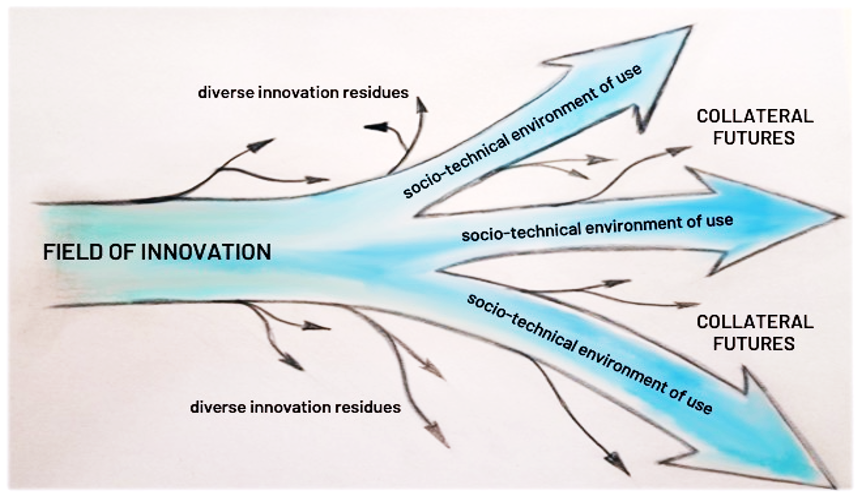
In what follows, I elaborate on the different kinds of residues innovation activities leave behind with examples from three fields of innovation at the core of the empirical work in the Innovation Residuesproject: nuclear technologies, plastic, and digital transformations.5 Taking the example of nuclear technologies as a significant field of innovation, the extent to which this innovation has moved into several areas of application — from energy production to medical diagnosis, various industrial processes, and food sector applications — is quite well known. (The divergent socio-technical environments of use are represented by the big arrows in Figure 1.) Yet, along this journey, many left-behinds have also been produced. They take the form of regulated nuclear waste, the toxic remnants of uranium mining, the lingering spatial residues of decommissioned nuclear power plants that resist repurposing, and the dispersed traces of contamination released by nuclear accidents. Indeed, the trajectories of innovation can be seen as wrapped in a meshwork of residues, each of which requires specific forms of attention as well as modes and infrastructures of care.
Taking such an approach will enable us to notice the diverse types of residues innovations produce, reflect on how they develop their own trajectories, leave multiple traces, and create collateral futures that were not at all part of the promise captured by the sociotechnical imaginaries developed and distributed during the implementation of the innovation. In doing so, this focus will make the reasons for the limitations and challenges surrounding our most dominant understandings of responsible innovation abundantly clear.
Residues to think about/with
I classify the complex and layered kinds of residues that innovations leave behind into three groups: material, infrastructural, and epistemic residues. Whether intentional or unintended, visible or latent, enduring or ephemeral, these residues invariably impact the worlds we inhabit. Each one of them shapes the social worlds we live in and — when it comes to who ultimately carries their burden — each creates its own issues of intergenerational justice and uneven health impacts, which should make us aware of the persistence of coloniality, i.e. the "intersectional stratification and violence directed against 'other worlds'" (Arora & Stirling, 2023). In addition, each of the residue types I discuss creates very different environmental impacts, which follow fundamentally different temporalities and hardly match with those that are considered in contemporary governance.
While this essay does not aim to provide a comprehensive assessment of the impact of each group of residues, it is important to identify the three principal domains in which innovation residues exert their influence. First and foremost are the residues' environmental impacts, which encompass a broad spectrum — from pollution and toxic accumulation to resource depletion, ecosystem disruption, and contributions to climate change. These effects are rarely isolated, often entangling with one another in complex and compounding ways.
Second, residues' social impacts must also be considered. Residues can entrench or exacerbate existing and altogether new forms of inclusion and exclusion, raising pressing questions about environmental justice as these residues tend to disproportionately burden already vulnerable communities. They may, for example, lead to displacement or marginalization, or result in an uneven distribution of harm. Such effects are often underrepresented in mainstream innovation discourse.
Finally, the third dimension requiring our attention is the temporal component. Consequences are not always immediate; some unfold slowly, others emerge only after long periods of latency, and others persist for generations to come. Both the durability and the deferred nature of specific harms complicate the issue of ethical and political responsibility. We must therefore not only ask what or who is affected but also when and for how long.
Figure 2: Different residual categories and their potential impacts
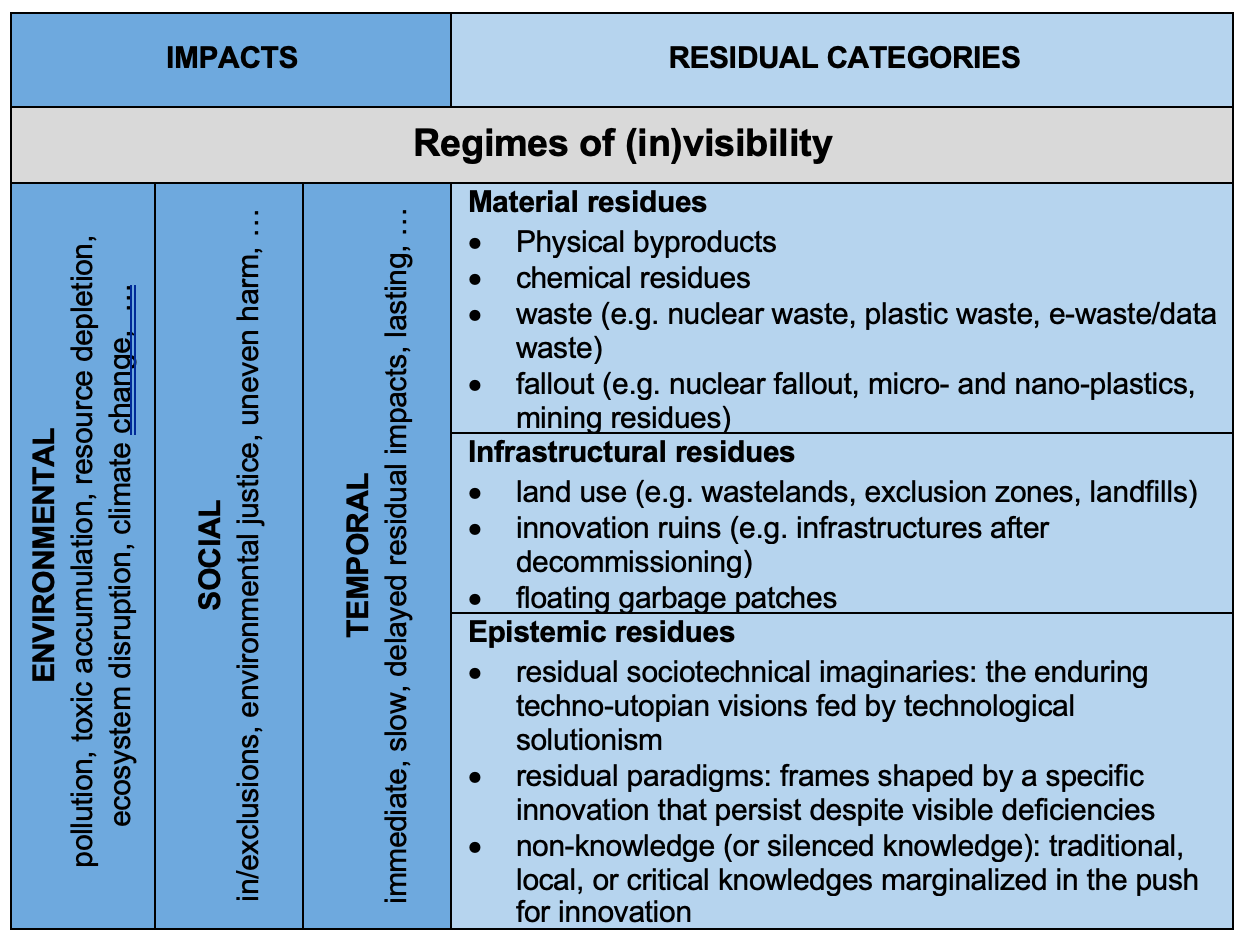
Across each of these three residue types and their impacts, we must carefully consider the different regimes of (in)visibility that have been established to support a form of innovation governance that purposely refrains from asking certain questions (see Figure 2).
Material residues
Material residues, in my definition, are a category that brings together enduring physical and chemical residues generated throughout the life cycles of innovation — often dispersed or transformed, they are the remainders of processes that once held economic or technological promise. This category comprises a wide variety of substances and fragments that persist in the environment. Circulating through soil, water, and air, they range from microplastics and heavy metals to chemical effluents from the extraction and production of the raw materials needed for innovations, e-waste that is often burned, crushed, or informally dismantled, leaving behind various toxic residues (Perczel, 2023) and residual compounds that become embedded in our infrastructure (e.g. the radioactive rocks and debris of uranium mines that are used in construction, including roads and housing).
Focusing on chemical residues, Soraya Boudia and co-authors (2018; 2022) have developed the framework of residual materialism to draw attention to the enduring and often overlooked impacts that residues have on our environment. This approach views chemical residues not as mere inert leftovers but as active agents that persist through time and space, shaping ecological systems, impacting human health, and leaving traces across multiple societal structures. Their work convincingly highlights the ability of these substances to evade control and regulation, often slipping through the cracks of regulatory systems and escaping public attention. They argue that tracking these substances would allow us to observe not only their continual transformation and unruly nature but also to understand which promises and industrialization practices of the past have contributed to this situation (Liboiron, 2016; Liboiron et al., 2018).
Material residues, however, also importantly include the technical components and other elements that were once integral to an innovation but have since become obsolete or invisible through normalization. These can be embedded within products, infrastructures, or systems, persisting silently as part of the material fabric of everyday life — microplastics in food chains, legacy nuclear isotopes in soil, or unusable data buried in digital infrastructures. Although they may no longer serve an active function, early-generation materials and the way they were chosen and processed may still reside within older constellations. PVC wiring in older buildings, depleted uranium shells in conflict zones, or unused background services in operating systems all exemplify how these residues endure. Their obsolescence does not erase their presence; instead, they continue to shape reusability and recyclability even if they often complicate such efforts. In this way, the very technological architecture of innovation accrues residues with components that — while reflecting a logic of design that belongs to the past — have a legacy that must nonetheless be managed in the present. Often, these residues are non-degradable or slow to degrade; they are dispersed across ecosystems and borders, difficult to trace to specific points of origin, and are frequently rendered invisible. Obsolete reactor parts, ghost data in cloud systems, and endocrine-disrupting plasticizers leaching from consumer goods are not usually seen as waste, yet they are part of the ongoing material legacy of innovation, continuing to shape ecologies, health outcomes, and futures long after their moment of invention has passed.
Of course, material residues also contain classical waste, a much-regulated category, that accumulates across cycles of innovation. In the 2008 Waste Framework Directive of the European Union, it is described very broadly as "any substance or object which the holder discards or intends or is required to discard." Waste is then classified along different dimensions based on the source: who or what processes generated it, what is it made of, does it have hazardous properties, and if so, how dangerous are they, and finally, how can it be managed, handled, and cared for. Despite the broad understanding, many of the problematic things we discard are not classified as waste under the EU's directive; for example, both wastewater and contaminated earth are not considered waste while still being residues of our innovation activities.
A critical counterpoint to mainstream waste governance is currently offered by research in the field of waste and, more recently, discard studies (e.g., Alexander & Sanchez, 2018; Hawkins, 2006; Hawkins & Muecke, 2005; Liboiron & Lepawsky, 2022). It invites us to go beyond bureaucratic boundary drawing and critically examines how materials, practices, and people are rendered disposable. While waste studies focus more on the social, political, and economic framing of waste, challenging the dominant technocratic approach that treats waste as a resource managed through scientific expertise, discard studies adopt a broader lens, analyzing how processes of devaluation operate — how materials and related regions or populations become seen as expendable. Both fields, despite their different emphasis, interrogate the value systems and power structures that shape what is discarded and why. This, in turn, is essential for understanding the lives of innovation residues.
Across each of the material residues mentioned above, we must remain attentive to the important differences in how different residues move through societies. To remain attentive to these nuances, I draw on Joseph Masco's (2015) concept of "fallout," which helps capture the slow, dispersed, and often imperceptible material consequences of innovations. Here, fallout stands not for immediate rupture but for long-term processes and forms of slow violence (Davies, 2019; Nixon, 2011). Fallout spreads across ecosystems, bodies, and time, creating injuries that are challenging to trace and even more difficult to regulate. This concept aids us in understanding how innovation residues can be both hyper-present and under-acknowledged; how they can manifest in landscapes and health threats while being denied or overlooked in both policy and public discourse. The notion of fallout connects the material and the atmospheric, the technical and the affective, and emphasizes the urgency of developing the "arts of noticing" that Anna Tsing (2015) has advocated for — practices that can reveal the slow violence, subtle transformations, and unintended accumulations that shape the worlds we inhabit.
Infrastructural residues
Infrastructural residues, while also material entities in and of themselves, are the built and spatial legacies that endure even after an innovation has moved on or been abandoned. As innovation reshapes space through long-lasting infrastructures, they become witnesses to the past. Indeed, as Larking convincingly argues, infrastructures also teach us about the "forms of desire and fantasy" that "emerge[d] out of and [remain] store[d] within them" (Larkin, 2013). These residues can include, for example, technological infrastructure like data centers, closed-down nuclear power plants awaiting their decommissioning, abandoned factory complexes, or supply chain remnants like logistics systems, extraction sites, and transport corridors that persist long after the innovation cycle.
Here, we should also consider zoned landscapes. Nuclear power plants and nuclear fuel processing plants are, of course, quite clear examples; however, waste repositories, which are purposely surrounded by extensive buffer zones and security perimeters, mandate exclusive and restricted land use, often lasting or planned to last for decades or even centuries to come. For example, even after a nuclear power plant is decommissioned, the land it occupies will remain under surveillance and cannot be repurposed for quite some time due to contamination risks and related regulatory frameworks. These spatial residues — empty zones, restricted access areas, and the environments mining activities have destroyed — constitute a hidden residual geography of innovation that continues to shape regional development patterns and land value.
Yet, there are additional infrastructural residues left behind by innovations that are even more difficult to reconcile with, since they are comprised of not just one residue but an assemblage of them. I will refer to these assemblages as emerging infrastructures. Nowhere is this more evident than in the Great Pacific Garbage Patch, a sprawling gyre of buoyant polymers, ghost nets, microbeads, and fragmented consumer goods drifting between Hawaii and California. Although it was never planned, the patch functions like an infrastructure in several ways. First, it organizes and channels material flows by capturing debris from trans-Pacific trade routes. Second, it scaffolds new ecologies by providing substrate for microbes, barnacles, and pelagic insects. Finally, it even shapes scientific, regulatory, and entrepreneurial imaginaries, from ocean clean-up start-ups to climate migration narratives. The Garbage Patch is therefore both a residual product of global petro-industrial logistics and a platform that generates social, economic, and biological interactions. Recognizing it as such forces us to reappraise how we think about responsibility. We can no longer treat plastic residues as mere diffuse pollution to be removed; instead, we must see them as part of a quasi-durable, evolving infrastructure that binds distant producers, consumers, ocean currents, and non-human life into a single, uneasy assemblage. This reframing highlights the urgent need to develop governance approaches that grapple with residues not as waste to be managed but infrastructure to be reckoned with — material systems that will continue to mediate life and politics long after their initial moment of discard.
Epistemic residues
Finally, epistemic residues refer to the often-overlooked traces of knowledge, imaginaries, unacknowledged futures, and structured absences that persist in the wake of innovation and linger in the shadow of dominant innovation narratives. These are not simply fragments of past visions and (often unkept) promises; rather, they are the byproducts of selective knowledge-making, systemic ignorance, and the discursive filtering of what is deemed worth knowing, imagining, or acting upon. Epistemic residues include suppressed or inconvenient knowledge, discredited theories, unexplored alternatives, and abandoned futures, all of which have been concocted or put forward in the name of a specific innovation and all of which remain embedded in the very fabric of our innovation societies even though they have been rendered invisible or irrelevant by the narratives that have become dominant.
Such residues emerge not only from what is known but also from what is actively not known, unsaid, or no longer within the realm of the imaginable, which again highlights how epistemic structures privilege certain visions of progress while sidelining others. In this sense, epistemic residues are intimately tied to residual imaginaries: lingering visions of modernity, control, or linear progress that continue to shape innovation discourses long after their promise has fallen flat. They also intersect with knowledge residues, the institutional and infrastructural remnants of past research regimes, and regulatory frameworks that continue to influence present thinking. Finally, epistemic residues also underscore the presence of residual knowledges — diverse, marginalized, or incomplete forms of knowing that challenge dominant epistemologies but often lack a platform or legitimacy within formal systems. By attending to these residues, we can begin to see how innovation is not only propelled by novelty; it is also shaped by what it leaves behind. A focus on epistemic residues invites a more reflexive stance — one that asks not only which knowledge drives innovation, but also which types of knowing are systematically ignored, forgotten, or foreclosed in its name.
In short, thinking about responsibility in innovation also requires us to reckon with residual sociotechnical imaginaries — those enduring techno-utopian visions rooted in a deep faith in technological solutions. Equally important are the residual paradigms shaped by past innovations, which continue to frame how we think and act, even when their flaws — especially the neglect of traditional, local, or critical perspectives — have become evident.
Regimes of (in)visibilities: Between strategic ignorance and hidden in plain sight
To understand why the environmental residues of innovation so often remain unattended, we must move beyond simplistic accounts of ignorance as a mere absence of knowledge. Instead, a range of mechanisms, structures, ideologies, or practices actively render the environmental harms of innovation — and their often-profound social impacts — invisible. These are not accidental oversights but rather systematic, strategic, and embedded: they constitute regimes of (in)visibility.
Using the notion of regime invites a focus on the multiple, intersecting dimensions necessary to produce and sustain (in)visibility. In Gabrielle Hecht's (2001) formulation, regime refers not only to "people who govern, to their ideologies, and to the various means through which they exert power," but also to the ways in which resistance is organized and counter-hegemonic visions are sustained. Regimes "prescribe not just policies and practices but also broader visions of the sociopolitical order," she would underline (Hecht, 2009, p. 17). Thinking with this notion shifts our attention from invisibility as a passive absence to (in)visibility as something actively configured — through institutions, infrastructures, ideologies, and practices (Law, 2004) on the creation and role of absence).
Building on this, we must, first, pay close attention to the institutional structures and actor constellations that shape how the residual effects of innovation — particularly environmental and social harms — are made visible, or remain obscured. Visibility does not emerge naturally; it is politically and institutionally produced. Governance, particularly in the domain of innovation, is inseparable from the practices through which knowledge is rendered legible and actionable. Drawing on Benedict Anderson's (1991) writings in Imagined Communities and James Scott's (1999) reflections in Seeing Like a State, it becomes evident that states do not passively observe societies — they actively shape them in ways that create "perfect visibility." This means that states simplify, standardize, and codify complex social, ecological, and economic realities into formats they can monitor, measure, and manipulate. While this creates some form of visibility, it, in one and the same move, creates essential invisibilities. We can observe similar processes surrounding innovations, where impact assessments are conducted and political debates weigh an innovation's value against its residual effects.
John Law captures this tension in his notion of collateral realities: if representations enact realities, then alternative enactments are possible, making visibility not only a technical matter but a profoundly political one (Law, 2011, p. 161) As a result, when we enact one version of reality (e.g., a technical solution to a problem), we may simultaneously suppress, background, or render invisible other possible versions. These collateral realities persist in the margins: not entirely absent, but not fully present, shaping what is possible to see, say, or do, even when they are not directly acknowledged. This, in turn, means that we need to take seriously the role of institutions — through their (non)actions, such as (non)regulations, but also (non)communication (Felt & Davies, 2020) — in shaping what becomes visible and what remains obscured. The politics of (in)visibility are thus central to understanding how innovation and its residues are governed.
Crucially, visibility is not a simple function of sensory perception; it is the result of social, epistemic, and political labor. Early Science and Technology Studies — most notably Latour's laboratory ethnographies — emphasized how scientists only begin to "see" phenomena once nature has been transformed into inscriptions, graphs, and simplified representations (Latour, 1988). Visibility, then, is a constructed achievement, not a given. This early STS work can be complemented by Andrea Brighenti's (2007; 2010, 2022) more recent reflections on (in)visibility as a social and political process, which also sees (in)visibility as an achievement. Brighenti argues that what is seen and what remains unseen is shaped within a broader socially and politically configured ecology of attention. Indeed, visibility must be understood as both relational and uneven, as specific sites, subjects, and effects are rendered hypervisible while others are kept "below the threshold of perception." (Brighenti, 2007)This disparity is particularly significant in the case of innovation residues, as public and policy concerns often depend on how well a residue can capture collective attention — this has been strikingly evident in the case of microplastics. In this regard, media attention has played a decisive role, a fact that underscores how media are not simply channels of information but institutional actors who orchestrate "collective synchronization of attention and synchronous affect" (Brighenti, 2010). However, while Brighenti's work offers interesting insights into the role of (in)visibility, he remains focused on humans, subjectivities, and social settings rather than complex human-nonhuman relationships, material residues, or ecological systems — all of which are just as vital if we are to understand innovation societies in and through their relations to innovation residues.
While institutional structures and the actors that animate regimes form a crucial layer of analysis, they represent only one dimension of the broader dynamics at play. Equally important — and often less scrutinized — is the prescriptive and normative power of regimes of (in)visibility: the guiding myths, affective attachments, and ideological frameworks that shape how innovation is imagined, legitimized, and pursued. Innovations are not merely supported through policy instruments or funding mechanisms; rather, myths, ideologies, and explicit promises also actively produce meanings and expectations about what innovation is, what it should achieve, and why it matters. This calls for a critical examination of the "economy of technoscientific promises" (Felt et al., 2007) — a discursive and affective infrastructure that sustains innovation cultures by projecting hope, urgency, and inevitability. From technological solutionism (Morozov, 2013), which frames all social problems as solvable through technical means, to what I have called extended innovationism, where innovation becomes a default response to perceived issues across all sectors of life, these narratives serve as powerful rationales for action and investment. They are supported by recurring mantras — competition, sovereignty, resilience, sustainability — that lend innovation its moral and geopolitical weight, while often obscuring residual effects which in turn allows to frame them later as "unintended" consequences, i.e. as "side effects" rather than structurally embedded outcomes of innovation systems and, in turn, to deflect responsibility, naturalize harm, or depoliticize outcomes (Jasanoff, 2003; Stirling, 2008; Wynne, 1996). To understand the full force of innovation, then, we must attend not only to their institutional architectures but also to their symbolic economies, affective appeals, and the epistemic infrastructures that authorize their visions of the future.
Finally, when thinking about regimes of (in)visibility, we should not overlook that contestation, dissent, resistance, workaround practices, and repair efforts are not external to these regimes — they are constitutive of them. Every regime, no matter how totalizing its vision or streamlined its apparatus, is marked by friction, leakage, and negotiation. The regime of (in)visibility — the structured processes through which certain residues, consequences, or knowledges are rendered unseen — is always accompanied by efforts to unmask, disrupt, or reframe what is being hidden (Kimura, 2016). These counter-practices can take many forms, from grassroots activism (e.g., the case of the uranium mines mentioned earlier) and community science to internal acts of subversion, slow resistance, and quiet care work. Workarounds and repair work — often performed by marginalized groups, maintenance workers, or local actors — are not only crucial because they can mitigate the harms of innovation but also because they reveal the regime's boundaries and blind spots. (Denis et al., 2015; Rubio et al., 2025)These forms of situated knowledge and embodied resistance point to the unfinished and contested nature of any socio-technical order. Attending to these dynamics reveals that the regime of (in)visibility is not a static or monolithic structure, but a dynamic and negotiated field in which visibility and invisibility are constantly produced, challenged, and reconfigured.
Having explained how I understand regimes of (in)visibility to come into being, two complementary concepts help explain how these regimes are stabilized: Linsey McGoey's (2019) concept of "strategic ignorance" and the phenomenon of, as Eviatar Zerubavel (2015) articulates, being "hidden in plain sight." Although both deal with the occlusion of knowledge related to real-world events, they operate in different registers: one is institutional and systemic, while the other is cultural and collective, offering a nuanced understanding of how innovation residues are normalized, ignored, or deferred.
McGoey challenges the assumption that ignorance is merely the result of information gaps and individual failures to seek out available information. Instead, she argues, ignorance is an intentional product, actively cultivated and sustained within organizational cultures, bureaucratic systems, and economic structures. In this framework, ignorance itself becomes a form of power. By avoiding inconvenient truths, including the long-term risks of nuclear waste, the health impacts of microplastics, or the environmental costs of what is labelled as "the digital transition" (Horn & Felt, 2025), organizations can protect reputational capital, sidestep regulatory scrutiny, and maintain operational legitimacy. Strategic ignorance is not a lack of knowledge — it is a calculated management of uncertainty. In other words, not knowing becomes a resource that can be exploited.
For example, in the early decades of plastic proliferation, chemical companies funded research that emphasized consumer convenience and downplayed the toxicity and environmental persistence of plastics (Freinkel, 2011). Similarly, in the realm of nuclear energy, records of early contamination events were often suppressed or euphemized — contemporary clean-up programs continue to grapple with the consequences of these obscured legacies. Lastly, in the digital sector, tech companies have long promoted narratives of efficiency and immateriality, including, for example, through the use of metaphors such as "the cloud," even as they rely on exploitative mining practices and rapidly expanding data centers with immense energy needs. Across each of these cases, institutional incentives align with not knowing or, at the least, not acknowledging, the full scope of our innovations' environmental consequences.
While McGoey's work helps reveal the macro-structural forces sustaining ignorance, Zerubavel's work about "hidden in plain sight" adds an important sociocultural dimension. According to Zerubavel (1997, 2002), societies develop "optical socialization": norms and habits that teach us what to notice, what to ignore, and what to pretend (not) to see. This is not a simple willful blindness by individuals, but rather a culturally patterned conditioning of inattention that enables entire communities, industries, or publics to overlook the harms unfolding around them. Building on this understanding, Carr and Milstein (2021, p. 183) convincingly point us to what they describe as "a broader sociocultural tendency to articulate and reinforce spaces of ecological 'invisibility.'" "In such spaces," they explain, "our quotidian practices and discourses play a central role in enabling collective environmental inattention and environmental inaction." This helps explain why innovation residues can be materially present — visible landfills, leaking storage facilities, displaced communities — yet fail to register as urgent problems. The issue is thus not invisibility in a literal sense but rather invisibility produced through normalized silence, selective framing, and the routinization of distraction.
These two perspectives — strategic ignorance and cultural inattention — reveal that what we often treat as information gaps are in fact structurally and socially produced. Together, they expose a troubling paradox: modern knowledge systems, rather than illuminating the world, also routinely function to obscure, defer, and distribute harm in deeply patterned and politically advantageous ways. Innovation residues — be they radioactive waste, plastic microfibers, or e-waste — are thus not hidden because we lack the scientific capacity to detect them; after all, they are often quite well-known among respective experts, relevant communities, and certain regulators. On the contrary, what keeps these residues unaddressed is not ignorance itself but the strategic organization of ignorance and the cultural normalization of non-seeing.
Understanding this dynamic is crucial for any attempt to reframe innovation as a socially responsible practice. It compels us to ask not just what we know, but how we do not know — and why. It shifts the ethical imperative from generating more knowledge to interrogating the political economies of knowledge suppression and the affective economies of societal denial. It also reframes responsibility: not only must innovators and institutions be held accountable for the direct consequences of their work, but they must also be made responsible for the knowledge environments they create and, likewise, for the blind spots they cultivate.
Ultimately, to bring innovation residues into public consciousness and governance, we must confront both the institutional architectures and cultural dispositions that keep them obscured. By focusing on what is left behind, we can begin to unsettle dominant narratives of innovation. This approach strongly resonates with Anna Tsing's (2015) call to develop our"arts of noticing": practices of attunement to the marginal, the overlooked, and the emergent. Such practices must pay attention not only to innovation's promises but the diverse residues, including ruins and contaminated landscapes that are deemed economically disturbing or obsolete. Ultimately, because life persists in fragmented, unexpected ways, paying attention requires arts — not systems — of noticing. Importantly, such arts are not scalable, as they are bound to the fact that collateral futures matter differently: in different places, at different times, and in different ways for different actors. It is by noticing these residues produced along innovation trajectories — the broken, the small, and the emergent — that we may be able to resist and remain "unencumbered by the simplifications of progress narratives" (Tsing, 2025, p. 6), universalizing logics of development, and the urge to collapse everything into linear narratives of innovation, growth, and recovery when things go wrong. To develop such arts of noticing is an ethical commitment, one to remain humble in our knowledge claims, to acknowledge "the ragged fringes of human understanding — the unknown, the uncertain, the ambiguous, and the uncontrollable" (Jasanoff, 2003, p. 227), and to stay open to unpredictable assemblages and non-scalable phenomena. Most importantly, it is a call to challenge the ideology of technological control and prediction.
Responding to this call requires us to develop and cultivate new arts of noticing, new infrastructures of care, and a steadfast commitment to resist the seductions of ignorance — strategic or otherwise.
Reframing Responsibility: Entangled Scapes of Innovation
To engage with the question of responsibility in the context of contemporary innovation in a meaningful way we must resist the temptation to define it narrowly. This means that we must see responsibility as more than a discrete ethical choice, regulatory checkpoint, or retrospective evaluation. Instead, we must reconceptualize it as an entangled, multi-scalar, and processual phenomenon that is embedded into the very infrastructures, timelines, and social relations that constitute our innovation systems. To do so, we must first consider how responsibility is shaped, enacted, deferred, or denied across shifting terrains of knowledge production, technological development, and societal transformation. A productive way to approach this, I propose, is through the lens of entangled scapes of responsibility — interweaving timescapes (Adam, 1998), landscapes, and socioscapes, which each offer a different but interconnected dimension of ethical engagement in innovation societies.
This is inspired by Arjun Appadurai's (2002) concept of "scapes," a framework that draws attention to how people, ideas, technologies, and capital move across the globe in non-linear, fragmented, and context-dependent ways. Through these "scapes" — he considers ethnoscapes, technoscapes, financescapes, mediascapes, and ideoscapes, each of which focuses on different kinds of flows — Appadurai aims to capture the disjunctive, uneven circulation that produces structural inequalities and complex spatiotemporal dislocations. This is an essential sensitivity when one begins to think about responsible innovation in the ways I have advocated for.
Thinking through the timescapes of responsibility allows us to move beyond the event-based or momentary logics that often govern ethical discourse. Innovations are rarely singular acts or bounded decisions; they unfold across time, entangled with both historical legacies and collateral futures. Each act of technological development carries the weight of sedimented histories: extractivism, colonial science, racialized labor, and prior environmental harm, all of which continue to shape the conditions under which innovation is conceived and executed. At the same time, innovations are deeply future-oriented: they project speculative horizons, promise progress, and postpone harm. From radioactive waste to persistent plastics and material legacies of digitalization, many of innovation's consequences emerge only decades after they have been introduced (Müller & Nielsen, 2023). These deferred effects challenge ethical frameworks that are based on immediacy or linear causality (e.g., the straightforward polluter pays logic) and instead invite a practice of responsibility that is longitudinal, anticipatory, and enduring.
In parallel, the material and symbolic geographies in which innovation takes place demand attention to what might be called the landscapes of responsibility. Innovations are not placeless abstractions; they are deeply embedded in and transformative of specific ecological, infrastructural, and political terrains. Whether through lithium extraction in the Andes, rare earth mining in the Congo, data centers in Ireland, or the afterlives of plastic packaging in the Global South, innovations alter environments in spatially uneven ways. These landscapes are not neutral: they are historically saturated spaces shaped by colonial legacies, global inequalities, and infrastructural marginalization. Responsibility, then, is never simply a matter of technical deployment or market reach; instead, it is always situated. As such, it must be attentive to the politics of land use, the ecologies disrupted, and the communities made vulnerable or invisible. Thinking of these conditions as landscapes helps remind us that ethical engagement is something that must be grounded, not only in terms of physical location but also in terms of a particular sensitivity toward how innovation intervenes in the spatial textures of heterogeneous lived experiences.
Overlaying these spatial and temporal dynamics are the socioscapes of responsibility: the social terrain through which responsibility is imagined, distributed, and contested. These include not only the institutional actors conventionally associated with innovation — scientists, engineers, funders, regulators — but also the communities, activists, and publics whose knowledge and concerns are often marginalized or ignored. Socioscapes encompass both formal structures and informal practices, shaping how responsibility is felt, claimed, or disavowed across diverse social positions. They also highlight the affective and emotional registers of responsibility: the fear, fatigue, or moral injury borne by those who live amid the consequences of innovation. Responsibility is not just about rules or roles; it is also about relationality, about how ethical obligations are mediated through power, recognition, and the distribution of voice.
Together, these entangled scapes offer a dynamic and situated framework for reimagining what responsible innovation could mean. They prompt us to move beyond static checklists or compliance protocols and instead ask more profound, more challenging questions: When is responsibility enacted, and for how long? Where are the effects of innovation residues registered, and who bears them? Who is deemed responsible — and who is excluded from that reflection? Toward whom is responsibility owed, and how is that obligation enacted? These questions shift responsibility from being an individual attribute to a practice that is embedded in systems, infrastructures, and relations stretching across time and space.
This shift has profound implications for how we approach innovation governance. It demands that we direct our ethical reflections not only on key decision points, such as product launches, patent filings, or public controversies, but across the full lifecycle of innovation: ideation and design, development and dissemination, use, obsolescence, and, indeed, the long afterlives of technological residues. Timescapes of responsibility urge us to integrate practices of foresight, retrospection, and long-term care into the fabric of innovation. Landscapes of responsibility call for us to attend to spatial justice and the ecological and infrastructural worlds that innovation transforms. Finally, socioscapes of responsibility insist that ethics must be relational, participatory, and attentive to the voices and vulnerabilities of those who are most affected but least empowered.
Approaching responsibility through these scapes does not lead to a static model, but rather a mode of attunement. They call for a transformation in how we perceive, practice, and institutionalize responsibility within innovation systems. The shift they call for is thus not merely conceptual, but structural: it requires us to rethink how innovation is funded, evaluated, and governed, demands institutions that are capable of supporting ethical reflection over time and relationships that are built across space, and to center perspectives that have usually remained peripheral. Ultimately, it calls for a reimagining of innovation itself — not as a linear pursuit of progress, but as a situated, contested, and world-making practice that must be accountable not only to current stakeholders but also to future generations, distant others, and the multiple ecologies with which we are inextricably entangled.
Responsibility, in this view, is not a singular act or a finished state. It is an ongoing negotiation — one that must travel through the ruptures and residues of innovation, trace its hidden geographies, and listen for the voices that fall outside the dominant frames. Reframing responsibility through entangled scapes offers not only a richer conceptual vocabulary but also a more just and attentive practice for living with and through the technologies that shape our collective futures.
Towards Spatiotemporal Geographies of Response-ability
In the backdrop of these observations, I propose an expanded conceptualization of responsibility — spatiotemporal geographies of response-ability. This formulation aims to transcend conventional ethical frameworks that confine responsibility to discrete acts, proximate relationships, or immediate contexts. In an era of accelerated globalization and systemic complexity, these frameworks have increasingly revealed themselves to be limited in their scope of responsibility. Today, innovation unfolds within vast, interdependent systems marked by asymmetrical flows of power, material, knowledge, and consequence. As such, responsibility must also be understood as an emergent and distributed process — unfolding across both space and time, and traversing national borders, social domains, ecological zones, and generational boundaries. This aligns closely with Haraway's (2016) understanding of response-ability, which is not merely the capacity to respond, but instead a relational and ethical practice of attentiveness, care, and situated engagement. It is about staying with the trouble — being accountable to the complex, entangled relationships we inhabit with other beings, technologies, and worlds.
Take the example of microplastics: while the production and consumption of plastics are highly concentrated in certain regions — along with the economic benefits they generate — , their residues are dispersed globally. Microplastics now permeate nearly every environment: from the Arctic to agricultural soils, from marine ecosystems to drinking water; indiscriminately, they have even made their way into human bodies. In the European context, the Treaty on the Functioning of the EU enshrines the principle that environmental harm should be addressed at its source and that the polluter should bear the cost. Yet, as the case of microplastics makes clear — with residues that are so ubiquitous, origins so dispersed and diffuse, and risk so latent and difficult to quantify — responsibility, on a practical level, can be deeply ambiguous. The case of microplastics shows the extent to which relational boundaries of accountability can be blurred. Indeed, while there was undoubtedly a clear awareness of microplastics, at least since the 1970s (Carpenter & Smith, 1972), "the microplastic problem" has only begun to be addressed on the policy level — and that, very reluctantly — in the 21^st^ century. The EU, following many years of discussion and consultation, for example, only made a first step in restricting specific groups of microplastics intentionally added to products in September 20236.
Returning to the concept of spatiotemporal geographies of response-ability, there are two key thinkers (from distinct yet complementary intellectual traditions) who further help complement my thinking in this regard. First is the STS scholar Madeleine Akrich, who generally follows in the field's actor-network theory (ANT) tradition. The second, Arjun Appadurai, who comes from a cultural anthropologist tradition and has done extensive work theorizing the disjunctive landscapes of global modernity, was already introduced in the section above.
Most notably, Akrich's (1992) influential insight that technologies are always scripted, i.e., every technological artifact and system carries within it "scripts" — embedded assumptions about its intended purpose, target users, and socio-technical contexts of use. These scripts invisibly encode social roles and relationships, allocating agency, obligation, and access through their design. A nuclear power plant, for example, assumes not only the provision of uranium from abroad and a constant flow of cooling water but also long-term state stability (Winner, 1986) (e.g., ensuring safety measures and waste management). Meanwhile, an app using artificial intelligence requires continuous connectivity, data flow, and large-scale computing centers. Both of these artifacts are therefore not just technical systems but moral architectures: they not only inscribe specific visions of the world, but also who is responsible in it.
Crucially, Akrich (1992) explains how "technical objects contain and produce a specific geography of responsibilities," which, as a consequence, may not only "lead to new arrangements of people and things," but also "generate and 'naturalize' new forms and orders of causality and, indeed, new forms of knowledge about the world" (ibid., p. 207). Akrich's work opens the door to a vital conceptual space we can use when thinking about responsibility and innovation residues. Building on her ideas, I understand "geography" as a multidimensional field, encompassing spatial (where effects manifest), temporal (when consequences unfold), ethical (who is affected and who is positioned to care or act), and affective (how responsibility is felt, distributed, or disavowed) dimensions. What I call geographies of response-ability then becomes a lens through which we can better examine how responsibility is scripted, resisted, redefined, displaced, or fragmented across the countless actors and infrastructures that constitute contemporary innovation ecosystems.
While Madeleine Akrich invites us to interrogate the moral design of technologies, as we have already touched on, Arjun Appadurai (2002) draws our attention through his concept of "scapes" to the phenomena of uneven and disrupted circulation and flows — in my case, of innovations and their diverse residues. Within this framework, then, innovation cannot be understood as a directly linear or neatly bounded process. It is instead a transnational and multitemporal phenomenon in which invention, production, distribution, and consequence (including residues) are radically and unevenly distributed.
Such a perspective may, for example, invite us to trace how a digital infrastructure developed in Europe may depend on rare earths mined in the Congo, which will then be assembled in Southeast Asia, be used globally, and, likely, be disposed of in landfills in the Global South, all of which will leave diverse residues in different places that will endure for decades. The consequences of innovation then also emerge asynchronously: financial and technological gains (are expected to) accrue quickly and in particular places while ecological degradation, social exclusion, and health impacts often unfold slowly and elsewhere — something aptly captured by the notion of "slow violence" (Bickerstaff, 2022; Davies, 2019; Nixon, 2011) and the idea of "pollution as colonialism" (Liboiron, 2021), both of particular important when considering environmental impacts of innovation. Such realities challenge today's prevailing ethical models, which rely on proximity, immediacy, and direct causation, including the abstract modeling of an innovation's life without sufficiently considering real-world contexts.
Nonetheless, two contemporary examples can clearly show both the challenges of innovation's asynchronicity and the advantages of the approach I have advocated. First, with European policymakers having begun to speak of nuclear energy as "decarbonized energy," we must also realize what they make invisible by saying this: Neither the extraction of the raw material uranium and its journey through various locations before it even becomes part of a nuclear power plant, nor the complex dismantling processes and the long-term care required for the resulting waste, are adequately addressed. They are pushed to the background, made as invisible as possible. Second, a similar argument can be made about the "twin transition" discourse, wherein the "green" and "digital" transitions are curiously described as mutually reinforcing imperatives for sustainable growth (Horn & Felt, 2025). Again, what this framing masks are the tensions, trade-offs, and extractive underpinnings that accompany the digital agenda, which, as I have already mentioned, is deeply connected to energy-intensive infrastructures, considerable water use, toxic residues from rare earth mining, and e-waste production. Considering the totality of these circulations and flows reveals an urgent need for responsibility frameworks capable of grappling with complex, often delayed accountability and distributed consequences.
Appadurai's insights highlight this absence, showing how and why today's institutional and discursive mechanisms are incapable of tracing responsibility across global chains of innovation and harm. His work supports my call for attention to how long-term, transboundary effects, such as climate change or microplastic proliferation, elude conventional notions of moral responsibility. In short, cause and effect do not align neatly, and most actors operate without any meaningful accountability for long-range consequences. This grim reality calls for more than ethical vigilance; instead, we need new analytical tools — ones that allow us to map responsibility across fractured geographies and layered temporalities.
Bringing Akrich and Appadurai into dialogue reimagines responsibility not as a fixed moral attribute attached to technological objects, individuals, or institutions, but as a relational and dynamic field that is in a perpetual process of construction, contestation, and reconfiguration. Spatiotemporal geographies of response-ability compel us to see ethics as embedded in infrastructures, legal architectures, and epistemic norms rather than one-off choices or short-lived intentions. They shift the analytical focus from localized and narrowly timed moments of ethical reflection to the structural conditions that ultimately produce invisibility, deferral, and disavowal.
The need for this shift is particularly urgent in the context of innovation residues: radioactive waste and fallout, microplastics, mining residues, and digital carbon footprints, which continue to shape lives long after the initial promises of innovation have faded. Who is responsible for these afterlives? Where does this responsibility go when innovation crosses borders, shifts hands, or disperses harm across generations? To meaningfully engage these questions, we must cultivate conceptual frameworks that can trace the movement, erosion, and reconfiguration of responsibility over time and space.
Ultimately, the concept of spatiotemporal geographies of responsibility invites us to think and move beyond bounded, linear, and proximity-based ethics. It challenges us to reckon with responsibility as something that is distributed, delayed, and deeply infrastructural; not simply a matter of who acts, but of how systems are designed, how consequences unfold, and how accountability is — or is not — sustained across the many phases of innovation. Explicitly tasking us to rethink what it means to act responsibly — not only here and now but elsewhere and later — it urges us to follow innovations along their trajectories and regularly revisit whether the balance between their promised benefits and accumulating harms remains ethically tenable. As I have argued, we cannot continue to reduce responsibility into a one-time approval or singular phase of clearance (which is often the case in European policymaking). Instead, this concept demands that we create sustained modes and infrastructures of care (Felt, 2021): mechanisms that can regularly revisit the uneasy questions innovation so often ignores. Is the promise that once justified an innovation still in proportion to the residues it leaves behind, the disruptions it causes, and the futures it forecloses?
Concluding reflections: Rethinking Responsibility through the Lens of Innovation Residues
This essay has argued for the urgent need to rethink the frameworks through which responsibility is imagined, enacted, and institutionalized in contemporary innovation societies. Rather than offering a prescriptive model or set of clear-cut recommendations, what follows is an invitation to engage differently — with greater attentiveness to situatedness and nuance — with the conditions under which innovation unfolds and leaves its mark. Taking responsibility seriously means recognizing that innovations may not always simplify or improve life, as their proponents often claim, but may, in fact, render life more complex, particularly if we are to attend to their residual effects. This complexity is not necessarily a failure of innovation, but rather a call to reconsider what it means to live well with its consequences and to better weigh its residues against its promises. I close with four propositions that I see as essential to this rethinking.
First, we must attend to the politics of valuation. Any serious inquiry into innovation and its governance must begin by asking how innovations come to be valued, by whom, and according to what criteria. Valuing is never an objective procedure — it is the outcome of historically situated and politically saturated processes of authorization, legitimation, and selective visibility. Language, policy, investment, and public discourse all contribute to determining what is considered "promising," "necessary," or "inevitable." These valuations are not voiced in neutral terrain, nor are all voices equally heard. Different positionalities — whether technical, civic, economic, or affected — bring different epistemic and institutional authority. We must also not forget that valuations are always addressed to someone: regulators, investors, or publics, which shape their form and their force. As Boltanski and Thévenot (2006) have argued, multiple "orders of worth" coexist, however, the footing on which they exist is not equal. Today's most dominant value regimes, the configurations of norms, metrics, discourses, and institutional practices that determine what is considered valuable, prioritize efficiency, profitability, and scale. Meanwhile, concerns rooted in justice, care, and sustainability are often marginalized. To govern innovation responsibly, we must therefore make visible the uneven discursive and institutional conditions that shape what is valued, and what is systematically — institutionally, and culturally — ignored.
Second, we must see innovation not as a fixed object but as a journey — and one that leaves behind residues. Innovations are not static artifacts; they are socio-technical systems that unfold over time and across space, generating impacts that are rarely symmetrical or neatly containable. Thinking in terms of innovation journeys allows us to trace not only how innovations move through societies, but also what they leave behind — material, infrastructural, and epistemic residues that linger long after the initial moment of invention, impacting our environments and the ways we can live in them. These residues are often marginalized, sidelined, or ignored in dominant assessments, which tend to focus on lofty promises rather than the aftermath. Following Haraway (2016), we must cultivate a genuine "response-ability" to perform accountability through engagement with the complexities and constant transformation of the worlds we have inherited; we must eschew abstraction in favor of confronting and staying with the troubles. To be sure, this is a call for a continuous, situated practice of ethical engagement — one that refuses to delegate responsibility to the early phases of innovation. Instead, responsibility considerations accompany innovations, revisiting their consequences, the residues, and the challenges and uneven burdens that come alongside them.
This, thirdly, will require de-formularization: interrupting the institutional templates, staged processes, and standardized protocols that reduce responsibility to procedural compliance. This entails reopening closed questions, staying with uncomfortable uncertainties, and embracing more experimental, collective forms of ethical inquiry.
To do this, we must also adopt a critical stance toward the forms themselves, particularly those that structure ethical and governance practices. As Peter Becker reminds us, there is a "discrete charm of the form" (Becker, 2007), a certain elegance and institutional reassurance that procedural mechanisms, such as ethical screenings, stakeholder consultations, or impact assessments, have offered us in complex decision-making environments. These forms help stabilize meaning, foster comparability, and create a sense of order. But their charm is also their danger. What they illuminate is often accompanied by what they obscure. Ethics, when routinized through form, is frequently narrowed to what is administratively legible; an energy calculation for a digital infrastructure, for example, which ignores the necessary environmental damages stemming from its need for raw materials, or a risk assessment for the health impacts of microplastics that, due to temporal shortsightedness, overlooks any first hint of their long-term, slow toxicity. These are not failures of individual instruments but of epistemic scope. The challenge is not to discard forms, but to render them more permeable to other knowledges, geographies, and timescales, so that responsibility can become — not something simply capturable through the logic of metrics — but attuned to the fuzziness of lived realities.
Finally, we must cultivate new spatiotemporal geographies of response-ability. As a basis for this, we must first develop our arts of noticing. By examining the residual effects of innovation, the Innovation Residues project seeks to challenge linear narratives that portray innovation as a frictionless march toward progress. These narratives have long obscured the disjunctures between those who benefit from innovation's promises and those who live with its costs. Innovations that aspire to overly promising futures often cast long, material shadows — exhausting ecologies, displacing communities, and embedding new forms of social and environmental vulnerability. Innovation residues are not exceptions, accidental occurrences, or unintended consequences; they are constitutive of innovation processes. A more honest approach to innovation would recognize its entanglements and asymmetries — not to disavow innovation itself, but to imagine futures that are plural, debatable, and shared. This requires responsibility relations that are rooted in situated knowledges, embrace reflexivity, acknowledge partiality, and are open to the discomfort of contradiction. These relations must be:
ð Spatiotemporal: capable of addressing impacts that unfold over decades and across continents (to better address slow and residual violence)
ð Multiscalar: attentive to the interplay between the intimate, the institutional, and the planetary
ð Intergenerational: attuned even to those unborn but already implicated in our decisions and actions
ð More-than-human: inclusive of nonhuman life, ecological systems, and material agencies
These forms of responsibility resist governance through universal metrics or standardized protocols; instead, they call for the cultivation of response-abilities — situated, relational capacities to act with care and accountability. What is required are not fixed frameworks, but the creation of new infrastructures of care, the adoption of alternative epistemologies when assessing technologies, and the development of governance practices that remain open to discomfort, contradiction, and ongoing work of reparation.
In formulating this essay, I have embraced a rather Foucauldian notion of critique (Foucault, 1988, p. 154): not simply "saying that things are not right as they are," but rather "pointing out on what kinds of assumptions, on what kinds of familiar, unchallenged, unconsidered modes of thought the practices that we accept rest." This has led me, and will hopefully lead others, to repeatedly ask this question of innovation governance: "how not to be governed like that, by that, in the name of those principles, with such and such an objective in mind and by means of such procedures"? (Foucault, 1997, p. 28)
The governance of innovation must shift from a narrow focus on discrete outcomes to a deeper engagement with the enduring and entangled relationalities that innovation activates — in short: to acknowledge the tension between short-term political choices and long-term environmental impacts. By embedding responsibility throughout the whole arc of innovation — following its emergence, deployment, breakdowns, repairs, and residues — we may begin to shape more accountable, responsive, and just technopolitical futures. In the end, this might lead us toward more collective work, including the imagination and enactment of alternative innovation futures — ones that are not grounded in heroic breakthroughs or abstract (often economic) value, but in care, accountability, and a deepened sense of interdependence.
- see https://erc.europa.eu/news-events/news/europe-must-prioritize-research-and-innovation-be-competitive↩
- Innovationism is defined by Valaskivi (2020) in the following way: "The values of innovationism — competitiveness, progress, growth and success — direct and guide human action and societies around the world". She interprets innovationism as a "globally circulating religion that permeates all levels of societies and ties organisations, nations, individuals and ultimately humankind as a whole, into its value system."↩
- see https://www.innovation-residues.eu↩
- Here I should mention the important work by Soraya Boudia and co-authors (2022) on chemical residues, but also research by Scott Frickel (2004) or the Manifesto for a Chemical Geography by Andrew Barry (2017).↩
- For details see http://www.innovation-residues.eu↩
- https://eur-lex.europa.eu/legal-content/EN/TXT/PDF/?uri=CELEX:32023R2055↩