
Acknowledgements
This paper was written during a one-month residency at the Paris Institute for Advanced Study. I am very grateful to the staff and the other visiting fellows for creating such a generous and creative academic environment.
Introduction
In a world of increasing polarisation, international wars of aggression, profound suffering of innocent civilians, and pervasive violence that seeps into the fabric of the everyday, what is the meaning and value of reconciliation?
Within peace and conflict research, reconciliation is associated with the idea of rebuilding relationships in societies affected by violence. Reconciliation is widely treated as the expected endpoint of transitional processes, once the legacies of conflict have been addressed through various peacebuilding and transitional justice mechanisms. However, this optimism has been increasingly questioned. Critics warn that reconciliation discourse can function as empty rhetoric – a narrative device used to mask power asymmetries and substitute material transformation with discourse. The normative goal of reconciliation risks obscuring ongoing injustice, depoliticising conflict, and serving elite interests by deflating resistance and offering premature closure. While this critical scholarship (that I have myself contributed to) rightly highlights the limitations of reconciliation discourse, it has, at the same time, perhaps overlooked the fact that conflict-affected communities do, at times, rebuild relationships and move toward a shared future. Such transformations are often unexpected and can have profound effects on social and political life. Often they emerge as a conundrum – how is it at all possible that people and societies actually succeed in moving from terrible violence, entrenched divisionism, and deep suffering to durable peace? Identifying and seeking to understand how these transformations occur is an urgent analytical task in an increasingly violent and insecure world.
In this paper, I argue that reconciliation, rethought, is a powerful lens for grasping these dynamics. The paper develops the concept of reconciliation acts (RAs), shifting the analytical focus from reconciliation as discourse to reconciliation as acts. This shift redirects attention away from a focus on verbal dialogue, narrative exchange, and institutional speech, and toward embodied, relational, and often less visible acts that may otherwise be overlooked or misinterpreted.
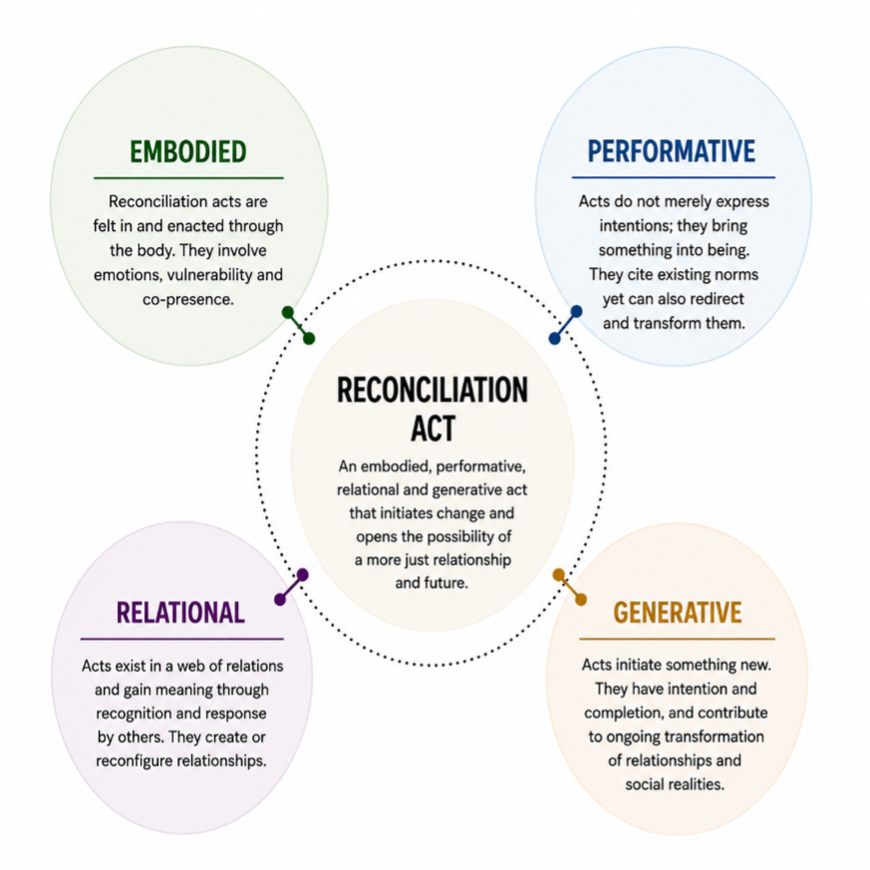
I propose that reconciliation acts are constituted by four key dimensions. First, such acts are embodied: they are felt and enacted through the body. Second, they are performative: they do not merely describe political reality but constitute it. Third, they are relational: their meaning depends on interaction and recognition by others. Finally, they are generative: they have the capacity to bring something new into being. Reconciliation can thus be understood as a series of embodied, performative, relational acts that produce new realities.
My point of departure is that there is a need to identify and theorise those moments that exceed mere coexistence and formalised justice-seeking and acknowledgement processes – and thus this rethinking attends to what people actually do in contexts shaped by violence, rather than what they say.
The paper now proceeds with a brief overview of the scholarly debate on reconciliation and outlines what I hope the contribution of this paper will be. It then introduces the RA framework, structured around the four dimensions suggested above. In the next step, the paper demonstrates how this framework can be applied across different scales and registers, with some poignant empirical illustrations. The paper concludes with a forward-looking discussion.
Reconciliation – a troubled concept
The discourse and practice of reconciliation as a means of addressing legacies of violence has gained significant prominence over the past decades, particularly within the field of transitional justice. It is an umbrella term indicating a process that is transformative of individuals and societies and includes an array of phenomena and strategies. In relation to trauma after war and mass atrocity, it is understood as part of a broader process of peacebuilding that can restore the social fabric and transform the post-war society into a more pluralistic, inclusive, and democratic society (Mannergren Selimovic, 2023).
However, many of the promises of this discourse have failed to materialise, and an increasingly critical body of scholarship has emerged in response, highlighting both conceptual and practical shortcomings. A first line of critique concerns conceptual overstretching (Meierhenrich, 2008). The concept ranges from 'thin' understandings, such as the development of positive attitudes or mutual recognition, to 'thick' interpretations involving deep emotional transformation, including forgiveness (Brecke & Long, 2003). Within transitional justice, there is broad agreement that forgiveness must remain an individual choice; as Martha Minow (1999) emphasises, the power to forgive is inseparable from the power not to forgive. It cannot be imposed from above. Also, reconciliation is variously conceptualised as either a process or an outcome (Bloomfield, 2006; Bloomfield et al., 2003), and its core components differ across accounts. For example, Kriesberg (2002) argues that they must include truth, justice, mutual regard, and security, while Brounéus (2008) emphasises transformation, specifically the shift from destructive attitudes and behaviors to constructive relationships. These variations render reconciliation difficult to define, operationalise, and measure (Lonergan, 2025).
A second line of critique targets reconciliation as a potentially depoliticising and even oppressive practice. A gap exists between top-down reconciliation initiatives and the lived experiences of victims and survivors, and in many cases, reconciliation is associated with staged, institutionalised processes that risk undermining struggles for justice. Mookherjee (2022), for example, introduces the concept of 'irreconciliation' to capture refusals to forgive in contexts of ongoing impunity, criticising reconciliation discourse for promoting "feel-good, up-beat endings' that obscure structural injustices and sustain the status quo. Similarly, Rigney (2012) warns that reconciliation can be mobilised to advance sectional interests and pursue conflict by other means.
Even more coercive appropriations of reconciliation can be observed in authoritarian settings, where the term is used to legitimise control, such as top-down and selective reconciliation discourse in Rwanda (King, 2010; Longman, 2017). Another example is the former Syrian regime's concept of 'local reconciliation agreements,' which were in fact strategies for forcing opposition bodies to surrender (Adleh & Favier, 2017). In these contexts, reconciliation risks becoming not only empty rhetoric but an instrument of governance and discipline, and may even become 'a byword for impunity' (Kerr, 2020). Related critiques have also emerged as the concept has more recently been invoked in relation to historical injustices such as colonialism, slavery, and settler violence against Indigenous populations. As Freeman (2015) notes, reconciliation discourse that (only) focuses on restoring relationships may obscure this historical structural violence.
A third critique concerns the strong emphasis on discourse within reconciliation practices. Much of the field has treated reconciliation as a "talking cure,' privileging narrative exchange, dialogue, and verbal acknowledgment, understanding reconciliation 'first and foremost as a discursive phenomenon' (Renner, 2012). Indeed, the influential peace scholar and practitioner John Paul Lederach (1997) suggests that reconciliation is 'the discursive space in which paradoxical and competing tensions can be mediated.' Many initiatives assume that bringing victims and perpetrators together to share stories will foster mutual understanding and respect. This approach is particularly evident in truth and reconciliation commissions and community dialogue programs. In deeply divided postwar contexts such as Bosnia and Herzegovina, externally driven reconciliation initiatives have often taken the form of scripted encounters, including dialogue meetings or symbolic gestures. These initiatives have often been harshly criticized by local voices (Dragović-Soso, 2016; Mannergren Selimovic, 2015).
Taken together, these critiques converge around three main points. First, reconciliation is conceptually vague, leading to difficulties in definition and application. Second, the discursive use of the concept can depoliticise conflict, obscure questions of justice, and reproduce existing power structures, particularly within top-down peacebuilding frameworks. Third, reconciliation has been overly associated with speech and dialogue at the expense of other forms of social and political practice.
In this paper, I propose a different approach. The theoretical framework developed in the following section rethinks reconciliation as a set of embodied, performative, relational, and generative acts. These acts can take place at different scales and registers in societies and can thus analytically function as a cross-cutting lens on how reconciliation may manifest. I see that this analysis can make two main contributions. First, it moves reconciliation beyond an understanding as empty (even violent) discourse and foregrounds the agency of those engaged in reconciliation practices, and in so doing, it can also account for unexpected and non-linear moments of transformation observed across diverse contexts. Second, the concept of reconciliation acts is analytically parsimonious and can travel across scales from intimate everyday encounters to more formal settings, through different registers.
My work here stands in dialogue with an emerging body of literature that looks to understand peace beyond mere institution-building, for example Väyrynen, who connects lived peace with corporeality, arguing that 'peacebuilding is ... a process that begins and ends with bodies as bodies are affected by it and feel it' (Väyrynen, 2019, p. 36) and the work of Brett et al. (2024) that suggests a new research agenda of "embodied reconciliation' as well as Bramsen's (2024) development of a micro-sociology of peace, which rests on the core idea that all macro-social phenomena are composed of and manifested through micro-level, intersubjective interactions. My own work has investigated the transformative power of everyday agency in conflict-affected societies (e.g., Mannergren Selimovic, 2019; Mannergren, 2026). The idea of 'relational peace' proposed by Jarstad et al. (2023) can also be of importance here. In this endeavour, I join other voices that of late have been voiced about the value of reconciliation as a concept, for example, Lonergan (2025), who explores multifaceted everyday reconciliation, and Freeman (2015), who articulates a 'defence' of reconciliation and shows how it can, in fact, support de-colonial practices.
The RA conceptual framework
Before developing the argument, some conceptual clarification is needed. What do I mean by an 'act'? An act can be understood as discrete and event-like. It is not simply ongoing behavior but something that interrupts, marks a moment, and carries performative force. An act produces a qualitative shift: it brings something into being. As Ware (1973, p. 409) argues, what is distinctive about human acts is their intentionality: they are 'personal doings' that can be performed because of a decision. Acts are not merely movements or behaviors; they are meaningful doings oriented towards ends. Acts are thus goal-directed and bounded as they have both intention and completion (Ware, 1973, p. 413). Acts may be ordinary or extraordinary, but even seemingly mundane acts can acquire an 'extraordinary' quality when they are set apart from 'ordinary life' and imbued with meaning, as Couldry (2003) suggests in his discussion of ritual action, and as such, their performative element holds special value (Lambek, 2013). I also want to note that acts often include speech, but speech itself is understood here as a form of action, following Austin's (1965) notion of speech acts. Speaking as part of an RA is not merely descriptive but performative, thus understood as a speech act that does something in the world.
I bring this understanding of the act into my conceptualisation of an RA. I propose that an RA is recognised by its four key dimensions. First, such acts are embodied: they are felt in, and enacted through, the body. Second, they are performative: they do not merely express intentions but constitute political reality. Third, they are relational: their meaning depends on recognition and interaction with others. Finally, they are generative: they have the capacity to bring something new into being. Below, I will further outline these dimensions.
The embodied dimension of an RA: Reconciliation acts are fundamentally embodied. Bodies are broken, suffering, healing. Bodies are fundamentally vulnerable, and this vulnerability is experienced through bodily exposure to others. Acts are carried and felt by bodies, and reconciliation can therefore not be simply thought or spoken - and emotions are lived, transmitted through bodily experience, and circulate between bodies. A reconciliation act is thus corporeally experienced by both perpetrator and victim, and its significance can lie in this shared, embodied encounter. Ultimately, meaning and understanding are grounded in corporeal experience (Merleau-Ponty, 2014).
The performative dimension of an RA: Reconciliation acts are also performative. To perform an act is to bring something into being, a political reality that becomes visible, present, and felt. Reconciliation acts do not merely call for reconciliation, but they make it real in the moment of performance. Following Butler (1990), performativity means that acts reiterate and cite prior norms; they are recognisable because they draw on existing social frameworks, often so ordinary that they remain unnamed or tacit. From this perspective, we can see that RAs are iterative as they gain meaning through repetition, yet they also have the capacity to redirect norms. Thus, acts do not simply express intentions; they constitute reality. Furthermore, acts are not isolated events but part of ongoing processes, and they must be sustained, repeated, and supplemented by other acts. This means that they are inherently fragile as they, in their performativity, can fail to make an impact, be contested, or simply go unrecognised.
The relational dimension of an RA: Reconciliation acts are inherently relational, as reconciliation is always lived with and through others. It cannot exist in isolation. Crucially, drawing on Arendt's political theory (1958), we can see that acts and deeds exist only within a 'web of relations' and their meaningfulness depends on recognition by others. An act appears within a 'space of appearance', a shared space where they can be witnessed and responded to. This does not necessarily mean formal or public settings, and acts may also be subtle or tacit. The relational dimension means that reconciliation is a vulnerable process. In post-conflict contexts, asymmetrical power relations intensify this vulnerability, a vulnerability that is at the same time put on display, given the performative dimension. A consequence is that public RAs are often highly scripted in an attempt to manage or minimise this risk, especially when it comes to political actors.
The generative dimension of RA: Reconciliation acts are generative: they make something new. Again, turning to Arendt (1958), we understand that acts hold the capacity to initiate new beginnings. Reconciliation is meaningless without change, and with the focus on the act, this change is not only a promise of future transformation. The act in itself holds the moment in which something happens, and new beginnings are initiated. In this sense, RAs are both process and end as each act contributes to an ongoing chain of acts through which relationships are reconfigured over time. They are also inherently unpredictable, since the acting subject cannot control how others will respond. On this note, Lederach (1997) emphasises its creative dimension, arguing that reconciliation involves imagination and the capacity to step into the unknown. The generative dimension is inseparable from vulnerability, as the 'new' that emerges is contingent on how others respond. Vulnerability is therefore not a limitation but a condition of possibility, as it is what provides reconciliation acts with their transformative potential. Without vulnerability, it seems that there can be no genuine creation of new relationships.
Figure 1. The four dimensions of a reconciliation act.
The multi-scalarity of RAs
In this section, I show how RAs operate across different scales and registers of social life through their four dimensions. Much of the reconciliation literature has traditionally mapped vertical and horizontal levels of interaction, with Lederach's (1997) multi-layered framework as a foundational reference point. More recent scholarship has moved toward an even more dynamic understanding. For example, Bramsen (2023), Mac Ginty (2021), and Millar (2021) all, in different ways, show that political and social practices and relationships unfold across and between sites of interaction rather than within bounded levels, highlighting how power is produced through entanglements between local, national, and international actors.
My argument here builds on these insights, and rather than treating reconciliation in terms of fixed 'levels' (local, national, international) or in terms of binary distinctions (formal/informal, grassroots/elite), I conceptualise RAs as unfolding across intersecting and overlapping registers. I propose that regardless of where they occur, RAs operate through the same four dimensions of embodiment, performativity, relationality, and generativity. These dimensions are not confined to any single 'level' or type of actors but are present across all registers of social interaction. Nevertheless, there is a need to analytically make some distinctions. Here, I distinguish between three analytical registers that display some particularly salient features. The first is the everyday register, characterised by tacit communication, high affective intensity, and low visibility beyond the immediate encounter. The second is the interactional or situational register, which includes meetings, encounters, and organised activities that are partially scripted yet remain contingent. The third is the institutional register, encompassing formalised acts such as public apologies, commemorations, and truth commissions; acts within these contexts tend to be highly scripted and symbolically dense and are often aimed at broader audiences. In the following, I will provide some empirical illustrations of RAs that take place in these registers.
RAs at the everyday register
At the everyday register, reconciliation acts (RAs) take place in intimate encounters that are characterised by affective intensity and little or no scripting. Everyday RAs are often tacit, unfolding through gestures, silences, and small forms of care rather than explicit verbal articulation. My empirical example comes from Bosnia and Herzegovina. There, in communities marked by distrust and denial following war, public narratives are often deeply divisive and tend to silence the suffering of others. In my own research, I have looked at micro engagements among populations that struggle with everyday insecurities. Reconciliation seems far away, and many people actively criticise attempts to overcome divisions. Yet, I have found that within these same environments, individuals may engage in quiet acts that contradict dominant stories. Consider, for example, the following empirical note, that is taken (in a condensed form) from another one of my publications that looked into how everyday peace may unfold:
'It is a snowy morning in a village in Bosnia and Herzegovina. The houses climb the hills above the river Drina. Snow lies in thick layers on haystacks and rooftops. Some houses have smoke rising from the chimney, while others are abandoned ruins. Gordana, let's call her that, walks up the gravel road through the snow to her elderly neighbor's house, carrying an armful of firewood. She places the logs neatly by the door.
Later, she explains to me: I care for her a lot. She is alone after the war. Of course I care for her. She is my neighbour.
... In this village, as in so many other places in Bosnia and Herzegovina, too much is at stake to be able to verbally talk about a shared future, as the public discourse is as staunchly ethnonationalist as during the war. Everyone I interviewed in this area, including Gordana, repeatedly told me how much they feared their neighbors who had been 'on the other side' during the war. They omitted that these feared neighbors had been the main victims during the conflict and that some of the gravest war crimes committed against the Bosniak population had taken place in this town, causing almost the entire Bosniak community to flee. Those who didn't were killed. Only a handful of people had returned, and they now lived precarious lives, one of them being the elderly woman who had no firewood to heat her damaged house. And then there was this moment of kindness and care. It was one of those moments when you, as a researcher, realise the gap between speech and practice. I saw that in the midst of an extremely polarized, war-infused context, practices of peace were taking place' (Mannergren, 2026).
The simple act of 'caring for' is an example of an RA in the everyday register. It was an act that was not framed as reconciliation, nor publicly recognised as such, yet it entailed a subtle reorientation of relationships. It was an embodied act, carried out through physical presence and material gesture. It was performative in that it did not merely express goodwill but enacted it in practice, an act that was visible for others to see and note. It was relational, suggesting an orientation toward another, even in the absence of explicit acknowledgment, and in this also generative, as the act opens for small but meaningful shifts that may accumulate over time. And precisely because acts such as these are unscripted, they involve exposure and vulnerability.
RAs at mid register
At the mid register, reconciliation acts can often emerge within civil society, which is what we often name the sphere of voluntary, non-state associations. These associations provide spaces where relationships can be normalised through acts that are not directly centered on the conflict itself. RAs at this mid register of society are typically organised but not fully institutionalised. They can include practices such as sports, voluntary work, activism, or cultural initiatives. What characterises them is their structured yet open-ended nature, and, importantly for my understanding of the specific characteristics of an act, is that they bring people together in ways that are intentional.
Here, my empirical illustration is the Bi-communal Choir for Peace, founded in 1997 as a grassroots initiative to bring together Greek Cypriot and Turkish Cypriot communities. Cyprus has been divided for decades due to war and political separation, limiting direct contact and trust between the communities. A choir is particularly interesting in my enquiry, as it requires participants to listen, adjust, and perform together. Participants must rely on one another, and trust is enacted through embodied coming together. The performances form a string of reconciliation acts within the larger framework of the choir and its trust-building presence. Importantly for my argument here is that the concerts function as RAs – they are deeply embodied acts creating shared affective experiences that also extend to audiences. They certainly have a performative function, and the act of singing together in front of an audience is iterative, gaining meaning through repetition while still allowing for transformation. The concerts draw on recognisable social forms and rituals that go beyond verbal expressions. Moreover, they are relational, as they depend on mutual responsiveness and shared engagement, and they are also generative, creating new forms of interaction and potentially reshaping how participants perceive one another. A study from 2024 of the possible conflict transformative effects of the choir shows that it has led to increased everyday social interaction across the divide (Soykunt et al., 2024). The intentionality of the RA comes across strongly in one of the participants' reflections in the study: 'The peace will come after the good relations between the two communities. And we are showing them. Now we are just singing together. But then, we will live together' (Soykunt et al., 2024, p. 571).
RAs at the institutional register
At the institutional register, reconciliation acts are highly visible and formalised. They are performed by actors with political authority and reach, whose RAs can shape public discourse and affect large populations. Their power lies in their capacity to stage recognition publicly with a wide reach, and they rely on embodied participation to create collective meaning. Institutional RAs are performative in that they constitute political reality rather than merely describing it. They are relational, requiring recognition and response from those to whom they are addressed. When successful, they are generative, opening the possibility of a new beginning. However, excessive scripting can strip them of authenticity, producing what may be perceived as empty ritual. The public apology is a key example. A speech act in Austin's sense, it is employed by elites seeking to acknowledge wrongdoing. However, failed apologies can deepen grievances and are often marked by ambiguity, lack of taking responsibility, and avoidance of signs of vulnerability. Thus, even at the most formal level, RAs depend on the same underlying dynamics as those at the everyday and mid settings. Without an embodied and affective dimension, their performative force collapses.
For my empirical example, I here turn to one of the most poignant apology acts in modern history, which aptly illustrates the key characteristics of an RA. It occurred on 7 December 1970, when the West German Chancellor Willy Brandt visited the memorial to the victims of the Warsaw Ghetto Uprising. To the surprise of everyone, he fell to his knees. There was no script for this gesture. Brandt, who himself had been an opponent of Nazism, knelt before the memory of those murdered by the state he represented. His gesture has widely become understood as one of the most powerful acts of political reconciliation in modern European history that also deeply spoke across the Cold War divide. After the event, which at the time was not accepted by everyone in German society, Brandt himself described what had occurred. In a voice recording (available on YouTube), he said that 'The kneeling in Warsaw was ... not planned. Under the weight of recent history, I do what people do when words fail' (DW History and Culture, n.d.).
Concluding discussion
Unlike abstract processes or diffuse discourses, acts have a beginning and an end, and they can be delineated. Rather than grappling with reconciliation as an open-ended and often vague process, focusing on acts allows us to identify when something shifts, however subtly. By identifying such acts, it seems that we can access more deeply and possibly in a more systematic way a dimension of peacebuilding that speaks to the enigma of why conflict transformation sometimes does occur in deeply divided societies.
We know that reconciliation is not only shaped by formal mechanisms or elite decisions, but also by the everyday practices of individuals and groups; indeed, transformation does not reside only in grand political processes or formal agreements but unfolds across contexts and scales. Looking at the three empirical examples above, it is remarkable that they so closely share characteristics, although the actual acts are very different and take place in different settings and through different registers. They are all embodied, performative, relational, and generative, which I have proposed are the defining dimensions of an RA. Furthermore, RAs emerge as nodes in a societal web of interactions, consisting of highly visible acts such as official apologies or public ceremonies of transitional justice, civil society initiatives at mid register, and more intimate and tacit encounters in the everyday. Their significance lies not only in the act itself, but in how they are taken up, iterated, and transformed. These acts are fragile, contingent, and uneven in their effects, yet they all make visible the vulnerable agency of those involved in reconciliation processes, across all registers.
In this sense, the rethinking of reconciliation presented in this paper contributes to ongoing debates by offering a way to move beyond what has often been criticised as an 'empty' or overly elastic concept. Instead of reconciliation as an aspirational discourse or endless process, reconciliation emerges as something that can be systematically studied through RAs. A working hypothesis emerging from this conceptual scoping is that the effectiveness of reconciliation acts depends on how the four dimensions of embodiment, performativity, relationality, and generativity align and reinforce each other. Ideally, a database of RAs could be constructed, which would open up possibilities to compare across scales, times, and contexts. The next step towards such an endeavour would entail the construction of a codebook for the four dimensions, allowing for a systematic categorisation and comparison of RAs.
The emerging framework also raises important questions about how acts in intimate, mid, and institutional registers may interact. Under what conditions do they reinforce one another, and when do they remain disconnected or even contradictory? Understanding how reconciliation acts can travel, scale (up or down), or fail to do so would be an important question in moving forward. Moreover, if reconciliation is understood as emerging from a web of RAs, how do we determine which acts matter more than others? Not all acts carry equal weight, and an important task when developing the framework further is to think through how we can identify when and why particular reconciliation acts acquire wider significance.
I also see that the framework may help in identifying both visible and hidden dynamics of reconciliation. As Lonergan (2025) suggests, attention to less visible practices can reveal "hidden progress and hidden needs.' Conceptualising reconciliation through acts thus brings into focus not only where relational repair is required, but also where it is already quietly taking place.
Finally, an overarching question concerns power and structural inequality. While the notion of RAs emphasises the transformative potential of embodied and performative acts regardless of the positionality of the subject, such acts are nevertheless scripted and contained by entrenched hierarchies and injustices. Reconciliation acts cannot address deep structural inequalities on their own. Thus, at any time, the act of refusing reconciliation must always remain a possibility.