
Acknowledgements
I wrote this paper while I was on a one-month Writing Fellowship at the Paris Institute for Advanced Study. I thank the staff of the Institute for affording me a generous and remarkable opportunity to pursue my scholarship, and for making the logistical arrangements which made my stay effortless. The Institute provided an excellent environment for thinking, writing, and meaningful discussions. I am grateful to the intellectually generous Fellows in residence from whom I learned many new things and, especially, to Jan Eißfeldt for his insights on social media and cognition. During this paper's 30-year incubation, my husband, George Chaplin, listened, asked key questions, provided excellent feedback, and helped me clarify my arguments. The title of this paper was inspired by a long discussion with Patricia Wright in her office over 20 years ago, when we mused over the future of humans as "primates with devices."
Introduction
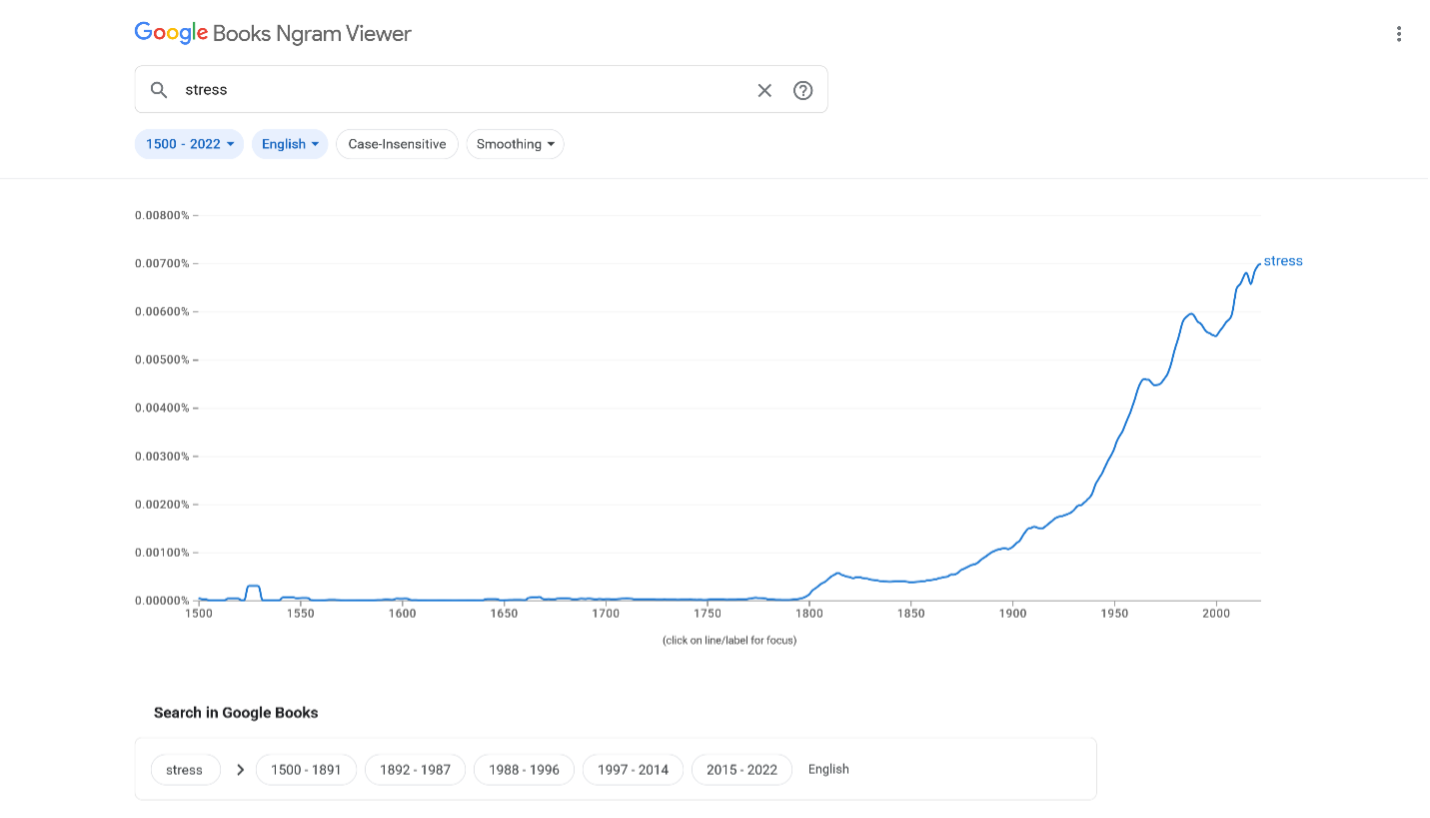
It is rare to have a conversation today that doesn't include the word "stress." Our vocabularies and writings have become so infused with "stress" that we have come to take it for granted as part of the drumbeat of modern life (Figure 1) (GoogleBooks, 2026).
Figure 1. The frequency of occurrences of the word "stress" from 1500 to 2022, from an analysis of books scanned for Google Books.
Humans have always experienced stress, and human physiology is well adapted to dealing with it when it is episodic and short-lived. Chronic stress is maladaptive, however. It leads to a cascade of harmful physiological and hormonal changes, which cause long-term inflammation throughout the body that eventually manifests as impaired cognitive, metabolic, and immune system functioning (Russell & Lightman, 2019). The ubiquity of stress and inflammatory processes affecting humans has prompted exploration of the impact of these processes at scales higher than that of the single human organism. The recent publication of a "multiscale inflammatory map" connecting individual stress to societal dysfunction and ecological disruption encourages us to examine the possibility of interdependent inflammatory and neural processes that cycle within individuals and then are transmitted between and among individuals as behavioral stressors to affect human interactions, and even whole ecosystems, at scale (Vodovotz et al., 2024). According to the mathematical model developed by the authors, these stressors are magnified and multiplied through digital communications frameworks to create rapidly advancing, multiscale "inflammatory" processes, which adversely affect human interactions and decision-making processes at all levels (Vodovotz et al., 2024). It is noteworthy that the authors of this deep and thought-provoking paper do not foreground their model in the context of human evolution.
In this paper, I examine the phenomena of individual and societal stresses from the perspectives of human and primate evolution. I use knowledge drawn from primate biology and sociality and from studies of human social interactions before the advent of remote communications to examine how individual and social stresses were dealt with in the past, and how this information can inform human life in the twenty-first century. I focus primarily on behaviors and modes of social interaction that evolved in primates and humans to reinforce social bonds and to prevent and mitigate stress, and how these mechanisms effectively prevented the escalation of most "inflammatory processes" from within and between individuals to higher levels. My goal here is not to critique the overall multiscale inflammatory model or to exhaustively review the evolutionary contexts of all behaviors affecting individual and societal stresses. Rather, I seek to apply evidence from studies of primate and human evolution to shed light on the processes and phenomena that contributed to human primates today having lives and vocabularies filled with stress.
Humans as primates
Humans last shared a common ancestor with our closest relatives, common chimpanzees, somewhere between 4.4 and 7 million years ago (Foley & Mirazón Lahr, 2024). Humans share with our close primate relatives many aspects of biology and behavior, and a short summary of these shared attributes provides essential framing for the thesis developed here. Among mammals, primates are remarkable for having life histories with exceptionally slow rates of growth, aging, and reproduction (Leigh, 2004; Pontzer et al., 2014; Ross, 1998). Primates generally have single offspring and have brains that are large relative to body mass. Much of the early postnatal life of a neonatal primate is devoted to growing the brain and becoming socialized (Charnov & Berrigan, 1993; Leigh, 2004; Platt et al., 2016). Most primates live in small, stable social groups and have cognitive abilities well suited to tracking social interactions (Silk, 2007). Primates are highly visual mammals, and the development of relatively large brains is at least partly attributable to evolution favoring specific visual mechanisms involved in processing social information from the facial expressions, postures, and direction of gaze of members of their group and in foraging for specific types of foods (especially fruits) in physically complex environments (Barton, 1998; Parr et al., 2005). Primates live in complex social worlds in which observation and imitation in the context of a long program of social learning are central to successful development and survival (Whiten, 2000). The ability to recognize other members of one's social group, usually from a combination of visual, auditory, and olfactory inputs, is essential because it is the foundation of social knowledge upon which survival and reproductive success depend (Bergman & Sheehan, 2013; Silk & Kappeler, 2017). Second to this, the ability to imitate body movements related to survival, such as those involved in finding and processing food, is a central pillar of early social learning (Heyes, 2023). In early life, young primates imitate their mother, but later in life, apes and some monkeys especially prefer to imitate individuals who are of higher social rank or who are more proficient or successful in specific skills (Horner et al., 2010; Kendal et al., 2015; Whiten & Waal, 2018). Awareness of an individual's place in the social hierarchy is part and parcel of group living, and learning to recognize and imitate dominant or submissive actions is vital to survival (Bergman et al., 2003; Cheney et al., 1986; Koski et al., 2015; Sapolsky, 2005; Seyfarth & Cheney, 1994). Thus, in brief, primates are long-lived, large-brained, and highly social mammals that are highly visually oriented, imitative, and status-conscious.
As long-lived mammals living in small, stable, and hierarchical social groups, primates face the likely prospect of conflict with other members of their own group, over access to a preferred item of food or a potential mate, or because of a perceived breach of social protocol. Under such conditions, there is a strong imperative to avoid conflict and to mitigate or resolve it when it occurs (Aureli et al., 2002; Silk, 1998). In primate societies, there are multiple ways whereby social bonds are reinforced and many ways in which reprimands and retribution are meted out. Nearly every species, whether strongly hierarchical or more egalitarian, has a different combination of these behaviors that works to keep social tensions under control (Ostner & Schulke, 2014; Platt et al., 2016; Sapolsky, 2016; Tombak et al., 2019). In all primates, social touch is a highly influential form of social capital because it is one of the most direct ways for individuals to strengthen social bonds, and to prevent and resolve conflicts (Grandi, 2016; Jablonski, 2021; Lehmann et al., 2007). Social touch, also referred to as affective or affiliative touch, is pleasant touch and involves sweeping and caressing movements that activate specific sensory neurons (C tactile unmyelinated afferent fibers), producing pleasant sensations and inducing relaxation in both the giver and the receiver (Dunbar, 2010; Grandi, 2016; McGlone et al., 2014; Pawling et al., 2017). In primates, the physical grooming of other group members is the most common expression and the primary mode by which they create and maintain social relationships and build alliances (Dunbar, 2010; Grandi, 2016; Jablonski, 2021). It is also the single most important behavior contributing to the process of reconciliation after a conflict, with grooming often resulting in clear and immediate effects on former adversaries (Dunbar, 2010; Hertenstein et al., 2006; Silk, 1998). The effectiveness of grooming and social touch in general stems from the fact that it both induces relaxation and reduces anxiety by reducing heart rate and cortisol levels, and by triggering the release of endogenous µ-opioids and oxytocin (Ebitz & Platt, 2014; Griesser et al., 2025; Platt et al., 2016; Smith et al., 2010). Primates are described as prosocial because their individual reproductive success strongly depends on their ability to establish and maintain strong social bonds with group members by constantly adapting their own behavior to their social environment. Within individual primates, physiological stress is generally intermittent and short-lived because the checks and balances afforded by visual monitoring of behavior and the prevention and mitigation of aggression by social touch prevent it from becoming chronic (Sapolsky, 2005). After a conflict, reconciliation facilitated by social touch lowers the levels of physiological stress experienced by individuals, and repairs and restores social bonds so that overall levels of stress within a social group are lowered (Lehmann et al., 2007; Silk, 1998).
Humans are quintessential primates in that they share with their nonhuman relatives a common heritage of slow life histories, a strong visual orientation, an aptitude for imitation, and a keen awareness of social status. What sets humans apart, quantitatively at least, is that they are even more cooperative than their nonhuman relatives (Tomasello, 2023). This is in large part because of articulate speech and language, which make it possible for humans to communicate both highly specific and abstract facts and concepts clearly and precisely, in addition to communicating with one another using the potent visual cues and social touch available to their nonhuman relatives. Humans are communication powerhouses because of the number and variety of modalities available for communicating with one another. They have evolved into incessant communicators, "informavores," who seek information of all kinds from one another (Pinker, 2003). They are also tremendously effective at using all the signals, behaviors, and cognitive facilities at their disposal to reduce individual stress and stress between members of their social group.
Humans before widespread literacy
Social stress in early human societies was controlled in many ways, and my goal here is to outline some of the commonalities among societies that have been observed in modes of positive and negative social reinforcement across space and time. This brief review focuses on people before the advent of widespread literacy. This watershed was critical because the ability to write, read, and exchange information in a written medium represented one of the first modes of remote communication, making it possible for people to communicate with one another when they are not in the same place at the same time. Writing was a remarkable landmark in the history of humanity because it is a graphic device for transcribing speech and because the recognition of writing as language makes possible the contemplation of words as objects of attention (Olson, 1996). Significant in the context of this discussion is that writing made possible the communication of information across space and time without face-to-face interaction (Morin et al., 2020). In order for us to appreciate why this is such an important watershed for humanity, it is best to start by examining the nature of non-literate human beings themselves who lived in traditional societies.
Modern people, members of the species Homo sapiens, have existed in Africa for at least 300,000 years as judged by the number of well-dated fossil remains (Hublin et al., 2017). It is hard to know the minds of our ancient relatives, but it is generally agreed that early modern humans living more than 100,000 years ago were behaviorally modern as judged by the diversity of their tools and the evidence of symbolic behavior. They used a sophisticated array of flaked stone tools in hunting, for food preparation, and in many other activities (Richter et al., 2017), and left durable evidence of symbolic behavior in the forms of inscribed ochre and engraved ostrich eggshell fragments (Tylén et al., 2020). Put simply, there was every indication that these people were cognitively modern. Like other primates, early humans engaged with one another through diverse visual and tactile cues. What set them apart was articulate speech and language. The addition of language to the communications repertoire meant that people could reinforce social bonds through words, modulation of voice, and the content of verbal messages, not only by visible cues and social touch. Similarly, they could deter others from antisocial behavior and prevent escalation of conflict, through a combination of visually perceived cues, physical contact, and verbal warnings. Evolution of multiple channels of social reinforcement and deterrence created paved the way for sophisticated systems of cooperative communication and enhanced social cognition (Griesser et al., 2025; Hare, 2017; Herrmann et al., 2007). The archaeological and ethnographic records reveal that the net effect of these developments was a greater understanding of shared intentions, enhanced social learning, heightened intragroup tolerance, increased food-sharing, heightened cooperation in foraging and hunting, and expanded social networks (Bird et al., 2012; Hare, 2017; Henrich, 2016; Morin et al., 2024; Tomasello et al., 2005). Our ultra-cooperative, prosocial natures made possible the "cultural ratchet" of cumulative modifications of behavior and culture that are faithfully communicated between generations and that form the very basis of modern human success (Hare, 2017; Herrmann et al., 2007; Tennie et al., 2009; Tomasello, 1999). The same heightened levels of cooperation facilitate active social learning and create a self-reinforcing system of rewarded social conformity and sanctioned non-conformity (Tennie et al., 2009). The faithful transmission of these bodies of social learning between generations made possible the development of cumulative, non-genetic cultural evolution (Boyd & Richerson, 2009). Under these conditions, social evolution favored genes that enhanced prosociality, and individuals who adhered to moral systems governed by systems of rewards and sanctions enjoyed greater reproductive success (Boyd & Richerson, 2009).
For thousands of years, the success of human individuals and groups depended upon high levels of social cooperation that were based on the faithful communication of emotional state and shared intention. High levels of social cooperation were scaffolded on verbal interchange, a rich suite of mutually understood visual cues, and by effective tactile reinforcements provided by social touch. These three channels of communication were and still are the standard currency of in-person interchange between people. This is the original version of full bandwidth communication.
Decades of observational accounts have documented the benefits of social touch, especially in the contexts of early human development, elder care, and the maintenance of stable social bonds (Field, 2010; Gallace & Spence, 2010; Gleeson & Timmins, 2004; Hertenstein et al., 2006; Montagu, 1971; Widdowson, 1951). This research exposed the need for experimental studies exploring and documenting the physiological basis of social touch in humans. Such research has been made possible by advances in neurophysiology and comparative psychology, including examining and verifying the shared biological basis of affective touch in humans and nonhuman mammals (Botero, 2018; Catania & Henry, 2006; Dunbar, 2010; Jönsson et al., 2017; McGlone et al., 2016; Parapera Papantoniou et al., 2026; Pawling et al., 2017; Prescott & Dürr, 2016; Wu et al., 2021). An excellent, recent review of comparative neurophysiology of affective touch provides clear documentation of the phenomenon and highlights the questions remaining to be answered (Parapera Papantoniou et al., 2026). Among the many important conclusions to emerge from this research is that social touch contributes importantly to establishing and maintaining social bonds across species of social mammals by reducing the effects of negative social stress (Liu et al., 2022; Parapera Papantoniou et al., 2026). Humans present an especially interesting case here because social talk, for all its importance in human communication and in mediating emotions, has not supplanted the need for social touch, including that occurring between people who have a close personal relationship (Dagnino-Subiabre, 2022; Dunbar, 2010; Morrison, 2016; Nelson & Geher, 2007; Parapera Papantoniou et al., 2026; Peled-Avron et al., 2016; Suvilehto et al., 2015; Suvilehto et al., 2019).
In human communication, social touch rarely acts alone, but rather reinforces visual cues established by eye gaze (Emery, 2000; Fairhurst et al., 2014; Kerr et al., 2019; Meier et al., 2020). When social touch is reinforced by direct gaze in face-to-face interactions, multiple neurophysiological signals from elevated serotonin, oxytocin, and vasopressin work in concert to reduce stress and reinforce social bonds (Kahya et al., 2024; Kerr et al., 2019). In early development, the coordination of gaze with social touch establishes the neural synchrony between parents and infants that forms the foundation of their social relationship (Alonso et al., 2024; Kahya et al., 2024; Kerr et al., 2019). Thus, multiple channels not involving language operate in humans to establish and reinforce social bonds, with social touch and eye gaze being by far the most important. With the addition of language providing specificity and nuance to the repertoire of communications, it is easy to see why humans are considered the most prosocial and cooperative species of mammals.
As with nonhuman primates, social bonds and social order within a group are not maintained by positive reinforcement only. Aggressive behavior is common in human societies, but only a fraction of that behavior results in physical violence. Aggression and violence have been thoroughly studied and types of violence classified (Fry & Söderberg, 2013; McCall & Shields, 2008; McGuire, 2008); this treatment is superficial and intended only to illustrate in general terms how violence is manifested and controlled. Humans use varied means of nonverbal and verbal communication to deter and deal with aggression and the physical and psychological injuries resulting from it. Several of these methods involve visual threats that can be seen at a distance and do not require physical contact. These include threatening stares, dominant postures, and threat displays (Emery, 2000; Jablonski & Chaplin, 1993). The magnitude of such threats can be increased – especially when individuals are in close physical proximity – with inflections of voice and by threatening language, leading to cycles of shame, humiliation, and rage (Braithwaite, 2000). Escalation of confrontations is not inevitable because individuals who are threatened often can successfully appease an aggressor through submissive postures and language, including displays of shyness, embarrassment, and shame (Jablonski & Chaplin, 1993; Keltner et al., 1997).
When aggression escalates, verbal violence in the form of teasing, taunting, insulting, or cursing precedes physical contact (Duque & Montoya, 2013; Felson, 1982; Geiger & Fischer, 2006). The severity of the physical assault, if it does occur, depends on the age and sex of the individuals involved, as well as the weapons that may be available (Duque & Montoya, 2013; Geiger & Fischer, 2006). What is remarkable about the give-and-take of aggressive and appeasement behaviors in humans is just how many effective verbal and visual signals are utilized to prevent the outbreak of injurious aggression, some of the most effective being the intercession of members of an aggressor's or a victim's social group (Anwar et al., 2018; Duque & Montoya, 2013). A review of lethal violence in hunter-gather societies showed that half of the lethal aggression documented involved one individual killing another as an act of homicide motivated by personal animus, while raids and warfare involving group attacks on one or more persons were far less common (Fry & Söderberg, 2013). This evidence supports the hypothesis that lethal aggression has been selected against, not promoted, in human evolution, and that mechanisms for resolving disputes other than killing adversaries were a prominent part of our heritage (Fry & Söderberg, 2013; Jablonski & Chaplin, 1993; Jablonski et al., 2002).
When physical violence is threatened or does occur, many outcomes are possible, depending on the context and severity of the interaction. Verbal apologies play a key role in preventing the escalation of aggression and in redressing the emotional damage inflicted by a wide range of transgressions, making them some of the most effective mechanisms available to people for restoring social bonds (Silk, 1998). Repentance rituals involving the acknowledgement of shame caused to self and others by violent acts occur in some traditional societies and are remarkably effective at restoring social bonds (Braithwaite, 2000). Punishment can be highly effective in ensuring cooperation and discouraging "free riders" when it is ritualized, and the number of individuals meting out punishment is relatively small (Boyd et al., 2010). In larger societies with laws, violence that is deemed antisocial is methodically, and often publicly, punished in order to deter others from engaging in it and to educate and reform (Stearns, 1936). Throughout most of human history, aggressive behavior and violence have been prevented, mitigated, or atoned for through in-person interventions in which a full suite of visual, postural, and verbal signals could be marshaled and exchanged between the affected parties. From these, organized systems of retribution emerged because the idea of inflicting physical or psychological pain on someone when the punishment is known to others in the same social group is seen as a worthwhile goal that restores fairness and ultimately enhances within group cooperation (Baumard, 2011; Walker Wilson, 2020).
What this brief review reveals is that multiple overlapping methods of rewards and retribution worked to reduce stress and establish and maintain social bonds within traditional human groups. Individual behaviors – especially what people say and do, and the gestures and facial expressions they use – provoke immediate reactions, both positive and negative. Individuals are reinforced by a cascade of affiliative behaviors, from approving glances and smiles to verbal reassurances, physical signs of approval (a "pat on the back"), and physical rewards involving the sharing of food or the gifting of a valued object. Individuals are punished by a finely graded series of reactions and interactions from disapproving glances and gestures, to sharp words, and threatening postures intended to shame and embarrass. If the cycle of shame and rage spirals out of control, physical aggression can be expressed as anything from a slap or push to a punch or injury with a weapon, sometimes causing death. The feedback system is tight and carefully monitored, so that, generally, harmony within a group is maintained, and everyone knows what constitutes acceptable and unacceptable behavior. This is especially true in small groups of humans of generally less than 50 individuals (Dunbar, 2022). When groups get larger – as is common in agricultural societies – the checks and balances are strained, exposing the potential for serious or unchecked aggression and threatening the stability of the group. Under these conditions, many "glass ceiling" mechanisms have developed in human societies to reduce the likelihood of serious within-group conflict whereby (Dunbar, 2022). These can take many forms, from formal social rituals that work to enhance cohesion within and between groups to the emergence of charismatic leaders who work to rally group energy around specific causes. Probably the most common way of preventing high levels of stress and aggression from developing within large groups is to divide them into smaller ones, in which traditional small-group methods of behavior monitoring and management can be employed (Dunbar, 2022).
Social bonds of friendship and relationships within communities in human societies are built on the same neurochemical framework as those of primate societies, and all require face-to-face interactions and, often, personal physical contact to be most effective (Dunbar, 2022; McGlone et al., 2016; Nummenmaa et al., 2016). Many traditional social activities undertaken by humans in groups, including singing and other types of musical performance, dancing, social laughter, and some religious rituals, also trigger the release of endogenous opioids, thus reinforcing the neurochemical effects of traditional primate interactions centered around social touch (Dunbar, 2023; Dunbar, 2022; Manninen et al., 2017).
Primates with devices: Humans in the twentieth and twenty-first centuries
Cultural evolution can occur quickly when technological innovations make possible "new and improved" ways of doing things. Humans tend to innovate first and consider the consequences later. In the late twentieth and early twenty-first centuries, inventions and rapid technological advances in telecommunications and computing led to rapid changes in the way people interact. These big changes affected many of the longstanding behavioral and cultural mechanisms for establishing and maintaining social bonds and cooperation in human societies. These, in turn, disrupted many of the efficacious physiological mechanisms that had developed over millions of years of primate and human evolution to control stress within individuals and groups.
To recap briefly, in the previous sections, I have shown how nonhuman primates and humans evolved complex systems for avoiding and mitigating the manifestation and accumulation of harmful levels of stress within and between individuals. These systems developed as long-lived primates with slow life histories came to live in small, tightly knit social groups with stable memberships. Individuals lived in close physical proximity, became thoroughly acquainted with one another, and monitored and responded to each other's behaviors directly. Modern people evolved under and continued to live in such circumstances within traditional hunter-gatherer and agricultural societies for thousands of years. This situation changed gradually with the rise of fortified sites, cities, and standing armies, between 8,000 and 4,000 years ago (Ferrill, 2018). These represented profound changes because, for the first time, people from single social groups started to live far apart from one another, while unrelated people, often strangers, found themselves living together in new social groups in close physical proximity with one another. Under these circumstances, communication between closely related individuals could be impossible or only be accomplished by indirect or remote means.
Writing became increasingly important over time because written messages could be delivered by someone other than the writer and read by another person, often in a far distant location, much later in time. The advent of writing in both Mesopotamia and ancient Egypt dates to about 3300 yr bp., but the transition to widespread literacy occurred erratically and slowly, partly because some societies invented writing systems and writing technologies, while many others acquired them from others (Hannon & Hannon, 2000; Kaestle, 1985). This transition is still not complete for many reasons, including the high cost of printing, and social obstacles such as the expenses of establishing schools and training teachers, and delays in recognizing the importance of writing and reading for all children of the modern world. Writing and literacy afforded, and still afford, people many opportunities. When able to read and write, people can write messages or letters to one another. Unrelated individuals living in diverse places can share information and write to one another about it. People can immortalize themselves by creating written records of births, deaths, and property, and writing genealogies of their families. They can pass cherished books of personal philosophy, religious tradition, or technical learning through generations, thus transmitting complex bodies of shared values and knowledge. The list of affordances is long, but these samples indicate the magnitude of the revolution in human learning and relationships that writing and literacy made possible.
We rarely think of writing and literacy having disadvantages, but from the perspectives of primate and traditional human behavior, these inventions had some, because they made it much easier for people to, literally, get out of touch with one another. Initially, this mostly affected people who left home for economic or social reasons, for military service, or because they had been enslaved and transported far from their homeland. Regular folk left at home continued to rely on established methods and networks for maintaining social bonds and providing social feedback. The tried-and-true visual, tactile, and language signals that had served humans for millennia continued to be used effectively among members of small social groups, whether they lived in villages or cities. Of key importance is the fact that children and adolescents in these groups were socialized to understand and respond to these well-established patterns of signals and feedback, delivered face-to-face. Understanding and interpreting the currency of social encounters – the facial expressions, gestures, and postures – children observed was essential for understanding another's emotional state and intention (Herba & Phillips, 2004). Similarly, children felt the comfort of physical proximity and social touch, and the potential embarrassment and pain that could result from shaming and aversive touch. Lastly, children learned the art of conversation, including the nuances of speed of response and of approval and disapproval that language conveys, especially when combined with visual cues (Templeton et al., 2022). They also learned how to apologize when they hurt someone physically or emotionally (Silk, 1998).
The advent of widespread methods of remote communication used for everyday exchanges between individuals heralded a new era of human communication. The invention, improvement, and dissemination of the telephone in the late nineteenth and early twentieth centuries was momentous because the device permitted simultaneous voice communication between two people anywhere in the world. First used for business and emergencies, landline telephones were originally conceived of as a serious technology to be used for short and important messages (Abildgaard & Humphreys, 2020). By the latter half of the twentieth century, the role of telephony shifted from its original primary uses in business and emergency settings to being a reassurance technology that made it possible for people of one's social group to stay connected and provide updates on their status when away from home (Abildgaard & Humphreys, 2020). The step from telephone landlines to mobile phones made it possible for many more teenagers and young adults to use telephony to have normal conversations with their friends. To these "landline natives," the telephone was a natural part of their day-to-day communications that they took entirely for granted; for scholars of twenty-first century telecommunications, this phase became "prehistory" (Abildgaard & Humphreys, 2020).
In the 1960s and 1970s, Bell Telephone touted that long distance telephony was "The next best thing to being there." Despite the catchy slogan, the deficiencies of telephony as a medium of communication were already becoming clear by this time. An insightful review of the literature on telephonic communication from the pre-mobile-phone era noted several problems posed by the medium for routine business and personal interactions relative to face-to-face interactions (Williams, 1977). For business communication, telephony offered speed for simple transactions such as confirming existing arrangements, and – when used in group contexts – tended to flatten internal group structures hierarchies that would have emerged in face-to-face settings (Williams, 1977). Less favorable was the evidence that telephony made the resolution of conflicts more difficult, and that it was more likely to result in lopsided communication not representing the complexities of the matter at hand or in complete failure of negotiations (Williams, 1977). In personal contexts, the biggest difference found between telephony and in-person interaction was in the formation of first impressions: A telephone conversation often resulted in a less favorable impression of a person because the medium lacked the nonverbal cues that might lead to more favorable impressions (Williams, 1977). The overall assessment was that telephony negatively affected the efficiency of information transmission, the function of nonverbal cues, and the effect of social presence (Williams, 1977). These results are not surprising in the context of the multichannel nature of primate communication: Voice alone cannot convey the kinds and nuances of socially salient messages that are permitted by the full bandwidth of in-person interaction, complete with eye gaze, facial expressions, gestures, touch, and even smell.
Even bigger effects began to be felt in the early 1990s with the introduction of smartphones, and the access to the internet and email from a mobile device they afforded. This decade also saw the expansion of community bulletin board systems (Driscoll, 2022) – the forerunners of social media – and the first blogs. With these changes, a person could not only use a mobile device to have a telephone with another person in a remote location, but they could access information on internet websites from the same device, and broadcast information of their own to others on shared internet platforms. Not only were people no longer as dependent on printed materials for information and entertainment as they had been, but they could also create information – of almost any kind – that could be shared and exchanged with anyone through specified platforms. Bulletin boards provided forums for social interaction among people with shared interests, and their open nature ensured that all voices could be heard without the interference of authorities or editors. Anonymity and the adoption of pseudonyms were encouraged on many of these forums as a way of protecting identity, but these measures made possible trolling and flaming (Driscoll, 2022), the earliest mass occurrences of virtual bullying, stalking, and character assassination. These were remarkable watersheds in human behavior because, for the first time, large numbers of people could engage in virtual communication with one another without the checks and balances afforded by face-to-face interaction. People posting to virtual forums could receive positive and negative feedback, but the response was usually not immediate, and the protection afforded by the anonymity of the platform meant that persons posting harmful, nasty, or injurious content could not be directly reproached or punished. These same virtual community networks made possible the spreading of rumors about a range of subjects, heralding the arrival of fake news spread quickly by virtual networks to potentially global audiences (Koidl & Matthews, 2017). This decade also witnessed a shift in interpersonal communications away from phone calls and in-person meetings to text messages and emails. Taken together, the changes in the nature and patterns of human communication occurring in the 1990s represented major shifts in the way people interacted with one another. Mechanisms for establishing cooperation and maintaining social reciprocity that had defined human communications and social behavior for hundreds of thousands of years were being attenuated, as the multichannel sensory dimensions of conversations and community discussions were flattened and the immediate rewards or punishments for individual behavior disappeared. This was only the beginning.
The era of social media as we know it so far in the twenty-first century began in the early 2000s with the launching of Facebook in 2004. First envisioned as a forum for friends getting together and sharing personal news and photos in a virtual environment. The popularity of the platform and the incentives for internet adoption offered by Facebook's parent company led to its rapid spread around the world within a decade. At the same time, innovations in computer networking and information storage, alongside the growth of consumer interest in new kinds of content, quickly led to the emergence and growth of other social media companies and platforms over the next decade. These included Twitter, YouTube, Instagram, WhatsApp, and TikTok, each specialized for different audiences and modes of expression, including user-generated video and, later, live-streaming. Most of these platforms were supported, from the outset, by advertising revenue. Social media advertising made it possible to target consumers and reach new audiences (Love, 2015). The histories and effects of social media and social media advertising have been competently reviewed elsewhere (Avalle et al., 2024; Gerbaudo, 2026; Gongane et al., 2022; Love, 2015; Sheth et al., 2022; Valenzuela et al., 2017), so here I will only touch on two interrelated matters that have directly impacted the ways people communicate (Avalle et al., 2024). The first is how virtual audiences are shaped by advertising, and the second is how toxic content influences the tenor of human interactions in social media environments.
Many social media platforms boasted that they provide unsurpassed opportunities for free speech and the unimpeded sharing of ideas. This is not the case because algorithms are used to organize speech in such a way as to increase user engagement and marketability via targeted advertising, a phenomenon dubbed "algorithmic audiencing" (Riemer & Peter, 2021). This directly impacts human behavior because messages of any kind no longer travel by word of mouth or through established social networks; rather, new social networks are created by the algorithms distributing content to targeted individuals (Riemer & Peter, 2021). Far from being innocent, this process has been one of the most potent in bringing about the polarization and fragmentation of social groupings in virtual environments because of how it creates audiences for targeted advertising (Riemer & Peter, 2021). This was a momentous step in human history because from it emerged new, virtual social networks in which like-minded individuals – originally targeted by algorithmic audiencing – could congregate (Avalle et al., 2024). It is easy to see how these groups, which are, by definition, already polarized in their interests, are referred to as "echo chambers" in which shared beliefs are recirculated and reinforced. Within these groups, long discussions about controversial topics tend to generate toxic content, defined as material that is rude, objectionable, or unreasonable (Avalle et al., 2024). Toxic content does not discourage people from participating in online discussions (Avalle et al., 2024). Controversial topics increase levels of user participation and toxicity in virtual exchanges, sometimes leading to hostile and contemptuous interchanges. The spiral of unquenched negative emotions that can ensue promotes the generation of increasing amounts of toxic content (Avalle et al., 2024). In theory, the process of content moderation, performed manually by humans or automatically by artificial intelligence bots, might operate to filter or flag different kinds of toxic content for elimination, but at present this treatment is limited to materials that are considered extremist, dangerous, highly offensive, or that are not congruent with the interests of the owner or advertisers of the online platform in question (Gongane et al., 2022; Madio & Quinn, 2025; Sheth et al., 2022). In practice, there is very little that can be done to reproach, deter, or punish the creators of toxic content or the perpetrators of injurious virtual attacks; similarly, the support that is available for the victims of online attacks may have a limited effect (Alfurayj et al., 2024). Both the active participants and the bystanders in toxic exchanges are physically separated and cannot observe the impact of the verbal violence on the victim (Alfurayj et al., 2024). Cyberbullying and harassment can flourish when the perpetrators cannot observe the impact of their actions and when meaningful punishment and retribution for inflicting harm are absent or, at best, are weak and delayed. Bystanders at first may have been attracted to the excitement of toxic exchanges, but find themselves leaving conversations when the content becomes distasteful, and they find themselves stressed. For active participants, online forums provide social environments where their thoughts are propagated and where they can be heard and seen, but in which the effects of their communication are diffused and delayed. For both participants and bystanders in online social networks, many behaviors and emotions are left unresolved, and the chain of cause and effect is broken.
When the internet, social media, and smartphones are combined, the effects on individuals and groups can be startling because the content of the material and the device delivering it are designed to grab and retain attention and create an always-connected reality (Shiferaw et al., 2025). In environments like these, where online news feeds from favored platforms and virtual connections with real and virtual friends and communities constitute the totality of individuals' social worlds, the lack of connection itself can be disabling. Fear of missing out (FOMO) was known before the age of the internet and social media, but is now widespread among digital natives who are regular social media users (Abel et al., 2016). Among teens, the heightened anxiety, irritability, and feelings of inadequacy associated with FOMO affect decision-making (Abel et al., 2016). FOMO is one of the major reasons cited by teens for not complying with social media bans (Bursztyn et al., 2026). Internet addiction and social media addiction have become significant problems for adults, but particularly for adolescents, because these communication media affect behavior, mental health, and brain function (Arana-Rodríguez et al., 2025; Shiferaw et al., 2025). The uncontrolled use of the internet in youth is associated with a range of negative psychological outcomes leading to functional changes in the brain comparable to those observed in substance and gambling addiction, while uncontrolled use of social media leads to changes in reward-seeking behavior that potentially affect brain development (Arana-Rodríguez et al., 2025). With both internet and social media addiction, individuals are likely to experience heightened levels of stress, social isolation, paranoid ideation, and withdrawal symptoms such as anxiety, depression, and anger (Arana-Rodríguez et al., 2025; Rajeshwari & S, 2023; Shiferaw et al., 2025). With the passing of time, youth who have experienced such problems face great difficulties as adults in acquiring effective social skills, making close relationships, and maintaining social connectedness, thus leaving them vulnerable to chronic stress, feelings of social marginalization, and loneliness (Lissitsa & Kagan, 2026). Faced with such issues, individuals often turn to digital media for emotional support and engage in compulsive scanning of content, "doom scrolling," a process that often leads to even more intense feelings of alienation, helplessness, and despair (Lissitsa & Kagan, 2026). Social media use, FOMO, and the addictive behaviors and anxieties they are capable of producing interact with one another in complex ways to produce compounded and sometimes disabling psychopathologies (Chadha et al., 2024; Liu & Ma, 2019). These problems are not easily addressed even with individualized psychotherapeutic interventions because of the intensity of the anxieties experienced and the likelihood of relapses, particularly in youth (Liu & Ma, 2019).
Viewed from the perspective of primate and traditional human behavior and evolution, the issues and problems discussed here are weighty because human primates are not equipped behaviorally, culturally, or physiologically to deal with the intensity of compound stressors created by modern modes of communication. Virtual social connections are real, but they lack the sensory dimensionality and physiological impact of the feedback mechanisms of traditional networks of human cooperation. As humans, we are very good at in-person meetings and conversations because we have refined over hundreds of thousands of years the production of the visual, tactile, and verbal signals that constitute the full communication repertoire of our species. These signals regulated the nature of social exchanges and their physiological effects. Much of our early history involved living in small stable groups where everyone knew each other and observed each other every day. People exchanged information verbally while reading each other's facial expressions and gestures carefully. Learning the visual display rules was part of the socialization process. The full bandwidth of the communication left little room for uncertainty or for a lack of resolution. Conversations and discussions conducted face-to-face make it easier for the people involved to experience the moment-by-moment impact of their words and actions and receive positive or negative reinforcement on the spot. These interactions can be quick and still result in decisive outcomes because the signals are mutually understood and not ambiguous. By comparison, even seemingly innocent electronic communications like text messages can result in a lack of resolution or feelings of emotional ambivalence because the medium is non-synchronous, unidimensional, and inherently lacks subtlety. While the addition of emojis provides some potential for effective and nuanced communication when a strong expression is desired, emojis are less effective and more ambiguous when the intended emotional tenor of the message is attenuated or subtle (Liu, 2023). Even in the virtual conversations afforded by many social media platforms, continuous multichannel feedback is missing because only verbal and visual interactions are involved, and the cadence of exchanges is often imbalanced and unnatural because of issues of bandwidth or connectivity. At best, these modes of communication leave much information unsaid.
Problems generated by text messaging and virtual conversations pale in comparison to those people experience after exposure to intense levels of unbuffered sensory stimulation delivered via the internet and social media. While humans can usually deal effectively with high levels of stress when it is intermittent and short-lived, nothing in human evolution prepared people for the stresses and unfettered anxiety that high levels of exposure to the internet and social media can produce. Here, we observe human beings subjected to initially attractive visual stimuli and messaging that is designed to keep individuals connected and looking for more. Vulnerable individuals, including youth who feel socially isolated or stressed because of family or school issues, are strongly drawn to powerful sources of sensory stimuli like those offered by internet gaming or the continuous consumption of video content (Caponnetto et al., 2025; Petrescu et al., 2025) because they offer a refuge and the potential for control, reward, and emotional attachment. The problem comes in disengagement, when signals from the real world are less intense and attractive, and orders to go to bed or turn off a device are unwelcome and, often, actively resisted because the virtual world is more rewarding than the real one. Unidirectional consumption of content, as in compulsive video watching and doom scrolling, renders individuals passive and powerless, especially when they are alone, and no one is around to disengage them from the content that has engaged their attention.
Perhaps the most momentous, overarching problem created by virtual forms of communication is the absence of presence. People may be in the physical company of others, but they are not engaged with them psychologically and physiologically. Even within the same household, they may be like passengers on a bus: with them but not. Many of the current issues of "absent presence" we now face were presaged decades ago in an essay by Kenneth Gergen, where he observed that the cell phone was, "...inimical to community, relations in depth, the sense of self, moral character and functional linkages between realms of meaning and action" (Gergen, 2002). We live in an era in which absent presence is common, and in which the level of absorption with virtual communication has reduced or disrupted the range of high-fidelity human channels we have relied on for meaningful interpersonal connections in the past. The most profound of these losses has been the loss of social touch, now recognized as one of the major contributors to anxiety, depression, and feelings of social exclusion in the current century (Parapera Papantoniou et al., 2026; Wang & Su, 2026). From evolutionary and developmental perspectives, the problems of internet and social media addiction, the absence of immediate positive or negative feedback in response to behavior, and the attenuation or loss of means to prevent or mitigate individual and group stress are serious and possibly disastrous for individual humans. When we add to this the problems caused by increased social polarization and escalating spirals of negative rhetoric, the origins of multilevel inflammation can be clearly seen. The global adoption of modern remote communication technologies has dangerously undermined the highly effective, overlapping mechanisms for preventing stress and ensuring social reciprocity that evolved in the human lineage, and has exposed new and serious vulnerabilities. These facts need to be recognized and not casually dismissed, and meaningful steps need to be taken to ensure that future generations are not stripped of their humanity.
Rethinking human socialization
The development of smartphones and the rapid rise and global spread of online virtual communication and social media have changed the ways in which people communicate and cooperate. These changes have rapidly altered the ways in which youth are socialized and how they come to understand cause and effect. Individuals with their own smartphones are in their own world, receiving and sending information in social isolation, even when they are in the company of others. This dramatic change in how people communicate has resulted in people gathering together physically in the same place less often and generally having less visual and tactile contact with one another than in previous generations. The implications of this are highly consequential. Systems of social cooperation and social reciprocity are built through the individuals receiving immediate, face-to-face reinforcement of their behavior, whether positive or negative. These opportunities are now much less common for young people, especially for those growing up in highly urbanized settings who grow up in always-connected virtual environments. Similarly, there are fewer opportunities for children and youth to observe interpersonal interactions in person and become gradually more prosocial. The skills of face-to-face conversation, negotiating simple social contracts, avoiding and resolving conflict, and mitigating aggression are now harder to acquire because people no longer gather together as consistently as they once did in order to converse and solve problems together. Virtual communications have altered and, in some cases, disabled the multichannel sensory and social feedback systems upon which systems of social cooperation and reciprocity were based, resulting in the disruption of long-established mechanisms of social control and successful socialization.
The negative behavioral and social consequences of modern modes and patterns of digital communications, including social media, have not been lost on anyone. Excellent and growing bodies of scholarship on the effects of smartphones on attention, memory, abilities to delay gratification, and on motor development in youth and adults are capably reviewed elsewhere and will not be discussed here (Chaibal & Chaiyakul, 2022; Marks et al., 2026; Upshaw et al., 2022; Wilmer et al., 2017). Rather, I focus here on how the effects of smartphones, internet content, and social media on human socialization have been tackled. These subjects have garnered much attention, and many interventions have been proposed (Arana-Rodríguez et al., 2025; Conkey-Morrison et al., 2025; Garland et al., 2026; Shiferaw et al., 2025; Wong et al., 2022). These are summarized here, only in outline. Three completely different approaches have been offered. The first is targeted at youth and involves banning devices or access to addictive internet games and/or social media. The second involves treating affected people and "immunizing" vulnerable individuals through therapies and programs aimed at cultivating digital resilience. The third involves targeting the source rather than the consumer and modifying the design and mode of delivery of social media itself.
With respect to the effectiveness of bans on smartphones and other mobile devices in classrooms, studies conducted so far suggest that simple bans on devices don't work as well as hoped (Deng et al., 2025; King et al., 2024; Marks et al., 2026; McCoy & Marcus-Quinn, 2025). This is due at least in part to the fact that, during the COVID-19 pandemic, large populations of young people became dependent – in many cases against their will –on smartphones and digital media for communication, education, and socializing face-to-face school attendance and in-person encounters outside of the home were banned (Marks et al., 2026). Apart from this effect, smartphone bans appear to be less effective than hoped because they are a blunt instrument that curbs many of the legitimate desires and expectations that drive youth in the first place: the needs for social connectedness, information, and autonomy (McCoy & Marcus-Quinn, 2025). The experiment in banning social media access now underway in Australia has, as already discussed, not worked because of the pervasive effects of FOMO on youth behavior (Bursztyn et al., 2026). The overwhelming ineffectiveness of the social media ban itself is enormously informative.
With respect to treatment approaches, programs aimed at stress reduction outnumber those emphasizing stress prevention. Most of the proposed methods for dealing with stress-coping caused by virtual communication overuse of the internet and social media emphasize treatments tailored to individual problems, including offline counseling and re-socialization (Conkey-Morrison et al., 2025; Liu & Ma, 2019). The treatments are designed to mitigate anxiety, depression, feelings of isolation and social exclusion, and chronic loneliness with personalized coping strategies, including offline counseling, cognitive behavioral therapy, and various kinds of in-person resocialization (Conkey-Morrison et al., 2025). Many treatments, especially for youth, are targeted at the development of emotional and digital resilience in individuals by establishing a positive mindset, managing stress, and cultivating self-awareness in order to achieve a balanced emotional state which will help individuals counter FOMO and cope with the negative emotional triggers they encounter online (Bursztyn et al., 2026; Naeem & Mushibwe, 2025; Shiferaw et al., 2025). It bears noting that prescriptions for mitigating the negative effects of high levels of internet and social media use that rely only on self-help are a tall order for any individual, but are especially so for teens and young adults who are coping with changes in their bodies and emotions at the same time they are adjusting to new ways of communicating and relating to peers. Thus, the most promising treatments appear to be those designed to imitate the major features of traditional in-person socialization but in online environments. These programs emphasize the development of effective communication skills along with abilities to seek and to provide support in order to create a supportive online community (Arana-Rodríguez et al., 2025; Naeem & Mushibwe, 2025). When such programs involve offline group activities, including role-play and group discussions, the greater the potential for more effective prevention of the harmful effects of stress, probably because meetings like this recruit the full suite of sensory inputs involved in face-to-face meetings, such as the simultaneous exchange of visual, verbal, and possibly some tactile signals. When individuals experience in person how social bonding and social support work in face-to-face environments, they can then more easily bring experiences to bear on issues of online relationships and the establishment of social reciprocity in virtual environments.
The third major approach involves the introduction of greater friction in the design of social media content. Friction here refers to design features aimed at making the sharing of social media more cumbersome and at slowing the user experience to increase cognitive engagement with content (Garland et al., 2026; Jahn et al., 2025). Social media platforms have relied on maximizing efficiency in sharing media posts in order to increase revenue from advertising and user engagement. The negative consequences of these practices have been serious for societies because they have hastened the spread of misinformation and toxic content and have increased the potential for social polarization. For individuals, these practices have worked to reduce the level of cognitive engagement that people experience when in social media environments because they don't have to open or read posts in full in order to comment on them or forward them to others (Garland et al., 2026). Modifications of social media sites to increase the friction that users experience are very promising in prospect, but it remains to be seen whether profit-driven companies will undertake voluntary modifications of content structure in order to reduce societal dysfunction or individual dysphoria.
None of the three approaches summarized above is likely to be successful in isolation, but portions of all three could be combined within a framework informed by studies of human evolution and human cooperative behavior and knowledge of human cognitive development. Human psychosocial development is a protracted process which occurs over decades, not months. In nonhuman primate and traditional human groups, infants benefit psychologically and physically from the attention of multiple caregivers and, particularly, from the close physical contact and caring social touch of mothers (Botero et al., 2020; Jablonski, 2021; Simpson et al., 2019; Su & Su, 2018). As human infants progress through childhood and adolescence in traditional social contexts, they receive multiple channels of sensory input from face-to-face contact that have neurophysiological effects (Cascio et al., 2018; Platt et al., 2016). Developing humans react to these inputs and gradually integrate them into a continuously evolving body of knowledge on social cognition and how to maintain networks of cooperation and social reciprocity within a context of explicit prosociality (Hare, 2017).
Detailed studies of the timeline, mechanisms, and behavioral correlations of human cognitive development have shed light on the nature of critical periods in the brain development of infants, children, and adolescents (Sydnor et al., 2025; Turecki & Meaney, 2016). Development of the human cerebral cortex unfolds through a hierarchy of critical periods involving the sensorimotor and association areas, from infancy into adulthood (Sydnor et al., 2025; Sydnor et al., 2026). During these critical periods, environmental stimuli are particularly influential in determining the final mature form of any given neurological circuit, and it is this form that will be more likely to predict adult functioning (Sydnor et al., 2025; Sydnor et al., 2026). Establishment and maturation of the circuits between the thalamus and the cortex are of particular importance because environmental inputs like light, sound, and touch delivered early in development initiate heightened activity in primary cortices that is relayed through axons from the thalamus, thus establishing the pathways for cortical plasticity that respond to specific activities (Sydnor et al., 2025). The thalamus serves as a nexus of connections between nerves receiving inputs from external sensory stimuli to various parts of the cerebral cortex; thus, the stabilization of critical periods for thalamocortical connectivity is of particular importance in determining how individuals will respond to sensory stimuli throughout later life (Sydnor et al., 2025; Sydnor et al., 2026). Understanding the timelines and hierarchies of critical periods in the development of the major circuits of the human brain is a significant breakthrough. Progress in this research will make it possible to identify discrete time points for brain development in relation to specific environmental exposures and to better understand the range of variation that exists in the onset and duration of critical periods (Sydnor et al., 2026). With the knowledge already in hand, many observation-based natural experiments concerning the cognitive and behavioral effects of disease, nutrition, and trauma occurring at specific times during development are already possible, and these will undoubtedly yield invaluable information for the prevention of conditions affecting cognition and behavior (Sydnor et al., 2026).
Knowledge of the general schedule and hierarchical pattern of human brain development also paves the way for the rethinking of childhood and adolescent socialization in relation to technology in the current era. Such a reconceptualization would be geared toward complementing, not disrupting, the developmental trajectories of specific neurological circuits. While the current bans on smartphones in educational contexts and of social media were informed by some knowledge of brain and behavioral development, they probably have not worked because they are being foisted on children and youth who have already been neurologically altered by early childhood exposure to technology. I have casually referred to this process as cognitive hijacking, the taking control of the development of cognitive pathways without permission in such a way as to affect the maturation and final conformation of cortical circuits. Cognitive hijacking is something that can and should be avoided.
The responsibility for implementing a rethinking of socialization in relation to technology needs to fall on the shoulders of all individuals who participate in the raising of children – parents, caregivers, and educators – and be taken seriously throughout infancy, childhood, and juvenile development. Devices are some of the most dangerous of possible babysitters. They succeed at holding the attention of infants, children, and youth through vivid, moving imagery, but this is at the expense, neurologically speaking, of the development of other circuits, notably those involved in motor skills, verbal communication, creative ideation, and the learning of a full complement of human social skills in face-to-face interactions. For the last twenty years, humans have been conducting uncontrolled experiments on their own brain development and behavior mediated by ever-changing combinations of stimulating, mostly handheld, technologies. The resulting elevated levels of stress and psychosocial pathology experienced, especially by young people, have been alarming to observe. This is the origin of the multilevel inflammatory processes, which can dangerously affect interpersonal and intergroup relationships as well as those at higher scales (Vodovotz et al., 2024). The limited success of interventions occurring after critical periods of development has passed bears witness to the importance of stressing prevention over treatment. Modifying the mode and tempo of introduction of virtual communications devices, internet content, and social media to children according to scientific evidence rather than in response to the busyness and cognitive preoccupations of parents and caregivers will take conviction and resolute effort, but the future of humanity hangs in the balance.
Rethinking human socialization in relation to critical periods of brain development and our understanding of the long-term development of prosociality in an era of virtual always-connectedness is a forward step for humanity, because it is informed by a detailed scientific understanding of how the dynamics of evolved patterns of human socialization were integrated biologically with the sequential and hierarchical development of cognitive capacities. When personal agency and prosociality develop together, people can enter into cooperative networks of their own choosing and unleash their full creative potential and problem-solving skills. When opportunities for cognitive hijacking are reduced, people will be able to take greater advantage of the cognitive tools they need to understand and interpret a world that is increasingly being directed by the tools of artificial intelligence. The human brain is a spectacularly powerful instrument capable of great feats of creativity, insight, analysis, and empathetic understanding, but it can only fully develop these faculties within the developmental constraints and social parameters established during human evolution.