
Introduction
We analyze whether and how young low-status white collar and blue collar workers (aged 18-30) living in and around Manchester, New Hampshire, seek recognition through politics and how concerns for recognition may shape their political preferences.1 We draw on forty-five 90-minute in-depth interviews conducted between May and December 2024 with randomly sampled men and women. We identify four recognition paths through which these workers engage in politics: Analyzing these paths broadens our understanding of working-class politics by shedding light on the place of morality and dignity in shaping political positioning, and how politics can act as a space for self-definition, agency, and empowerment for workers.
Studying the place of recognition narratives in politics is important because recognition gaps have grown since the start of the second term of the Trump presidency: Republicans have systematically ramped up their attack against stigmatized groups, whether immigrants, LGBTQ+, or others who benefit from DEI policies (Lamont, 2025). Moreover, much of the social science literature on young voters concerns middle class youth attending college or college graduates (Haidt, 2024; Katz et al., 2022; Twenge, 2023). Many of these young people are described in surveys as liberal, and the label applied to this age group, Gen Z (born between 1997 and 2013), typically implies progressive attitudes.2 But what about the non-college-educated? We show that these young workers connect or justify their political preferences, participation, and non-participation to concerns about dignity and recognition – theirs or that of others – whether they locate themselves to the left, right, or at the center of the political spectrum, stay away from politics,or define themselves as above party politics. Thus, we aim to contribute to a larger scholarly agenda aiming to understand the place of emotions in politics (Abadi et al., 2025; Elad-Strenger & Kessler, 2025; Illouz & Sicron, 2023; Feinstein, 2024; Shah, 2024; Verbalyte et al., 2025), as well as the process of politicization by which individuals connect their individual fate to collective problems (Aldrin, 2021; Boltanski & Chiapello, 2018; Déloye & Haegel, 2019; Hamidi, 2022).
In the first path, participants seek recognition through exclusion by typically aligning themselves with the Republican Party and a particularist worldview focused on "America First," and a view of solidarity limited to "taking care of our own" and to "people like me" in a context of perceived zero-sum competition, fed by their experience of growing insecurity tied to the housing crisis, and the rising costs of groceries, health care and education. In the second path, participants seek recognition through inclusion, and align themselves (more or less strongly) with the Democratic Party, moved in part by the universalist promise of a more equal and/or inclusive society, open to immigrants and others. They are moved by the desire to improve the situation of people in need, including their own and those of disadvantaged and stigmatized groups. In the third path, participants gain recognition from distance from politics because they believe politicians don't pay attention to "people like them," associate politics with "drama," toxicity and corruption, or feel politically uninformed, disinterested, or disempowered. They assert their own standards and self-respect by staying away from the immoral world of politics. In the fourth path, participants gain recognition by elevation by adopting a stance as an "independent" voter, whether they lean left or right, as they claim autonomy from parties and ideologies. They also view politics as corrupt and engage in politics by placing themselves outside or above politics and parties to assert their own judgment and agency, instead of abstaining from voting.
The electoral participation of young American voters (18-30 years old) has always been relatively low, hovering between 20 and 30 percent between 1966 and 2020, and at 50 percent in 2020 and 42 percent in 2024(Medina, 2025). It is even lower among young workers without a college degree (Maksura, 2024). This is typically explained by life stage, high spatial mobility, low party identification, a low sense of political efficacy, and low outreach (Kulachai et al., 2023; Laurinson, 2016). They are also less courted by political parties than their middle class counterparts; for instance, in one study, 48 percent of youth without college experience surveyed said they were never contacted about the 2024 presidential election, compared to 29 percent of youth with college experience. Moreover, the non-college educated voters are far more likely than their college-educated counterparts to believe they are not qualified to vote - 29 percent to 13 percent (Medina, 2025). Thus, explanations for their low political participation often involve a deficit model, much in line with the broader literature on culture and poverty (Lamont et al., 2010).
Considering the place of recognition in politics helps us understand why young Americans without a college degree often stay away from politics and where they stand politically. According to the Tufts CIRCLE 2024 Youth Survey, Americans aged 18-29 supported presidential candidate Kamala Harris over Donald Trump by only 4 percent in the recent presidential election, compared to a 25 percent difference in favor of Biden over Trump in the presidential election (Parker & Igelink, 2020). Why this abrupt shift? After decades of growing inequality, when the "college divide" has become more salient (Williams, 2025), many non-college educated young workers feel that they are on the sidelines of American society, as they face difficulties making a living wage. In the case of our New Hampshire respondents, experiences of economic insecurity were common when we met with them in the summer and fall of 2024. With a minimum wage of $7.25 in New Hampshire in 2024 – a standard that has not changed since 2015 – 30 percent of our interviewees worked two jobs to make ends meet. A 22-year-old group home manager describes her situation as follows:
From when I was 18, all the way to 21, I literally was working two jobs just so I could live a normal life, I guess you could say. I couldn't go to college 'cause I didn't have money for it. ... I don't wanna work two jobs for the rest of my life. That is so miserable... There's a lot of people that are working three to four jobs and have kids, which is so fucked up in itself.
Last hired and first fired, many of these young workers experience job instability and view the American Dream as out of reach, as expressed by a 20-year-old worker who works for a bargain home goods retail chain:
People can't really buy their own home anymore with your normal job. Like, back then, in the eighties, you could have a normal full-time job and pretty much live the American dream... [Have] your own house, two cars, two kids, and be fine... If I were to go full-time at [this store], I would never afford my own house.
Unsurprisingly, during the 2024 presidential campaign, economic insecurity fed anger, anxiety, and resentment, particularly toward President Biden and the Democratic Party, who proclaimed the economy to be "healthy" while workers experienced acute inflation, manifested in rising housing, gas, and grocery prices post-COVID-19. Some workers directed their resentment toward ethnoracially minoritized groups in the wake of the Black Lives Matter movement, including new immigrants and refugees coming from Haiti and Latin America, whom they perceived to be prioritized by the Biden administration – violating their "sense of group position" or what they perceived to be their legitimate place in the social pecking order (Koenig & Mendelberg, 2025).
These experiences fed the growing support for the populist radical right (Antonucci, forthcoming; Berman, 2021; Damhuis & Rashkova, 2024; Hochschild, 2024), which has been further aggravated by other social structural and institutional conditions such as downward mobility and declining status; growing class and ethnoracial residential segregation, resulting in declining intergroup contact; as well as cultural conditions such as the growing popularity of nationalism, populism, and authoritarianism. While these topics are beyond our purview, we aim to illuminate factors influencing the growing demand for right wing populism (Berman, 2021), by focusing on how workers think about recognition in relation to their political position-taking.
Such dire conditions stimulate a need for recognition and respect (Lamont, 2023; Enad & Kessler, 2025). This may be particularly acute among young workers, and even more so among those without a college degree who are excluded from the more prestigious jobs – even though those with a college degree also experience liminality when living in precarity (Ayala-Hurtado, 2025).Indeed, even in periods of economic contraction, recognition can function as a lever and a buffer against the impact of economic stagnation on individual lives. It may sustain a hope for improvement of one's life conditions in the form of narratives promising a more inclusive future (Lamont, 2023). This is partly why many young people embrace recognition, as manifested in their support for LGBTQ+ communities, Black Lives Matter, and other progressive social movements. For instance, in a 2018 Pew national survey of Gen Zs, 59 percent of those interviewed said that administrative forms should offer gender options other than "man" and "woman" (Parker & Igelink, 2020). Even those who identified as Republican were more open to this, as well as to fighting racial discrimination, than were older Republicans.
Understanding how recognition animates the political position of workers is an essential complement to the literature on working-class politics that often downplays empowerment to emphasize deficit – describing workers as a group lacking political efficacy or the forms of capital needed to engage in politics (Gaxie, 1978; Rico et al., 2020). In considering how workers orient themselves toward political (dis)engagement, we study inductively how they mobilize to make sense of their realities, going beyond observed behavior to consider stated or implicit motives and the framework they mobilized to make sense of their situation (Daniel et al., 2011; Ayala-Hurtado, 2025; Small & Cook, 2021). Given our small number of interviews, our aim is not to generalize to a broader population, but to put down the foundations for future theoretical generalization (Small, 2009), for the study of cultural processes of recognition (Gonzalez-Ocantos & Masullo, 2024; Lamont et al., 2014). This is particularly important at a time when political scientists (Koenig & Mendelberg, 2025) and sociologists (McVeigh et al., 2025; Ridgeway, 2019) are considering the impact of symbolic politics and on political orientations.
Recognition and Stigmatization
According to philosopher Axel Honneth (2012), "Recognition is the affirmation of positive qualities of human subjects and groups." It is the social act by which the positive social worth of an individual or group is affirmed or acknowledged by others. Conversely, for Erving Goffman (1963), stigmatization is the process that consists of qualifying negatively identities and differences. Both are cultural processes that result from intersubjective evaluations that occur as individuals interact in the course of everyday life. In this sense, they are cultural processes that involve intersubjective agreements (Lamont et al., 2014). They also influence how groups engage in politics and in other institutional realms (education, work, healthcare, etc.) – and whether they are voting, for whom, and with how much information (Damhuis & Rashkova, 2024). For instance, Hyland et al. (2024) show that rural populations across European countries have grown to support the populist radical right in part because they feel that European Union politicians do not pay attention to their needs Similarly, a comparative study of the emotions of supporters of Alternative for Germany (AfD) and Le Pen's National Rally (NR) identified a strong sense of abandonment from political leaders rooted in "experiences of devaluation," tied to the perception that politicians have neglected certain social and geographical areas (Hillje et al., 2018).
A focus on recognition and stigmatization is emerging as an increasingly popular framework to explain political attitudes such as anti-immigrant sentiments, support for authoritarianism and populism, and economic deprivation. The feeling that politicians do not pay attention to one's group is interpreted by voters as a signal that they are not valued in society, because other groups are accorded more weight. Some argue that "who gets what" from the state signals who is stigmatized and who is accorded higher status (Gidron & Hall, 2017; Mendelberg, 2022; McVeigh et al., 2025). Others focus on nostalgia and feelings of a loss of status as an explanation for the popularity of right-wing populism (Cramer, 2016; Hochschild, 2024; Gest, 2025; Lubbers, 2019). This results in "recognition gaps" (Lamont, 2018), which manifest themselves in feelings of disrespect and can have a significant impact on individuals' self-esteem, social mobility, political participation, and discontent. Indeed, recognition gaps generate feelings about the dignity of one's own group in relation to other groups that have a direct impact on both physical and subjective wellbeing (Andersson & Hitlin, 2023). These feelings may orient how workers engage in politics.
This focus on recognition and stigmatization is consistent with more recent European research that builds on cleavage theory to consider how class boundaries resonate with inclusive (universaliste) and exclusive (particularist) constructs that push the working class toward supporting radical right populism (Damhuis & Westheuser, 2024; Westheuser & Zollinger, 2024; Zollinger & Hauserman, 2025;). It is also a complement to political psychological approaches to affective polarization (Huddy et al., 2023), which privilege cognitive factors over meso-level analyses focused on shared cultural repertoires, and symbolic, social, and spatial group boundaries, in the study of collective political identity.3 In this sense, this paper contributes to the elaboration of a multi-level understanding of the intersection between culture, inequality, and politics in line (Lamont & Pierson, 2019).
The Case Study: Manchester, New Hampshire
We focus on workers in Manchester, New Hampshire, because of the historical place of this community in the American Industrial Revolution and the US working-class movement, as well as the advantages of studying a city located in a "purple state" – a state in which the Democratic and Republican parties enjoy similar levels of support.
The City of Manchester is located an hour north of Boston and is linked by the Merrimack River, which provided the power needed for textile manufacturing to the region (including in Lowell and Laurence, Massachusetts) from the apex of the American Industrial Revolution until about a hundred years ago. Accordingly, these cities are often described as the birthplace of the American Industrial Revolution. Textile plants owned by members of the Boston Brahmin elite dominated the local economy through the 19^th^ and early 20^th^ century. Home to the largest textile plant in the world in the late 19^th^ century, Manchester was a "company town" dominated by Amoskeag Manufacturing Co. The city also produced footwear, cigars, and other goods until the mid-twentieth century. Against this storied past, it is possible that an institutionalized place-based working-class identity (or residential habitus) may influence how contemporary workers think about recognition and related issues (Israel & Ryan, 2025).
Manchester is also located in an electoral battleground state, that is, a swing state or a "purple state," with similar levels of support for the Democratic and the Republican parties. In the 2024 election, New Hampshire had the closest presidential race out of any state in terms of the margin of raw vote for the two parties (Dionne & Keeney, 2025). Therefore, this state offers a uniqueopportunity to better understand how politics operates in a near political stalemate, as groups battle to receive recognition. Note, however, that Manchester residents tend to vote more Democratic than the towns of Southern New Hampshire, where more Republican residents from the neighboring state of Massachusetts move to avoid paying income taxes (imposed in Massachusetts but not in New Hampshire).
Early 20^th^ century Manchester was also the center for important working-class movements. It was involved in the storied 1912 Bread and Roses strike that took place in the nearby textile mills of Lawrence and brought together workers of 51 nationalities, many of them women, under the leadership of the International Workers of the World (IWW) union. Workers won an important strike for the 48-hour work week in 1918 and participated in the fight against child labor during the Progressive era. In the aftermath of the 1929 Great Depression, Amoskeag shut down in 1935 due to natural disasters and the migration of the textile industry to the South, where wages were lower.
Despite plans for urban renewal and job development, workers in the region have largely been left behind. While Manchester's manufacturing sector decreased in significance to 15 percent of its economic output since 2000 (NHES 2024), it is still the city's second-largest employment sector. In 2019, the city's largest employers were concentrated in hospitals and universities, in the health, social assistance, and education industries (Office, 2024). The service sector is its fourth largest industry after manufacturing, and service workers are the lowest paid in the city, at an average of about $750 per week as of 2023 (NHES, 2024). Its poverty rate has fluctuated between a low of about nine percent in 2021 and a high of roughly 17 percent in 2016 (US Census, 2024).
In the 2000s, Manchester engaged in a large urban renewal plan to bring in more tech jobs and entertainment to attract educated workers. Little of this plan attends to the needs of the New Hampshire working class, many of whom do not have bachelor's degrees, and work in retail, service, or blue collar industries. This plan drove up rent prices, burdening low-income residents (Hayward, 2018). Some of our interviewees discussed how gentrification exacerbates tensions between professionals, perceived as outsiders, and local workers. The combined high cost of energy, housing, childcare, and low wages is the reason why many working-class residents need to work multiple jobs to try to make ends meet (Wilhelm & Simpson, 2023).
The local paper, the New Hampshire Union Leader, includes coverage of Manchester's working population on the challenges of making ends meet on low service-sector wages (Hayward, 2016b). A review of the "City Matters" section of the Union Leader going back to 2012 reveals several articles written about Manchester's opioid and homelessness crisis facing the city. The focus on this crisis is contextualized by the fact that, in the mid-2010s, the state had the highest fentanyl and opioid related deaths per capita in the nation (Meier et al., 2020).
Methodology and Data
We are concerned with how participants' perceptions about the recognition they receive from politicians and the broader society inform their views on politics. We draw on interviews to capture how they make sense of their situation. The inductive analysis of their narratives informs us about how they understand their experiences and project themselves into the future (Ayala-Hurtado, 2025; Lamont & Swidler, 2014; Pugh, 2013).
We privilege level of education over income in defining membership in the working class because a college degree increasingly operates de facto as the basis for a socioeconomic caste system in American society (Williams, 2025). Those who don't have a college degree are excluded from most occupations that are associated with high income and high status. Members of this group have experienced a significant decline in their relative position and life chances over the last decades, at the same time as their productivity has increased.4 Also, the life expectancy of non-college-graduates has declined by more than three years as compared to the college graduates between 1992 and 2021, amounting to a difference of 8 years between the two groups (Case & Deaton, 2023). Accordingly, using Gallup survey data from 2017 to 2021, Andersson and Hitlin (2023) show that "non-college graduates perceive a lack of dignity within their lives," which is associated with not having a college degree, and that this "dignity gap" is also associated with finance, work, and perceived control and "mattering to others."
As shown in Table 1, about half of our interviewees (22 of the 45 participants) had a high school degree or GED as their highest level of education. Two participants had less than a high school degree. About a quarter (11 participants) had some college education, and about a quarter of the sample (10 participants) had earned an associate's degree or trade certificate.
Our interviews are roughly evenly split between men and women. Also, 32 out of 45 interviewees (71 percent) are non-Hispanic white, and the remaining 13 respondents (28 percent) are Latinx, Black, or Black and Latinx, with half primarily self-identifying as Black or Latinx. This racial composition mirrors the broader racial demographics in Manchester, where 72 percent of residents are non-Hispanic white (US Census, 2024). Given the small size of our sample, we do not attend to ethno-racial and gender differences in this paper.
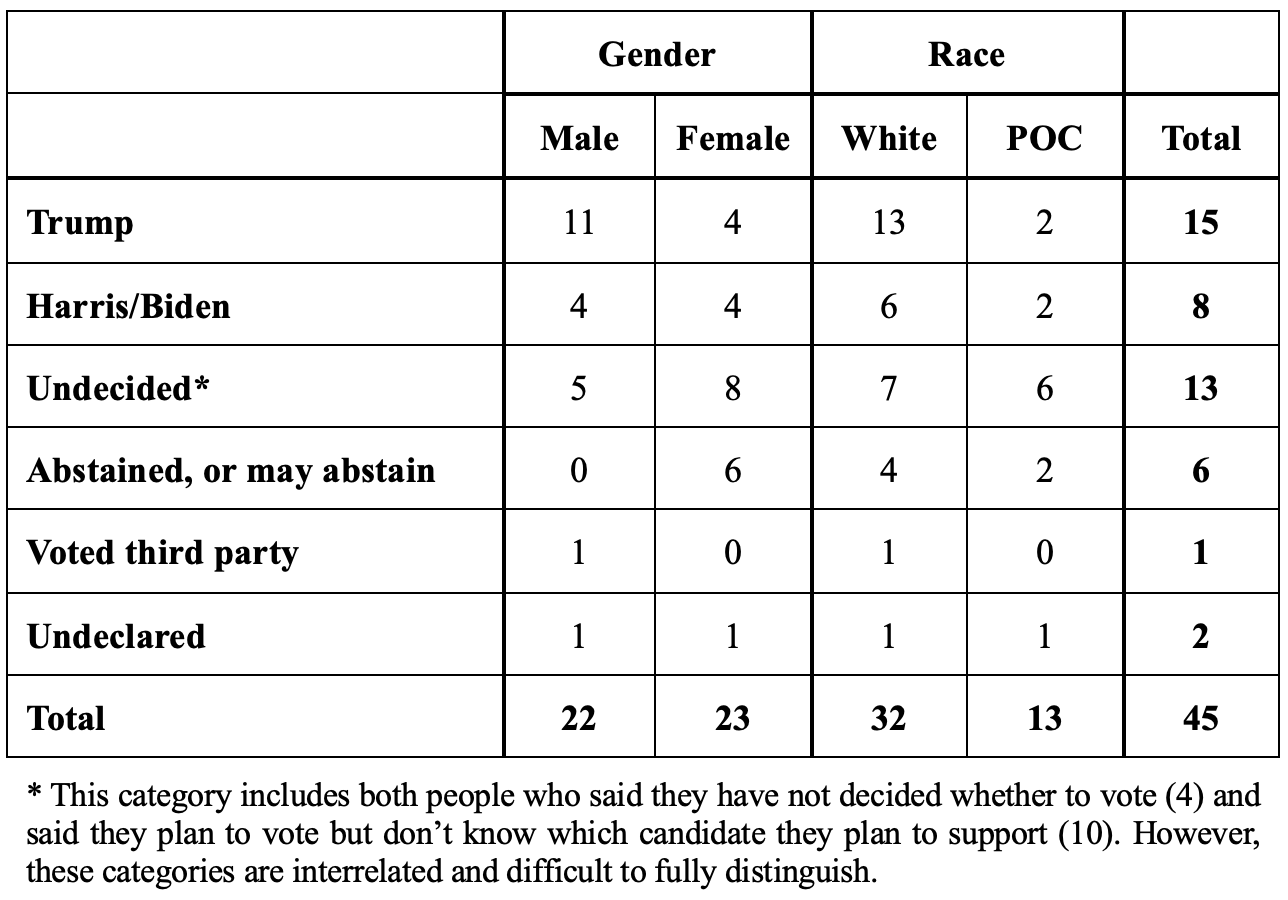
Table 2 captures the interviewees' candidate preferences for the 2024 Presidential election. Those expressing support for Republican presidential candidate Donald Trump constitute the largest group (15), while about half as many expressed support for Democratic presidential candidates Joe Biden or Kamala Harris (8). Thirteen individuals said that they are undecided but planned to vote, and six said that they planned to abstain or had abstained. One respondent shared that they planned to vote for a third-party candidate. Two other respondents would not share for whom they had voted.
Table 1 Level of Education of Respondents by their Types of Occupation
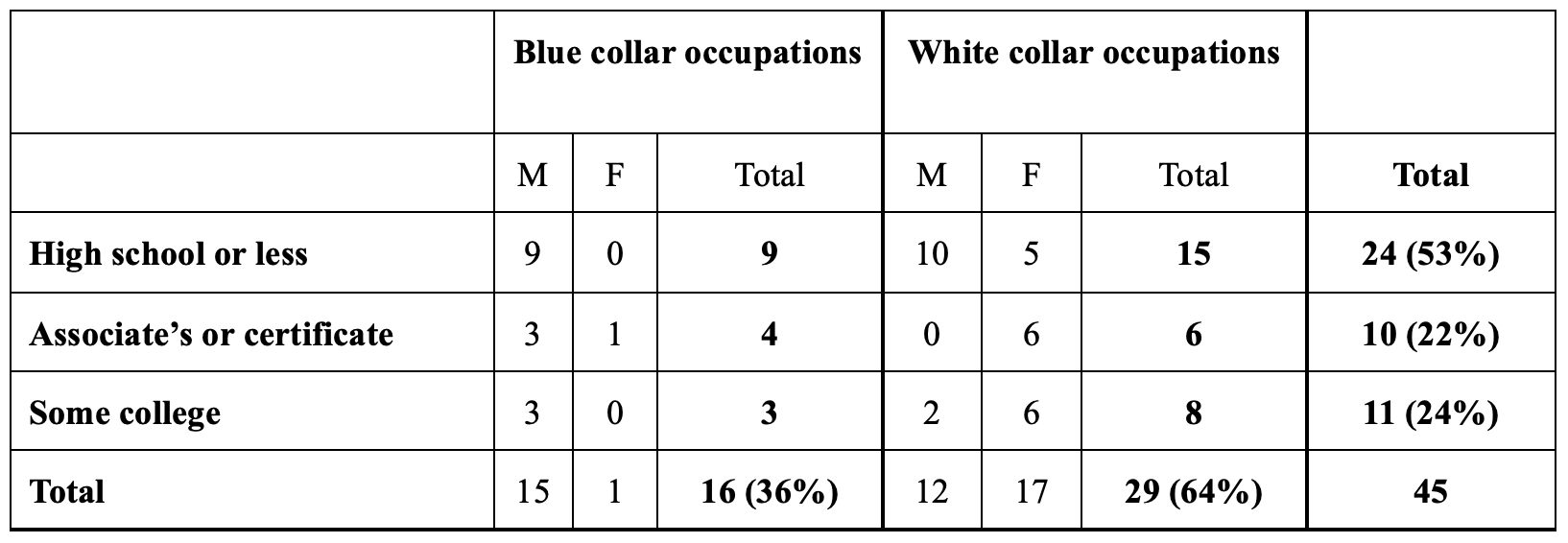
Table 2 Candidate Preference of Participants by Gender and Race in the 2024 Presidential Election
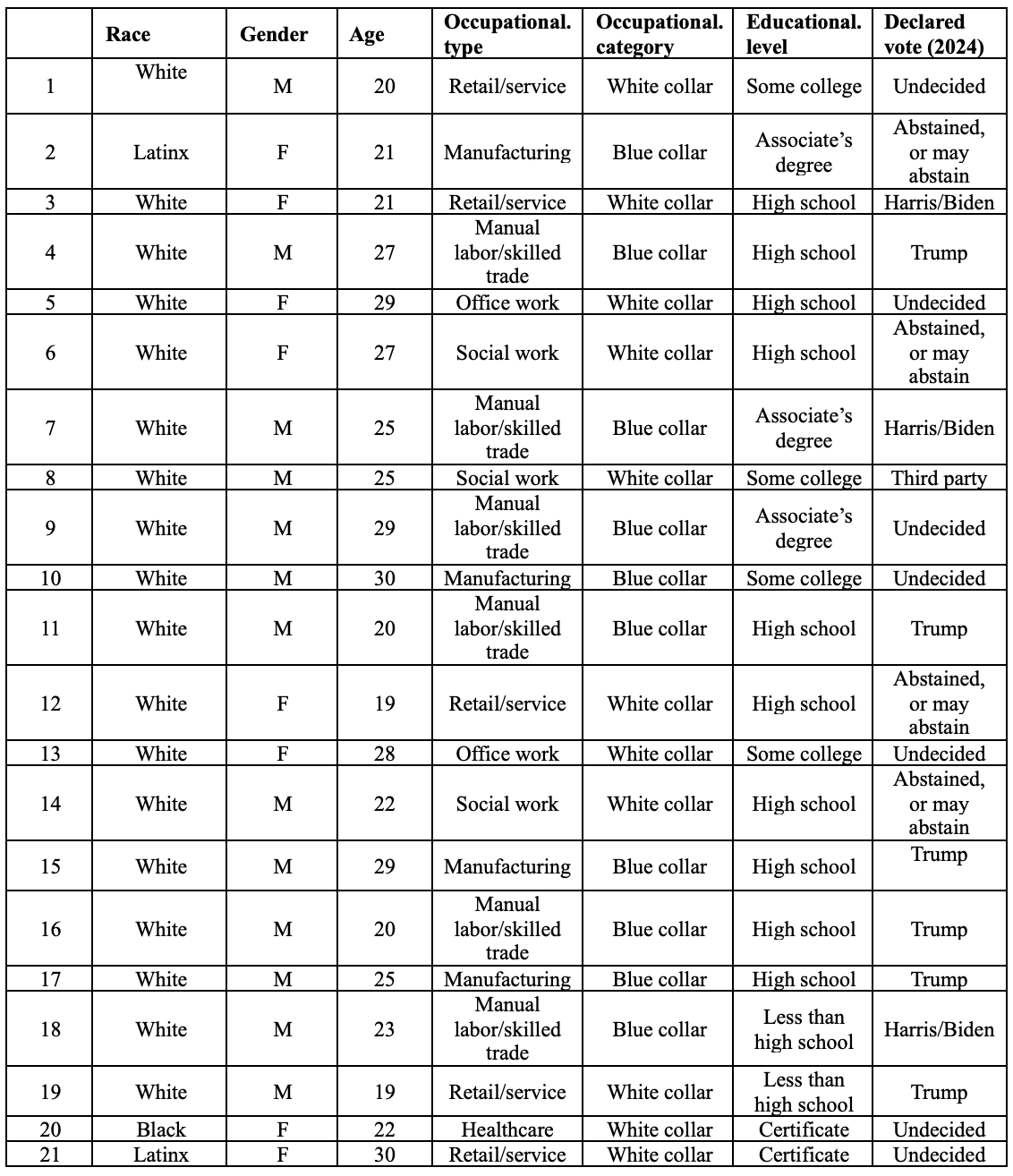
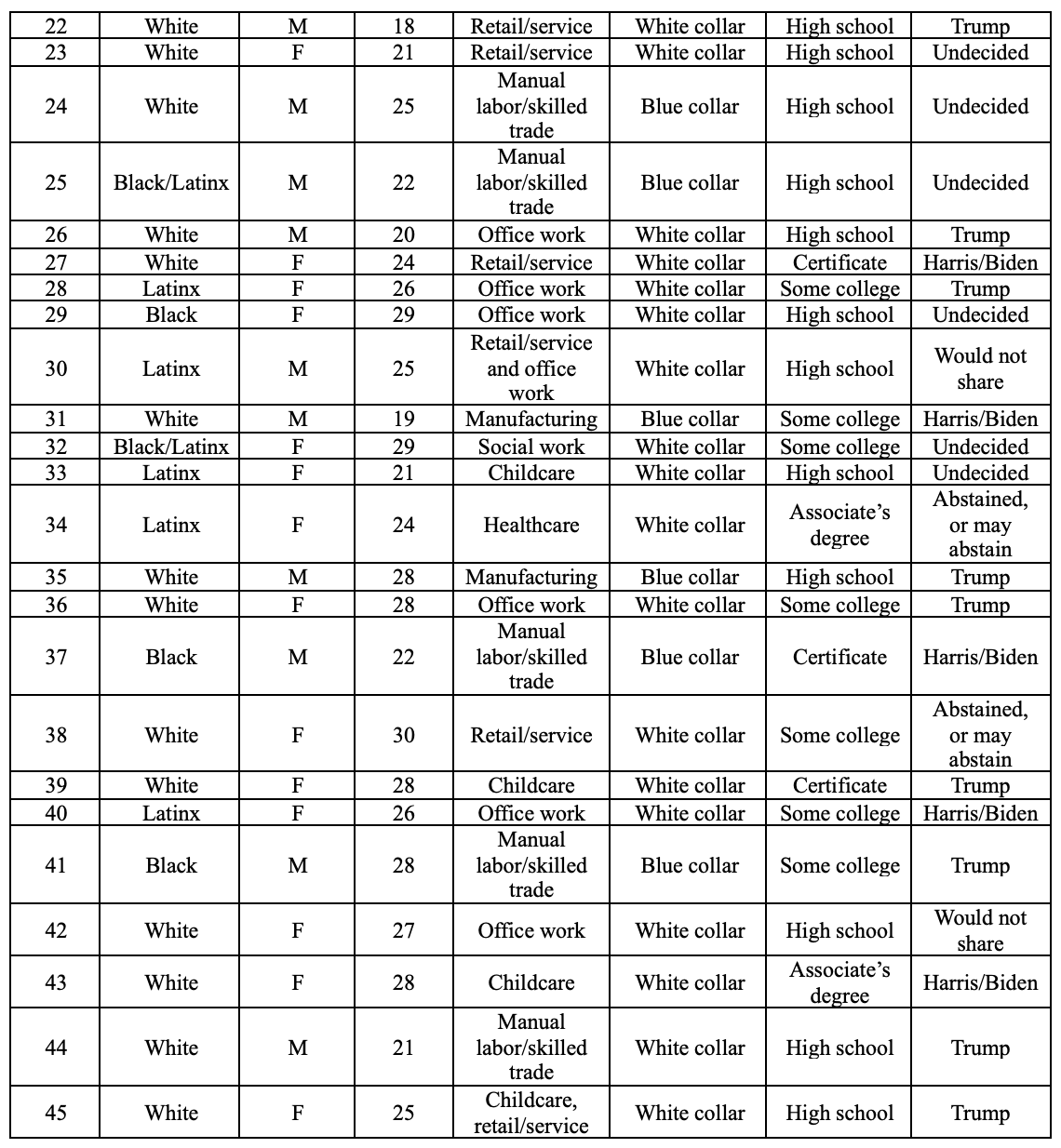
Interviewees were recruited randomly from in and around Manchester, New Hampshire. Details about recruitment, data collection, and interviewing can be found in Appendix 1 (online). To qualify for the study, individuals had to live or work in Greater Manchester;5 be eligible to vote; be between 18 and 30 of age at the time of the interview; have no more than an associate vocational degree; not be currently pursuing a bachelor's degree; and work for at least for 20 hours a week in a blue collar job or a low-status white collar job in retail, services and office work. This includes feminized "pink collar" jobs (especially care work). Thus, participants work in a large variety of job types (across sectors) that include grocery stockers, nursing assistants, construction workers, childcare providers, retail clerks, and quality inspectors. Appendix 2 (online) provides the full list of respondents by occupation, age, race, and other characteristics.
FOUR PATHWAYS TO RECOGNITION
From the interview data, we inductively identified four pathways through which young working-class people relate to politics. These paths are described in Table 3, while Table 4 describes the distribution of respondents across these four paths by gender, race, and voting intentions. We locate respondents within the pathways based on a) their political participation and declared political leanings; b) their expressed "common sense political reasoning," with a focus on universalist "inclusive" perspectives and particularist "exclusive" perspectives – i.e., how workers draw moral boundaries around politics, especially concerning whom they do and do not deem worthy of support (Lamont, 2000). This is informed by "people's sense of who they are, what they value in their lives, and how they believe they should relate to others." (Damhuis & Westheuser, 2024; Zollinger, 2022); c) how participants respond to stigmatization through politics; and d) whether they believe recognition can be affirmed through politics. Respondents often embraced more than one pathway during the interviews. They were coded taking a pathway if they made a statement invoking one of the four specified positions, independently of the frequency or emphasis with which they refer to the latter. This means that respondents can be simultaneously exclusive and inclusive (on different dimensions) and can take more than one pathway, and that pathways are not mutually exclusive. This is discussed in the last empirical section, where we consider how respondents hold both exclusive and inclusive positions concerning material redistribution and symbolic membership.
Table 3 Four Pathways to Recognition
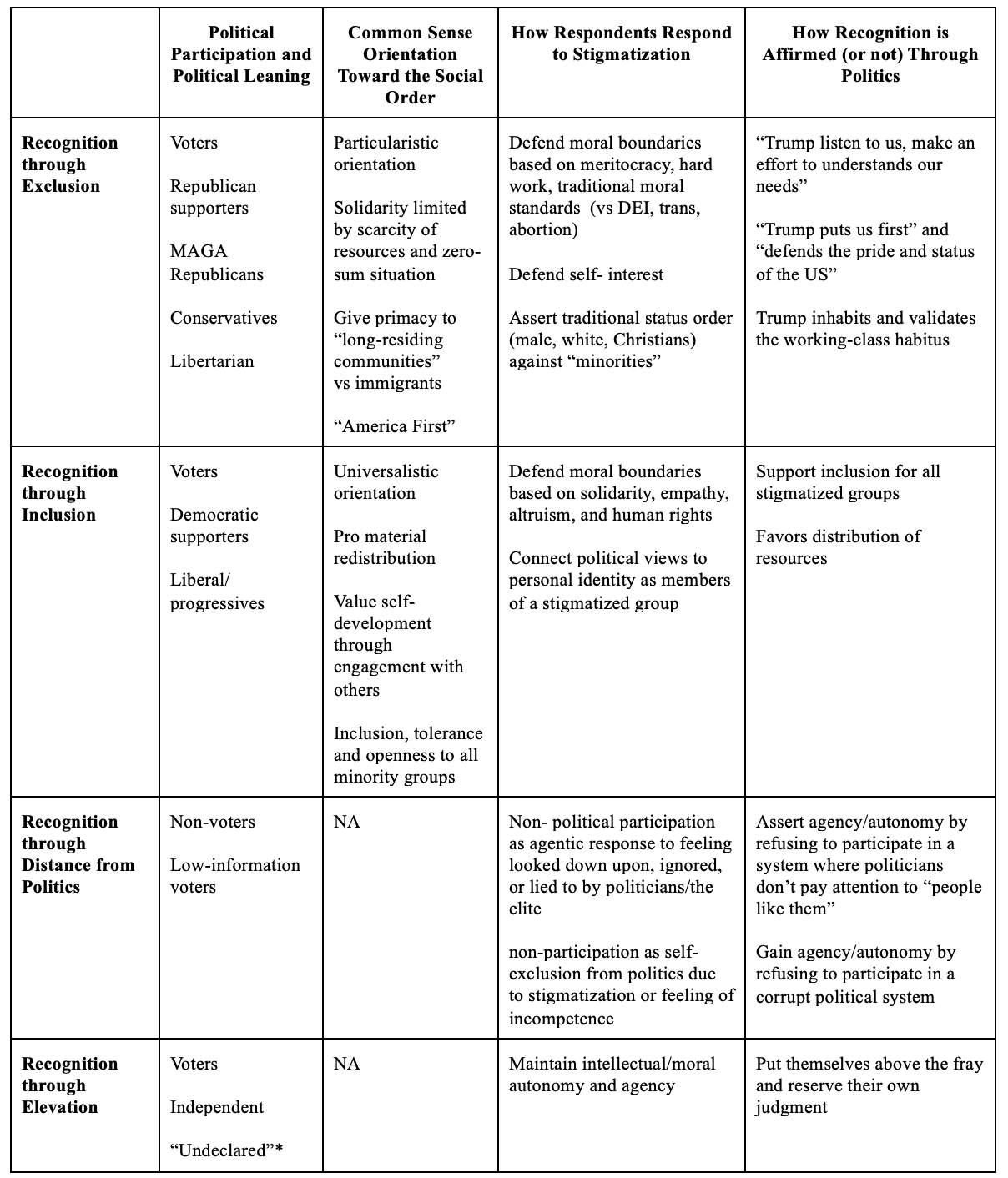
Table 4 Pathways by Race, Gender, and Voting Intentions
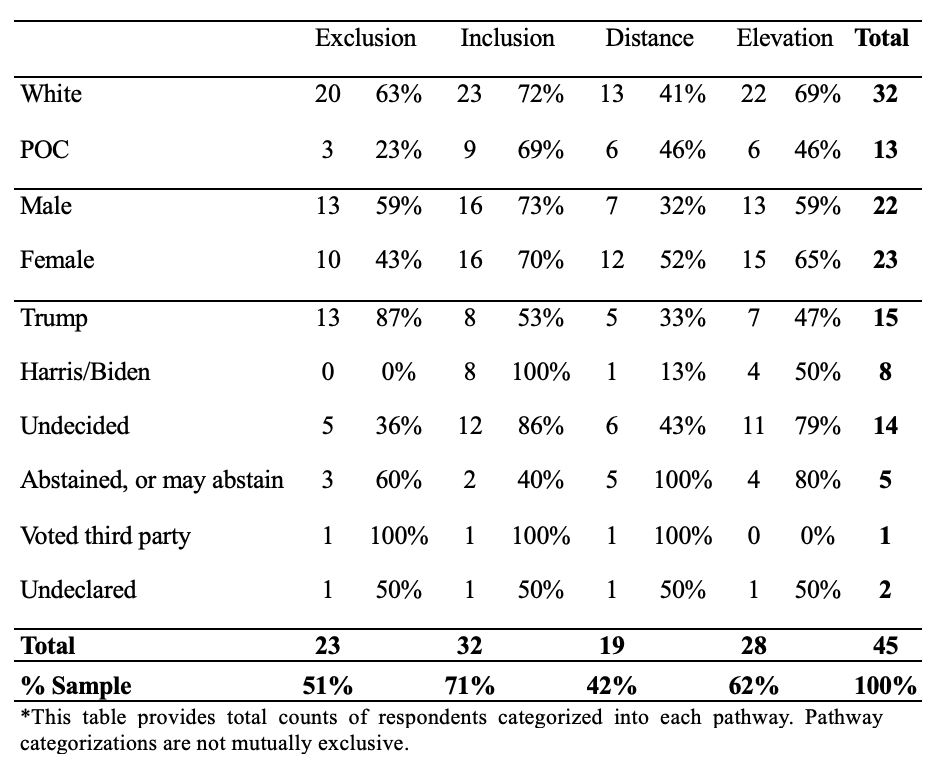
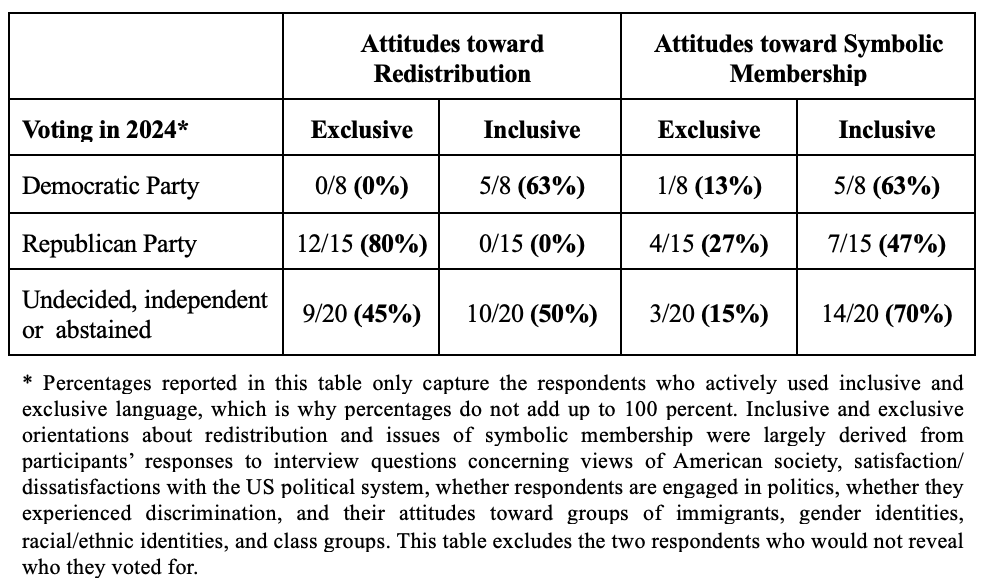
Table 5 Declared Voting Preferences by Inclusive and Exclusive Attitudes about Redistribution and Symbolic Membership
1. Recognition through Exclusion
This first path includes those who adopt a particularistic or exclusive perspective on politics, which often aligns with the vision for the country that then-candidate Donald Trump espouses. As shown in Table 4, those who embrace this path are mostly white men who planned to vote or voted for the Republican Party – of the 15 interviewees who did so, 12 are men, and 13 are white. However, this path also attracts other participants who did not vote for Trump, including non-voters and low-information voters (Table 5). Much of their rationale for voting for Donald Trump has to do with their moral vision for American society.
Many of these participants believe that Republicans are more "honest" than Democrats, who lie about the open southern border, engage in conspiracies and illegal acts, open the door to criminal immigrants, and adopt policies perceived as anti-meritocratic (DEI, in favor of trans rights, etc). By constantly describing Democrats as liars and thieves, Republicans elevate the moral status of their supporters and, as such, provide them moral recognition. This is particularly evident in Republican campaigning. For instance, in a content analysis of Donald Trump's 2016 Presidential electoral speeches (Lamont et al., 2017), we showed that he celebrated the American working-class as made up of good, hard-working people whose interests he would uphold and give voice to. He reassured them that immigration and globalization were to blame for their economic downward mobility and positioned himself as their savior as they were under attack by rapist Mexicans and other outsiders. Our interviews suggest that workers perceived that Trump and the Republican Party offer them a path for recognition, which bolsters their support.
Indeed, workers believe that Trump respects them in a way that Democrats do not, in a context where the non-college educated feel increasingly stigmatized as the college divide is gaining prominence (Williams, 2025). This belief is bolstered by Trump's populism, and particularly his claims that he listens to ordinary people. As a 20-year-old male who works in order fulfillment puts it, Trump "knows the people better. He's making the effort to actually... draw the eyes of the youth and connect with them more." Another respondent, a quality inspector, says that Trump listens to people like him because Trump is able to change his mind about policies that appeal to his base, "like [about] gun laws.... [Trump] was like, 'Okay, the people are telling me this. My base is telling me this, essentially. I'm gonna listen to 'em, 'cause that's what they want.'"
Trump also offers these workers recognition by claiming to defend their country's status, pride, and self-interest, in a context he defines as one where other countries are taking advantage of the United States. This nationalistic strategy appeals to workers who experience loss of status and insecurity. A self-described entrepreneur, who describes himself as such because he makes a living by combining hustles, supports Trump because he believes that Democratic policies made the country "look weak." Mixing his concerns for the decline of the country together with his worries about inflation, this respondent states: "Can you imagine what other countries think of us? ... the fact that I have to pay $200 for fricking eight bags of groceries. [For] gas, the price is ridiculous. I mean, it's unbearable, and it's just so bad. It makes America look horrible." While many respondents believe Trump is defending America's economy, some, like this 20-year-old man working in order fulfillment, also saw Trump as putting "America first" by disentangling the country from foreign affairs and defending peace: "The wars, I know [Trump] has said he's gonna get those to stop before he's even stepped foot in office. He's gonna get those to stop due to his connections."
This exclusive politics – putting "our interests" over those of others – whether those in Ukraine or Gaza, welfare recipients, persecuted refugees, and needy immigrants – appeals to workers who experience insecurity. It is also in line with a particularistic "common sense political reasoning" associated with radical right politics across Europe, which is a "self-ideal based on the valorization of effort ..., a scope of solidarity limited by a sense of scarcity and zero-sum competition, and the normative primacy of the autochthonous community" (Damhuis & Westheuser, 2024).
This same respondent also says he appreciates Trump because he is "necessarily blunt, very, very blunt." In his book Fox Populism, Reece Peck (2019) argues that bluntness is a type of political branding that appeals to an irreverent working-class habitus (or "way of being"), also promoted by the hosts of Fox News and right wing social media influencers in the manosphere (made up of conservative podcasters whose primary audiences are made up of young men). Liberals cannot gain traction by displaying the same kind of "in your face" masculine habitus, which is coded as vulgar, sexist, and ignorant by many liberals and progressives (Peck, 2019). This shared habitus creates a "natural fit" between Trump and his workin-class audience that operates as a form of recognition (or expression of respect) through homophily and bolsters a sense of mutual understanding and shared interests.
In many cases, respondents account for their support for Trump by their disappointment with the Biden administration, particularly when it comes to "the price of things" or war abroad. They also have expectations that Kamala Harris would be more restrictive on gun laws or other policy issues that are important to them. Opposing the pro-distribution policies associated with Democrats, a 25-year-old white man who works as an automobile parts manager says about Harris' policies:
She believes in regulations, like, crazy regulating everything. She said she wants to give $25,000 to new home buyers, [but] that's only gonna raise costs by $25,000. I would love to think that things are free. They're not, all right, they're always being shared... A lot of her policies believe in "me giving you my money." I don't think that's right. You should be able to work on your own things.
Among those who embrace this path, many focus mostly on redistribution concerns, such as tax increases and inflation, as well as investment in foreign wars, at the same time as they are critical of other GOP policies –opposing gun control, for instance. Three respondents self-define as protectors of Christian values, and three other respondents say that they simply don't like "wokeness," a progressive agenda they feel is being pushed on them. Perhaps because our study participants are below thirty, none of them explicitly make claims about putting males and whites above females and non-whites (as do patriarchal conservative nationalists such as J.D. Vance). This makes them similar to many college-educated members of Gen Z (Lamont, 2023). However, recent experimental work shows that white Republicans in particular perceive white Americans to be much more "American" than other groups, including African, Latinx, and Asian Americans, as compared to white Democrats (Asbury-Kimmel, 2025).
In a context characterized by the acute scarcity and insecurity experienced by workers, and the disappearance of working-class institutions promoting workers solidarity (unions and others), it is not surprising that those on the lower rung of the particularly steep American ladder of inequality to respond to stigmatization by adopting exclusive attitude, e.g. by drawing moral boundaries on the basis of meritocracy and hard work, as opposed to altruism and overture toward outsiders. Thus, workers engage resolutely in the defense of self-interest, asserting a strong pecking order that puts their group at the top – hard-working people who are portrayed as the most meritorious, particularly compared to immigrants and welfare recipients, who are perceived as sponges who only take from the system and fail to carry their weight (Lamont, 2000, Chapter 2).
2. Recognition through Inclusion
This second path, recognition through inclusion, is embraced by those who hold a more universalistic worldview. As shown in Tables 2 and 3, it is attractive to the small group of respondents who voted in support of the Democratic Party in the 2024 election (8 individuals, with four men and four women). But beyond this group, it is also attractive to many others who are undecided voters, non-voters, and low-information voters (see Table 5). This path also attracts significantly more women and people of color than Recognition through Exclusion.
These individuals embrace a universalist common sense orientation, justifying a more equal distribution of resources for all. A 28-year-old childcare worker illustrates this position when she states that she plans to vote for Kamala because of her policies toward "housing costs and food costs." Distribution is a traditional terrain of working-class politics and of the Democratic Party, whose historical platform is to support redistribution from the rich to those below on the socioeconomic ladder. This issue continues to be important to American workers today (Abbott et al., 2025).
This type of political commonsense also expresses itself through a concern for fostering social belonging and inclusion for all stigmatized and marginalized groups, that is, for closing the recognition gap experienced by women, people of color, immigrants, the homeless, LGBTQ+ communities, and others. This is consistent with the "caring self" embraced by African-American workers (Lamont, 2000) and with an ideal of "self-development through the engagement with otherness, an understanding of solidarity as altruism, and an attempt to both highlight the multiplicity of cultural horizons and abstain from evaluation" (Damhuis & Westheuser, 2024). Individuals embracing these paths put weight on altruism and solidarity, as well as on human rights. This last point is exemplified by a 23-year-old male electrical apprentice who voices concerns for women's rights:
"I am a big advocate for pro-choice. I believe that every woman should have the right to choose within reason. [...] I'm a big advocate for People's rights. I guess at the end of the day... I just feel that everyone deserves to be treated fairly."
Half of our participants who voted or planned to vote for Joe Biden or Kamala Harris link their political preferences to their personal identity as a person of color, immigrant, women (who favor pro-choice), or LGBTQ+ individuals, while none of the Trump supporters did. For instance, a Black construction worker explains his support for Kamala Harris as follows:
Number one, she's a black woman. [She is] the most person I feel like would be able to understand.... the hardships of this country. A Black woman is the best option for that. That's why I voted for her because I feel like a lot of Black women don't really get the recognition that they deserve, you know, in America.
Similarly, a Latinx woman working in business states that she voted for Kamala because:
Being an immigrant, I definitely support immigration rights.... I like how things are trying to be more progressive for the LGBT .... And then another one is gun rights, because everybody and their mother does not need to own a gun.
These participants extend their own experience of stigmatization to that of other groups who have experienced the same, and define themselves as allies to LGBTQ+ groups and others. Illustrating this, a 25-year-old janitor, who is a transgender man, said that he tries to be involved in politics because:
[I don't] want them banning gay and trans shit... It's one of those things where... if things got as bad here as it is in Florida, I don't even know what to do, I guess. I'm already gay, married; I've already been on hormones for six years... I would be remiss if, looking back, things got that bad and I just didn't do the bare minimum I could do to try to not have that situation happen.
These respondents have in common that they fear Trump's policies toward their and other vulnerable groups. They are promoting a politics of inclusion that is often justified by common sense universalism, one that aims to extend rights to everyone, and especially to members of groups that have been historically stigmatized. This is in line with the past history of the Democratic Party as a rainbow coalition that operates as a large umbrella for all historically disadvantaged groups, which is now threatened by a GOP that also claims to be multicultural (Ruffini, 2023).
Among those who support the Democratic Party, many participants are critical of the latter for not dealing effectively with inflation, the housing crisis, the opioid epidemics, and other social problems workers face post-pandemic. They are disappointed voters who are hoping that the Democrats would offer a more fully articulated alternative to the MAGA program. This leads a number of them to abstain and/or define themselves as distant from or "above" party politics.
3. Recognition through Distance from Politics
Six of our respondents were non-voters or did not plan to vote in the 2024 Presidential election. Thirteen can also be described as "low-information" respondents, having little-to-no engagement with gathering information about politics (Koch et al., 2023). The reasons these individuals offered for not voting and/or not following politics often pertain to recognition, which is why we look closely at this group.
These participants often explain staying away from politics because politicians don't pay attention to "people like us" –as one of them puts it, "maybe Obama did...but not many politicians do." Along these lines, a behavioral therapist explains that politicians do not care about ordinary people, because "I don't think [politics] directly affects them." She wishes politicians would have a better understanding of having to live the everyday lifestyle... of what [we] are going through rather than like possibilities or made up scenarios. . . The majority of anyone in power... a lot of them are of older age groups and have followed in the footsteps of, you know, their elders," which makes it hard for them to understand the realities experienced by young people. Similarly, a 19-year-old fast food worker argues that politicians focus on minority groups but ignore the struggles of "average ordinary people," perhaps referring to the white majority of workers. She goes on: "I don't think they care about ordinary people at all.... [the] average ordinary person does not really matter. They wanna appeal to maybe . . .if you're a person of color or like if you're whatever else, [they] pinpointing like one factor that you identify with [but] like how we have to work every day to survive and stuff, no one talks about that." For their part, a group home manager and a financial administrative assistant say that they are disillusioned by the existing political structure, because "politics is not working for working people. In fact, when we asked participants whether they agreed that "politicians don't pay enough attention to people like them," only two did not, and five were not sure, while 26 out of 45 responded affirmatively, with 79 percent of those elaborating on this theme, thus indicating their engagement with this issue.
There is a large literature on "low-information voters" who also maintain distance from politics.6 13 of our 45 interviewees can be characterized as "low-information:" it is the case for 11 out of 22 who declared voting intentions, of whom 6 supported Trump and only 1 supported Harris (the other 4 were undecided), and 2 out of 10 interviewees who did not plan to vote. This is based on the standard definition of this group found in the literature: (1) they have little information about issues or the candidates they vote for; (2) they justify their choice using heuristics unrelated to politics; and (3) cannot articulate policies the candidate is for/against (Bartels, 1996; Schaffner & Streb, 2002; Tóka, 2010; Strayhorn, 2025).
Many participants who fit these criteria also reported that they do not "read the news," by which they refer mostly to news in traditional media outlets like newspapers, magazines, and television programs, differentiating these outlets from "everyday talk" on politics on social media outlets. Some of those who consume social media may not consider these alternative sources as news. As one respondent puts it, "I don't read the news... I just look at Facebook." 7
In addition, a large group says that they avoid politics because they want to stay away from additional stress, negative emotions, and conflict (15), or because politics is "broken." (quality inspector female 21; female behavioral therapist 27). These responses reflect the overwhelming negative emotions workers tend to associate with politics, but they are also connected to their search for recognition as they speak to workers' desire to be valued or heard by politicians or co-citizens.
To explore reactions to politics in depth, we asked participants about the words they associate with politics. The vast majority of participants provided words that were emotionally charged and general evaluative terms that were negative, often having to do with polarization or corruption.8 As shown in Figure 1, answers to this question include only five positive terms ("freedom," "liberty," "patriotism," "equality," and "funny," each mentioned only once. In contrast, the long list of negative words include "pissing context," "ratchet", "old assholes", "stress (x3)," as well as ten words related to polarization (e.g. "power struggle," and "two-sided,") and sixteen words referring to corruption ("lies" (x2), "deceit" (x2), "corrupt" (x2), etc.).
Figure 1 "What Words do you Associate with Politics?": General and Specific Evaluation Terms
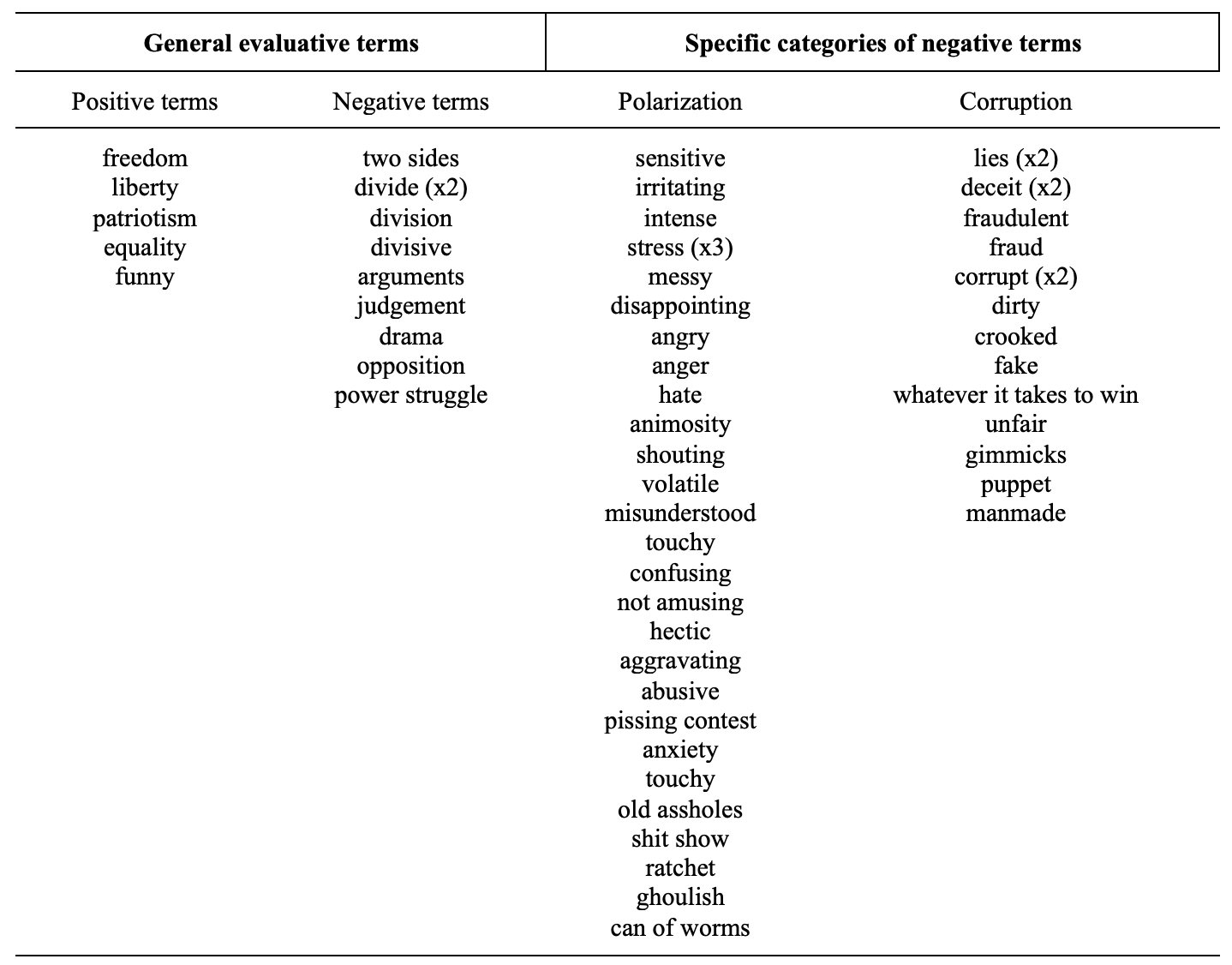
This is in line with previous research showing that workers perceive politics through a corruption frame (e.g., Hillhorst, 2024). At the same time, in line with research on right- and left-wing populism (Gidron et al., 2019), these workers express their desire to draw distance against the educated upper-middle class, whom they perceive as benefiting from and leading politics (the elite, the rich, the educated upper-middle class). In so doing, they often draw implicitly or explicitly strong moral boundaries toward the "people above" (Lamont, 2000). In this context, staying away from politics allows them to assert their autonomy in relation to the "powers that be." A 21-year-old electronics quality inspector illustrates this agentic stance as she expresses her lack of confidence and skepticism toward a political system she perceives to be "a gimmick." She wants to stay away from it and does not vote. She explains:
I don't really know much about politics because I don't really believe in the system. So I don't consider myself Democratic or Republican. I don't really abide by it... I just don't really resonate with it. I don't follow it. I don't vote.... And I just feel like the people don't really have a voice. I think it's all just gimmicks and sort of a puppet [show], like between presidents and stuff, because the system is already just so far out where even their own people don't really see it. ... So I don't really choose to believe in anything like that.
This desire to stay away from politics was strong in the particularly acrimonious context of the 2024 Presidential race, in which political polarization created conflicts between co-workers and within families. Indeed, several interviewees volunteered that they are careful to never bring up politics at work or in family gatherings, concerned as they are to avoid "drama." For instance, one electrical apprentice, a 23-year-old white male, explained, "An actual insult on my job site is 'Kamala voter.' I swear it is brutal. I'm just like, 'Oh yeah, sorry! I care about human rights.'"
One popular explanation for why individuals without a college degree stay away from politics is framing their behavior in terms of a deficit, that is, because such individuals feel disempowered or do not have a sense of political efficacy (Rico et al., 2020). Among our participants, only three explained their non-voting by reference to such dispositions. While feeling underqualified or underinformed is also another popular explanation, only two respondents' responses expressed these views. Four respondents also mentioned indifference toward politics.
Although recent authors point to moral boundary work in the political views of workers (Hillhorst, 2024; Zollinger, 2022), this perspective is typically overlooked in Bourdieusian approaches to the politics of workers, which emphasize self-exclusion due to feelings of incompetence (Gaxie, 1978; Déloye & Haegel, 2019; Hamidi, 2022).9 Only one participant, a 27-year-old behavior therapist, fits this Bourdieusian take on working-class voters. She explains that those who vote should be well-informed and that she does not vote because she feels she does not know enough. Moreover, she believes that voting is "too easily accessible" since there are people who vote who are ignorant:
I personally am not going to vote, and I have never voted. [...] Like me, personally, I don't know, really, anything. I don't take the time to do the research. I don't know what's true, what's not true, to make an educated and proper decision. I feel like a lot of people should be a lot more educated than they are going into [voting].
Such a response can be explained not only by a relatively low level of formal education, which may make respondents second-guess their qualification to vote, but also because of the constraints of their lives, in a context where a significant number of participants have to hold two jobs in order to cover their bills. Finally, it is remarkable that only one respondent describes voting as an act of responsibility central to full-fledged citizenship invested in collective life. The overwhelming negativity or indifference toward politics confirms that they do not primarily experience their political involvement as a deficit.
4. Recognition through Elevation
In the fourth path for recognition, respondentsadopt the stance of an "independent" voter – experienced as a state of mind or as an optional self-categorization that is part of the formal electoral registration process in New Hampshire, where voters have the option to identify themselves on voters' lists as Democrat, Republican, or "undeclared." In self-defining as undeclared (which is often interpreted as "independent"), some respondents may elevate themselves above the craziness of the American two-party system, and claim their autonomy from ideologies and clans– whether they lean left or right. This may confer recognition on them, as individuals express their desire to rely on their own judgment and wisdom in defining their political position instead of turning to flailing political parties, faulty candidates, and increasingly toxic politics. For example, a 21-year-old event planner said: "I feel like I have more of an independent-thinking sort of thing. [...] I know it's a very important time, but I've just been so far removed [from politics] for my own sanity."
Those taking this path may very well share the view that the political system is corrupt, toxic, and difficult to make sense of. Indeed, as was the case for those who maintain distance from politics, some say that they stay away from politics because they feel that politics has not worked for working people (e.g., a 30-year-old, female fast food worker), or that the system is broken (e.g. a 25-year-old, male youth support specialist). In particular, a 20-year-old self-described entrepreneur discussed his negative experiences of political polarization in everyday political discourse, and how these experiences have informed his decision to go independent:
I don't like to talk about my views a lot because sometimes... I actually do get angry and pissed off because there are certain things with that stuff where some people are so far gone, at that point they... don't even let you get a word off. [...] I've not really met one person that's voting for Kamala that, if I bring up a point, where, you know, Trump might be right, they don't get mad. [Even if] I literally sat there and was like, 'no, I agree with her point on this. And I agree with her views on this.' There are some things I do agree with... I'm an independent, I'm moderate, I'm not right.
For such individuals, the response is not to exit the political system entirely, but to make up their own mind about the best course of action. Beyond concerns with "drama" and political toxicity, some of the reasons interviewees who define themselves as independents evoke to explain their position is their discontent with the two party system (service manager male 20; quality system inspector male 30) and with all presidential candidates (nursing assistant female 22) – the lack of authenticity and experience for Harris, old age and incompetence for Biden, and dishonesty and narcissism for Trump. For example, a 22-year-old nursing assistant reported ambivalence about both candidates, particularly on the issue of healthcare:
I identified more as a Democrat before. I voted for Biden. And now I'm more independent because I can see from a healthcare point of view where Biden has some issues. But now, seeing that our next candidates are going to be Kamala and Trump, I'm like, "Geez." So, as a Democrat, you want me to just vote for Kamala without being sure? And with Trump, if I choose to be a Republican, then I'm voting for Trump...
Several others say that their own views are "in the middle," or a combination of typically Democratic and Republican views (e.g., a 28-year-old grant processing office worker, a 21-year-old event planner, a 25-year-old electrical apprentice, and a 25-year-old construction worker). For example, a 23-year-old electrical apprentice said, "I don't want to conform myself to a label, because I do believe that people should be allowed to have guns, but I believe they should be insured... And I also believe in legal marijuana. I don't want to conform myself to a [single] party." While their experience is similar to those who maintain distance from politics, their response is distinct: they engage by maintaining their political independence.
This position of "independent" could very well be particularly popular in the state of New Hampshire, which famously adopted "Live Free or Die" as a motto and has attracted a sizable group of libertarians to join the "Free State Project," whose goal is to create a libertarian society in the small town of Grafton (an hour north of Manchester). This position may be attractive in a context of growing affective polarization on politics (Gidron et al., 2020). It is a position that may grow in popularity as the institutions that socialized workers into politics have been weakened in recent decades to the point where many cannot tell anymore what is "left" and 'right" and where the radical right often frames its politics as centrist, as is happening in Europe (Zajak et al., 2025). It is remarkable that many of our respondents did not know what a union is when we asked them if they belonged to one.
It is difficult to estimate how many of our respondents adopt the path of gaining recognition through elevation. Eleven of our respondents explicitly said that they currently see themselves as independent, including one who revealed that he is formally registered as "independent" (meaning "undeclared"). Thirteen described themselves as "undecided" when queried about their 2024 voting intentions, mostly citing distrust or lack of faith in both Harris and Biden. For example, a quality inspector said, "I'm not a Trumper, but I have, honestly, no love for Kamala Harris. [...] What I look for is honest conversation and policy... I hate it when Trump goes on his little rants... and I think the same thing with Kamala Harris. Honestly, I haven't seen any policy from her that she hasn't changed in and out recently. So, it's hard for me to trust and make a judgment call." Members of this group are likely to be registered on the electoral list as "undeclared." For this reason, it is not always possible to identify specifically the motivation of those who take this path, what they aim to achieve by remaining independent, and why this position is meaningful to them.
DECLARED VOTING PREFERENCES AND ATTITUDES TOWARD EXCLUSION AND INCLUSION
To add nuance to our analysis, we compared the distribution of exclusive (particularistic) and inclusive (universalist) common-sense orientations among our respondents based on their declared voting intention in the 2024 elections (as Democrats, Republicans, and those who self-described as undecided, independents, or who said they abstained). More specifically, we consider both their views about the redistribution of resources and about symbolic membership, while acknowledging that supporting the former often entails supporting the latter.10 We find that the perspectives of Democrats and Republicans are less polarized than the standard literature suggests, which is in line with recent analysis of the emotional polarization in the American political landscape (Richardson, 2025; Gidron et al., 2020): surprisingly fewer self-identified Republican interviewees than expected upheld openly exclusionary attitudes when it comes to the symbolic membership of immigrants, LBGTQ+, and ethnoracial minorities.
Participants were coded as in favor of exclusion (particularism) when they supported limiting the distribution of resources to "people like us," as opposed to fostering solidarity with/inclusion of outgroups. These individuals regard differences in race/ethnicity, gender, sexuality, etc., as something to overcome or erase, rather than to embrace. Participants were also coded as favoring exclusion in symbolic membership if they promoted giving full cultural citizenship to a small circle of people who share their own characteristics, as citizens, nationality, long-time residents of the United States, members of their own ethno-racial or sexual identity group (e.g., cisgender people), etc. They favor drawing boundaries based on birth and other ascribed characteristics (phenotypes) rather than on criteria available to all.
Respondents were coded as in favor of inclusion (universalism) in the redistribution of resources if they voiced positive opinions concerning the desirability of redistributing resources to outgroup members/minoritized groups, including lower income groups; facilitating greater access to jobs/healthcare; broadening access to legal citizenship; and broadening other rights such as voting rights. Examples include expressing support for affirmative action policies; facilitating access to social safety net to more people; the right to abortion, and other inclusive policies. These orientations aim to make resources (jobs, housing, and others) available to everyone, regardless of race/ethnicity, gender, sexuality, income/class, etc. Participants were also coded as in favor of inclusion when they expressed their support for symbolic recognition of different racial/ethnic, gender, sexual, immigrant, identities -- i.e., whether people of different identities can be recognized as "proper Americans," or as "good people" more broadly. These individuals downplay moral/cultural boundaries in describing what groups share in common.
Table 6 Declared Voting Preferences by Inclusive and Exclusive Attitudes about Redistribution and Symbolic Membership*
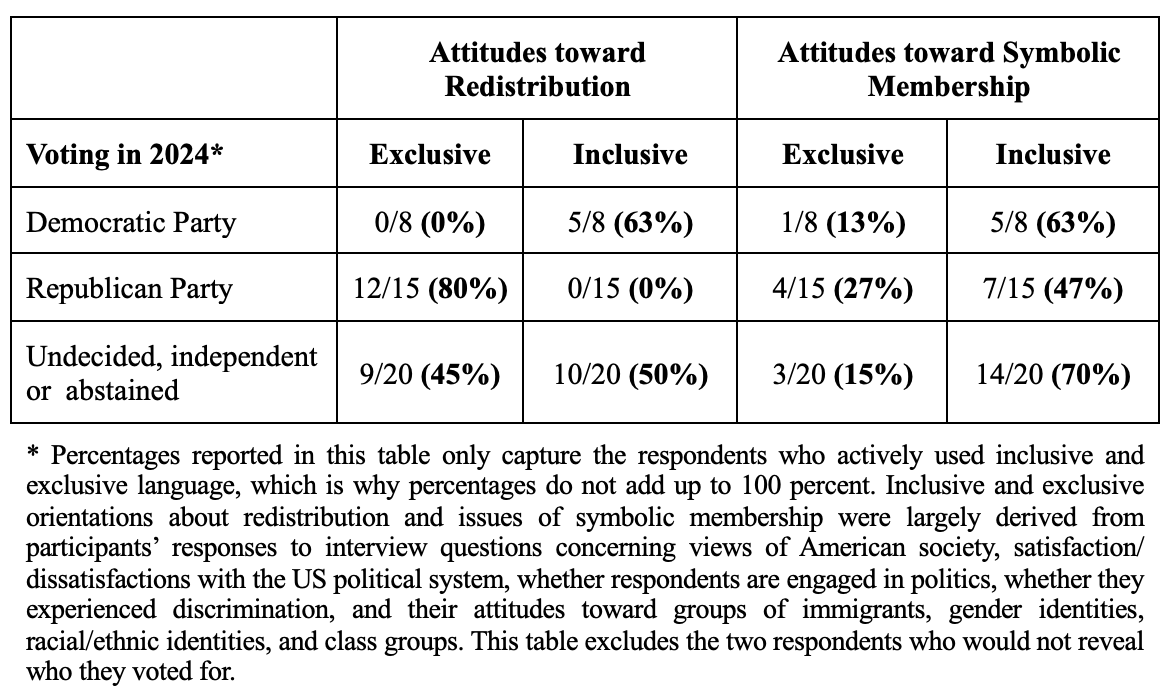
As shown in Table 5, many Republican respondents (12 out of 15 or 80 percent) expressed exclusive attitudes about redistribution, and most of their concerns were about access to jobs and government benefits. For example, when asked if it is the government's role to support the homeless, a 28-year-old general manager said, "I don't think that's the actual government's job, no." Also condemning welfare dependency, a 28-year-old childcare worker, said:
I've noticed, growing up, the people I've been surrounded by, they live in a victim mentality a lot of the time, unfortunately. They live off the state and the government, which is fine, everyone deserves a helping hand when needed, but a lot of people from high school, especially, a lot of girls I know now living off the state and not really trying to change... I would say I'm different in the sense where I just want to work and become the best I can and break generational curses and just be different, you know, because I feel like a lot of people unfortunately just fall back on the state... and I don't want to be in the same category with that.
By explicitly rejecting the government providing material resources to people of color, immigrants, and "lazy welfare recipients," these respondents place themselves "above" in the moral pecking order and claim recognition for themselves from doing so.
Expressions of exclusive orientations around symbolic membership are less frequent than those about redistribution among Republicans. An example is provided by a 25-year-old parts manager:
Immigration is a real problem... I have met people that come from other countries who I absolutely love... They wake up every day with a good attitude, they go to work, and they share the American people's morals and values. A lot of people do not share those same values. That is extremely dangerous when you have to live, work right next to these people... That can be extremely dangerous, especially when you come from countries that don't believe in the same kind of laws and disciplines that we do here. So that's another thing I really struggle with, in Manchester.
A similar rejection of diversity is expressed concerning gender-identity and sexuality by a 19-year-old grocery stocker, who declares: "I was raised, how I was brought up [with this principle]: Boy and girl. It's not, like, anything about saying you want to be, whatever, but it's obviously not real. It's mental illness, obviously."
Overall, we found that among the fifteen respondents who declared voting for Trump, only four expressed explicitly exclusive attitudes about minoritized peoples, such as people of color, LGBTQ+ people, and immigrants, on the sheer basis of membership in these groups. The number of Republican interviewees who uphold openly exclusive views may be limited due to the overall influence of pro-diversity discourse at a time when many of them were coming of age. Gen Z has been shown to be considerably more pro-diversity as compared to previous generations (Lamont, 2023).
Among Democratic voters, more than half expressed inclusive attitudes, with 63 percent of respondents supporting such views concerning both the redistribution of resources and symbolic membership. This is expressed by a 25-year-old janitor who describes an ideal society as one where sharing resources is a priority when he says that he envisions:
a cornucopia full of food and fruit and water and shelter.... To me, society is, it's the supporting and providing of each other. The earliest caveman instances of society... they cared for each other enough to actually take care of someone who didn't necessarily, you know, contribute to hunting or gathering. They still cared for them enough to give them care and have them live.
He compared this to his experience of contemporary American society: "You can have homeless people minding their business and someone will pick fights with them because, 'Oh, your shit's on the sidewalk.' ... There's an encouraged cruelty, and it's so casual a lot of the time."
A 23-year-old electrical apprentice shares this view when he explains, "I'm a big advocate for people's rights, at the end of the day. I care for people. I care about people, and I just feel that everyone deserves to be treated fairly... Everyone deserves their shot." Similarly, a 22-year old construction flagger said that he is "disappointed by the lack of community" he perceives in US politics: "I see it every day. It's like, we live in a world where it's just a lot of individualism. . . . We could do so much more if we work together and help each other, you know?" For her part, a business development associate compared her view of life in the US to her experience elsewhere:
Seeing the kind of divide here is saddening. [...] When I was in Aruba, there's people from all different walks of life. They speak three different languages there. It's very, everybody helps everybody, we all work together. If I'm working to have a good life, I make sure that, you know, my neighbors have a good life, too. I'm gonna help my neighbors by watching their kid... it's more communal.
Finally, when it comes to redistribution, the 20 respondents who self-described as undecided or independent, or who said they abstained, were almost evenly split between inclusive and exclusive attitude – with some expressing neither. For instance, a 28-year-old woman who works in grants processing expressed concerns about access to jobs: "Especially for someone like myself, I have a job. But if I were to need a job, I don't want to lose that job to someone that isn't even a citizen, if that makes sense. Like, I'm the American, I want an American job." Similarly, a 21-year-old childcare worker expressed negative views of the "undeserving poor" when she said, "[Politicians] don't help people that are working on becoming better... They kind of help the people that are, you know... like no job, no home, things like that. ... they help the people that don't wanna be helped. They help the people that want free things."
However, a few interviewees expressed more inclusive views about redistribution, as is the case for a 22-year-old construction worker, who expressed sympathy for the homeless population in Manchester and support for the expansion of shelters and other resources to alleviate their situation. He states: "I feel bad for a lot of the homeless people; it's a real big problem out here. [...] I've seen a lot of shelters around here that are taking people, but I feel like there's always room to do a little bit more."
Within this third group, 14 out of 20 respondents expressed inclusive attitudes about symbolic membership. For example, when probed about his image of society, a 20-year-old service manager explained that "society is about cooperation and harmony with each other... People are different, but by and large, we should set our differences aside.... just embrace our differences and get along regardless and realize that we're all human." In contrast, only three interviewees expressed exclusive attitudes relative to symbolic membership. A 25-year-old electrical apprentice expressed skepticism about the effects of structural racism on people of color: "You have African Americans that have grown up in poverty... [and] have become judges, doctors. So, yeah, your living situation and where you're from does affect you, but you can't really let it define you. [...] I've always just lived my life; I don't focus on that I'm a male or that I'm a white male."
Therefore, in this third category of respondents, three times as many respondents support inclusive redistribution of resources as compared to inclusive symbolic membership. The heightened concern over issues of redistribution may be driven by shared perceptions of resource scarcity as well as perceived threats to self-interests in a zero-sum landscape.
DISCUSSION AND CONCLUSION
This paper examined the connection between the search for recognition and the political preferences and identifications of non–college educated young workers in Manchester, New Hampshire. We documented four pathways these young workers take to gain recognition through politics, and suggest that different groups of workers take each of these paths. The first group, mostly but not totally composed of Republican Party supporters, gains recognition through exclusion by drawing moral boundaries organized around the affirmation of meritocracy, hard work, and pecking orders based on traditional notions of sexuality, ethnoracial identity, and nativism. A second, smaller group, which tends to support Democratic candidates, gains recognition by promoting a more inclusive polity. This is the traditional repertoire of working-class politics, which emphasizes working-class solidarity and involvement in left-wing parties associated with unions. The third group maintains distance from politics, which allows these workers to maintain a modicum of autonomy from the toxicity of a political world that ignores their needs. In the fourth group, which is mostly self-identified independents, workers place themselves above or beyond politicians and aim to define their own perspectives outside the many sources of influence that surround them. These last two groups have a negative view of contemporary American politics, often drawing strong moral boundaries toward the elite and toward politicians; those who benefit from politics, and whom they describe as corrupt and self-serving.
After describing the commonsense political orientation associated with these paths, we explored in more detail the distribution of exclusionary and inclusionary attitudes toward redistribution and symbolic membership for those who support the Republican and Democratic parties and for those who self-defined as undecided or independent, or who reported that they abstained from voting. Here, we find that exclusionary and inclusionary views are present across all groups, but to varying extents. This suggests that the four groups are less polarized than differentiated in their attitudes. This is consistent with recent analyses of polarization in the contemporary United States (Richardson, 2025).
This paper is only a step toward a more comprehensive analysis of how workers seek recognition through politics. Its limitations include the small sample and conducting interviews at a time when voters were strongly polarized, which made recruitment particularly challenging. This polarized atmosphere also made it difficult to gain the full trust of some respondents. For example, two respondents reported voting in the recent election but refused to reveal for whom they had voted, likely anticipating potential political conflict or backlash (see the "undeclared" category in Table 2). A fuller engagement with relevant political science literature on topics, such as vote switching and campaign messaging and strategies (e.g., González-Rostani, 2025), is necessary but beyond the scope of this paper.
Since the start of Donald Trump's second presidential term, we have seen his administration multiply executive orders that are weakening pro-social policies that became progressively institutionalized over the last decades – targeting ethnoracial minorities, transgender people, immigrants, and refugees. The concerns of working-class MAGA supporters about inflation and job security are likely to worsen given his economic policies, and there are indications that their relationship with Trump is already souring (Greenhouse, 2025).
A growing number of analysts argue that the key to a Democratic victory in the 2026 midterm and in the 2028 Presidential election will hinge on the ability of its renewed leadership to appeal to workers' "material interests" – drawing on the victory of the Democratic candidate Zohran Mamdani in the party's primary in New York City in the summer of 2025, as well as the continuing popularity of Senator Bernie Sanders who, together with Congresswoman Alexandria Ocasio-Cortez, who emphasize a message focused on workers' material conditions. Our analysis suggests that appeals to recognition will be equally important, and that this message should connect recognition to material appeal.
Future research should compare the attitudes of young workers residing in and around Manchester, New Hampshire, to the national population of American workers to ascertain broader trends. In future comparative work, we also plan to contrast our respondents with workers living in the greater Manchester, UK area, in order to revisit classical questions concerning similarities and differences between US and UK workers, how place identity and working-class collective memory influence how contemporary workers understand their relationship to politics, and whether and how both groups connect politics to recognition in very different socio-economic and political contexts.
While social scientists emphasize the impact of nostalgia for the former position and status of skilled workers in their society in the aftermath of deindustrialization (Lubbers, 2019), our interviews suggest that young American workers experience little of this nostalgia given their extremely limited engagement with the history of their city and region, and more generally, and of what unions and strikes did in the past to improve the well-being of Manchester workers throughout the nineteenth and twentieth century. It would be important to consider whether the same applies to their UK counterpart. Moreover, given the high level of spatial mobility characteristics of American workers, we should also consider the place of attachment to localism in how workers understand their social position in relation to the history of class struggle in their region of origin. We expect important cross-national variations in this respect.
We expect that some of these may challenge the classical writing on national differences in "working-class consciousness" (e.g., Lipset & Marks, 2001). For instance, our interviews suggest that American workers are deeply concerned with insecurity and precarity; at the same time, they are less aware of the role of labor unions, embrace the American Dream, and want to emulate "people above" while drawing strong moral boundaries toward "people below." Comparing this type of boundary work with the perspectives of British workers could unearth unexpected findings. Indeed, recent research shows that young college-educated workers who are underemployed in the US and Spain experience precarity very differently, given cross-national differences in the types of programs and the cost of living (with much higher health, education, and housing costs in the US than in Spain). These "configurations of insecurity" are likely to have a strong impact on these perceptions (Ayala-Hurtado, 2025).
Finally, we should also consider how class boundaries are articulated with one another in both national contexts, given that experiences of groupness are likely to be very different for US and UK workers (Lamont & Silva, 2016). We expect that for US workers, weak class identification, weak boundaries toward the dominant class, strong social and spatial segregation, strong national identification, strong universalist repertoires (religion, meritocracy, human rights, etc.), and strong boundaries toward people "below" translate into a fairly weak working-class sense of groupness and collective identity. In comparison, for UK workers, stronger class identification, stronger boundaries toward the dominant class, strong social and spatial segregation, strong national identification, and weaker universalist repertoires translate into a strong sense of groupness. These are some of the topics that future research should consider.
Appendix 1:
Participants by Race, Gender, Age, Occupation Type and Category, Educational Level and Declared Vote (2024)
Appendix 2:
Methodology
Recruitment and Data Collection
We recruited our first ten participants through a combination of strategies.11
As it proved difficult to find respondents, we increased the compensation to participants from $25 to $100 for a 90-minute interview and partnered with a New England-based market research firm specializing in recruitment for qualitative research. This organization recruited the remaining 35 participants by contacting people in public places (e.g., the Mall of New Hampshire and downtown Manchester) and reaching out to businesses with employees who might fit our recruitment criteria. It also connected with local organizations who shared information about the study and with individuals on local social media pages; and solicited referrals for friends, colleagues, or children from the firm's internal database. Finally, the research firm reached out to people through a phone and email sample within the target age range who lived in Manchester, NH. Interviewees were screened by phone or an online survey to ensure they met eligibility requirements.
Several factors may have made recruitment particularly challenging. A first consideration is that by tradition, New Hampshire voters are the first to vote in party primary elections in presidential elections, typically in January, following the Iowa caucus. This generates exceptionally high media coverage of electoral politics at the local and national levels. Repeated outreach by surveying firms often creates voter fatigue.
Other considerations include the overexposure of Gen Zs to social media, which may affect their attention span; their reluctance to be categorized demographically, which makes screening difficult (Trentacosta, 2024); and this group's skepticism toward science and expertise, and concern about privacy and data extraction. In addition, some of the people we reached out to may have hesitated to participate in our study due to their low level of education, combined with our association with an elite institution such as Harvard University: they may have anticipated feeling uncomfortable during the interview, an emotional response to the very recognition gap we aimed to study.
These factors should be factored in when interpreting the results of this study. Indeed, it is possible that individuals who agreed to participate are less alienated than the average worker or have more positive attitudes toward the "upper half" than others. It is also possible that these participants were particularly in need of supplemental income. We take these points into consideration when interpreting our data.
Interviewing
Interviews were about 90 minutes long and conducted on Zoom, and participants were compensated with a $100 mailed check or emailed gift card. In order to foster trust despite differences in level of education between members of our research team and interviewees, all interviews were conducted by the second and third coauthor –graduate students in their twenties –in May and December 2024.
Given the small number of interviewees we talk to, our goal is not to discuss the distribution of attitudes/position across social-demographic groups, as much as to understand how individuals make sense of their needs and positions, in line with the Weberian Verstehen tradition (focuses on meaning-making) that is central to the mission of the social sciences.
Our prime focus was to establish whether and how workers seek recognition in the current context of mounting resentment. This involves considering the interplay between moral boundaries and other types of boundaries and how they come together when discussing politics.
Each interview began with a series of questions about the respondent's job, personal life, and future goals, to provide an opportunity for the interview subject to get comfortable with the interviewee. It continued with additional questions about their thoughts on their work, whether and how they experience a working-class identity, and the symbolic boundaries they might draw toward "people above" and "people below." We next moved into questions about recognition for workers, unions, and politics. We asked the young adults the ways in which they engage with politics, their opinions on certain politicians, how they would describe their political views, their general thoughts on society, and their takes on the 2024 presidential selection, whether they planned to vote, and for whom. We made minor adjustments to the interview schedule to be in sync with current events as the electoral seasons progress (for instance, a probe on their views of Kamala Harris after she replaced President Joe Biden on the Democratic ticket). For the final interviews conducted after the election, we asked the young adults what they thought about the outcome of the election. The interview ended with the young adults' opinions on Manchester, the local community, and past and future of the city.
Data Analysis
Interviewers wrote short analytic memos, developing key themes of interest immediately after each interview. The memos centered around interviewees' social position as workers, boundaries they drew against those of other racial identities, social classes, immigrant origins, their political views, and their place identity. They also summarized views about recognition. The authors regularly met to discuss the developing key themes of interest throughout the interview process.
As we were finishing up the interviewing process, we began to qualitatively code the interviews using a content-analysis software, Atlas.ti, following Deterding and Waters' (2021) flexible coding approach. We created a code dictionary about the key questions in the interviews. The questions are broadly grouped into the individual's personal life, family, and work; recognition, symbolic boundaries, and class identity; perspectives on politics; and place identity. We also added an initial round of analytic codes that emerged from the memos written after each interview. A team of three coders (the two interviewers and another research assistant) iteratively coded the interviews in Atlas.ti, adding additional analytic codes as we continued the analysis. The members of the research team regularly met to discuss the codes and emerging themes. Ten percent of the sample was to be double coded for the purpose of establishing validity.
- An early version of this paper was presented at the Eastern Sociological Society meetings, March 9, 2025. We thank the Freedom Together Foundation and the Weatherhead Center for International Affairs, Harvard University, for funding this project. We also thank Adrienne Chan, Louise Kim, Catherine O'Donnell, Charlotte O'Herron, Sydney Sauer, Elizabeth Thom, as well as Mika Meyers for their assistance on this project. We also acknowledge the input of Andrew Miles and HIlary Pilkington, who are collaborating with us on a comparative study of the politics of young workers in Manchester, New Hampshire and Manchester, United Kingdom.↩
- A January 2020 Pew Research Center survey found that 61 percent of voters ages 18 to 23 said they were definitely or probably going to vote for the Democratic candidate for president in the 2020 election, as compared to less than a quarter (22 percent) who said they were planning to vote for Trump (Parker & Igielnik, 2020). The 2019 UCLA Freshman Survey revealed that "just over two in five (44 percent) students entering college in 2019 identified as politically middle-of-the-road....Nearly one-third (32 percent) identified as liberal and 4 percent as far left." This compares to 18 percent who identify as conservative and to 2 percent who identify as far right (Stolzenberg et al., 2020).↩
- (Berezin et al., 2020; Bonikowski, 2017; Eliasoph, 1998; Lichterman & Dasgupta, 2020; Medrano, 2003; Perrin, 2009; Somers, 1994.)↩
- The compensation for working-class jobs declined by roughly 43 percent in relation to the rise in productivity between 1979 and 2017 (adjusted for inflation) (Mishel & Bivens, 2021).↩
- This includes surrounding towns such as Hooksett and Derry that are no more than a 30-minute drive from Manchester.↩
- Critics of the term "low information voter" such as linguist George Lakoff (2012) argue that the term is pejorative because it posits that such voters are voting against their interest. Instead of embracing a notion of "objective interest" which has been rejected by a wide swath of contemporary political sociologists, we focus on how individuals account for their decision to vote despite having limited information. The political science literature on this topic often takes as a point of departure a cognitive behavioral standpoint that differentiates between the ideal voter who aims to get full information before casting their vote, and the actual voters who are "cognitive misers," and whose vote is shaped by impressions and vague information (Popkin, 1994). A related approach posits a "correct vote" which would be in line with the voters' interest, based on full information (Lau & Redlawsk, 1997). These approaches sidestep the challenge of explaining the behavior of low-information voters based on their actual life conditions (for instance, the experience of scarcity of time due to holding two jobs) and based on how they relate to the world of politics and come to understand an issue as relevant to their life. We believe that a focus on recognition can help us make sense of their voting behavior and degree to which they are involved in politics.↩
- Indeed, while some respondents viewed political information on social media as a legitimate form of news ("I get my news on TikTok"), others actively distinguished this form of political information gathering as non-news.↩
- This is in line with both the literature on emotions and politics (Shah, 2024) and on affective polarization (Iyengar, 2019; Torkal et al., 2025), that both emphasize the centrality of emotions, as compared to cognition, in meaning making (Gidron et al., 2020; Iyengar, 2019).↩
- While analyzing the non-voters and low-information voters in our sample, we are drawing on French political sociologists (Aldrin, 2021; Boltanski & Esquerre, 2024; Déloye & Haegel, 2019; Hamidi, 2010 ) who aim to understand how individuals come to view specific issues as shared social problems, and thus, as relevant to their lives – whether these individuals are fully equipped to make sense of politics or believe that politicians do not take their challenges seriously. In line with critical theory, these authors approach the processes of becoming engaged with political issues as a collective accomplishment that mobilizes the individual and his/her surroundings, and that takes seriously worldviews, instead of considering the low information voter as having little agency or as being manipulated by the media. This is in line with a focus on meaning making that is shared by many scholars working on everyday understandings of politics (Berezin et al., 2020; Bonikowski, 2017; Lichterman & Dasgupta, 2020; Medrano, 2003; Perrin, 2009; Somers, 1994).↩
- On symbolic membership, see Bloemraad et al., (2019).↩
- The research team initially recruited respondents through flyers posted around downtown Manchester (1), the local community college (2), Meta advertisements (3), reaching out to residents at local events (2), snowball sampling and word of mouth (2). We also reached out to several local organizations, such as community-based service providers, gyms, churches, and libraries, but with limited success.↩