1. Introduction
Over the last four decades, cooperation and the conditions under which it can be achieved have received considerable attention across numerous fields. A popular proposal by analytic philosophers and cognitive scientists has been to posit the existence of a special kind of intentionality, which they called "collective," "we-," or "shared intentionality," as a mental state that is ontologically distinct from individual intentionality (Bratman, 1993; Gilbert, 1990; Searle, 1990; Tuomela & Miller, 1988;). Considering the family resemblance between collective intentionality and the notion of intersubjectivity as originally discussed by Edmund Husserl and other phenomenologists, it is surprising that there has been little dialogue between contemporary analytic philosophers and phenomenologists. Dan Zahavi's latest book, Being We. Phenomenological Contributions to Social Ontology (2025) is a welcome exception, where he systematically reviews and assesses many of the arguments in the literature on the "collective" or "shared we" in light of phenomenological analyses of similar phenomena. Zahavi's overall goal is to oppose "the prevalent compartmentalization of research on selfhood, social cognition, and collective intentionality" and promote the clarification of "the complex interaction between the first-person singular, the second-person singular, and the first-person plural perspective" (Zahavi, 2025, p. 4).
A key question Zahavi asks in his book is whether there are different kinds of "we" and, if so, under what circumstances or during what kind of experiences, the sense of "we" changes from one kind to another. One sense mentioned by Zahavi is that expressed by the notion of "plural subject," as used by Margaret Gilbert (1990, p. 8) to mean "a pull of wills dedicated as one to [a goal]" and, as she added later, bound by a "joint commitment" (Gilbert, 2006). Unbeknownst to Gilbert (personal communication), David Carr, a phenomenologist, had used the same expression, "plural subject," to capture a similar type of shared experience, but putting more emphasis on the fact that communication is involved in the constitution of the common action.
"We" has to be said in certain ways and understood in the same ways on all sides. Thus the division of labor which is characteristic of common action carries over to the very discourse of the community: some individuals speak to and for the others, articulating what the group is about, not in their own name as individuals, but on behalf of all (Carr, 1986, p. 528).
While returning to Carr's narrative account of the "we," I wondered, as I have often done in reading phenomenological discussions, whether a language with a different kind of "we" – that is, different from the "we" of, say, German, English, French, or Italian – would provide us with some insights on the discursive constitution "plural subjects." Would we gain something from analyzing the "we" in a language, for example, where there is no neutral or default "we" and speakers must always make explicit whether in saying "we," they are including or excluding the addressee? Zahavi does not mention languages with these overt distinctions in their pronominal system, but he acknowledges the inclusive-exclusive distinction at the beginning of the book when citing Gilbert's (1989) discussion of the "we."
When saying 'we', the speaker is precisely not speaking merely as a single individual but on behalf of several. One must also distinguish the inclusive and exclusive use of 'we'. The inclusive 'we' includes the addressee, whereas the exclusive 'we' specifically excludes the addressee, as when saying 'we don't want you here any longer' (Zahavi, 2025, p. 8).
While interested in some recurrent differences between the singular "I" and the plural "we" ("'We' does not have the authority and referential infallibility of 'I' and can always be challenged" [p. 8]), Zahavi decided not to pursue the study of first-person plural pronouns.
Even if much can be learned from a study of the use of the first- person plural pronoun, my main concern, however, is not with the pronoun or its use, but with the social experiences (Zahavi, 2025, p. 9).
In contrast, in what follows I would like to explore the path-not-taken by providing a brief account of the use of first-person plural pronouns (distinguishing different types of 'we') and adjectives (distinguishing different types of 'our') in a Polynesian language, Samoan, which, like many other languages in the Pacific region and in some other areas (Filimonova, 2005), displays in its vocabulary a taxonomy of persons that makes the inclusive/exclusive meaning obligatorily marked.1
All the examples I chose for this article are from recordings made between 1978 and 1988. Only a minimum background will be provided on the nature of their social occasion, the identity of the speakers, and, in some cases, the sequence of events that preceded the moment of speaking captured in the transcript. More information on the Samoan community where the recordings were made can be found in other publications (Duranti, 1981; Ochs, 1988). The Samoan society that I experienced and recorded in those years was a highly stratified social system where everyone was very self-conscious of their own social standing in the community and paid much attention to the language appropriate for the occasion, the addressees, and the bystanders, always with some room left for negotiation. As we shall see, first-person plural pronouns were involved in the recognition and reconstitution of cohesive groups and of competitive relations. The main message in what follows is that language matters. The additional message is that communication of inclusion and exclusion as encoded in first-person plural pronouns seems to provide a cognitive map of people's efforts at constituting collective selves of different kinds. What those kinds are is crucially, albeit not exclusively, indexed by the choice of personal pronouns.
2. Samoan first-person plural pronouns
In the pronominal systems of modern Indo-European languages like German, French, Italian, and English, there is a generic pronoun for the first-person plural (English we, German wir, French nous, Italian noi) and more subtle distinctions, with a few exceptions for the dual form (e.g., English both, neither), are made by periphrasis, that is, by explicitly adding to the generic pronoun "we" some extra lexical content such as numerals, as in Engl. the two/three/four... of us or in Italian noi due/tre/quattro ... and quantifiers Engl. few/ some/ several/many/all of us or, in Italian, pochi/alcuni/molti di noi or noi tutti (or tutti noi). Old English had dual pronouns (wit 'we two' and git 'you two') that are no longer available in Modern English. Most importantly for the discussion to follow, in the pronominal systems of these modern languages, there are no distinct pronouns to specify whether the addressee is included or excluded.
In contrast, Samoan
a) has no generic first-person plural pronoun;
b) makes a lexical distinction between dual and plural (more than two) "we";
c) makes a lexical distinction between inclusive and exclusive.
The lack of a generic "we," see (a) above, raises issues that in my field are discussed in terms of a controversial but attractive perspective known as "linguistic relativity" (Gumperz & Levinson, 1996; Hill & Mannheim, 1992; Lucy, 1992; Whorf, 1956), which asks whether or to what extent the linguistic description of a referent, e.g., object, person, or state-of-affairs, matters for how we come to perceive or think of that referent. In our case, one could ask whether the use in modern European languages of a generic "we," without further specification in terms of number of parties (e.g., two of us vs. all of us) or inclusion/exclusion (we, you included vs. we, you excluded) has implications for speakers-hearers' understanding of what is being said or implied. Is the non-specified inclusion/exclusion distinction subjectively experienced? And if not, how is the inclusion/exclusion distinction brought to the attention of the hearer(s)? Or is the inclusion/exclusion distinction simply not present in the speaker's or hearer's consciousness, unless it becomes salient in the context of the ongoing interaction? And how is such salience activated if not by inclusive vs. exclusive pronouns?
2.1. A brief description of Samoan morphology
The distinctions listed in (b) and (c) above are built in Samoan on the opposition between two morphemes, tā and mā, expressing inclusion and exclusion, respectively. They can be used as clitics, i.e., unstressed, possessive adjectives or subject pronouns, as shown in (1) below, where the first tā (pronounced /kā/) means 'our' in the dual inclusive sense and the second means 'the two of us inclusive" as the subject of the verb ō 'go (plural).' Both forms are used in a joking reference to the car with which I had driven my friend, the chief Tavō to Faleālili, where the conversation is taking place.
Example (1) From "The watch" – a conversation during which an orator arrives and enters the conversation with a joke.
Orator; māgaia sē le ** kā** ka`avale
Nice hey the **our-two-incl** car
\ "our (dual) car (is) really nice"
\ kā ke koe ō ai i Apia Kāvō!
\ "we-two-incl go with it to Apia, Tāvō!"
"What a nice car for the two of us to go to Apia!" (Apia is the capital)
Full independent pronouns meaning 'the two of us' and 'all of us' (inclusive and exclusive) are formed respectively with the addition of the morpheme -`ua, most likely derived from the number lua 'two,' or with the addition of the morpheme -tou, most likely derived from tolu 'three' – there are other languages in the Pacific that have separate pronouns for the trial form, e.g., Fijian (Milner, 1972, pp. 15-16, 65-66).
Table 1 and Table 2 below show the full forms of the first-person plural pronouns in Samoan.
Table 1 Samoan first-person pronouns in written Samoan

The pronunciation in Table 1, locally called "good speech" (tautala lelei), represents the written form and is used in praying, singing, and sometimes talking to foreigners. The pronunciation in Table 2 is called "bad speech" (tautala leaga) and is prevalent in the examples I will use from spontaneous interactions, whether informal or formal (Duranti & Ochs, 1986, pp. 218-219)2.
Table 2 Samoan first-person pronouns as pronounced in most spoken interactions

The corpus from which I will draw examples includes spontaneous conversations, formal speeches in two different kinds of speech events, and prayers.
An earlier study by Scott Saft (2017) focuses on the use of the Hawaiian first-person plural inclusive kākou in interviews conducted in 1970 by a bilingual Hawaiian speaker, Clinton Kanahele, with older Hawaiian speakers and concludes that kākou evokes a larger community to which speaker and hearer belong, and as such can be used to make a claim on behalf of a community of "Native Hawaiian" (2017, p. 104). The evocation of a larger community is also one of the uses of first-person plural inclusive pronouns and adjectives found in the Samoan interactions to be discussed here, together with other features that, as I will show, emerge from looking at a variety of speech genres across social events.
2.2. Dual pronouns
There is an aspect of the use of the dual forms in Samoan that distinguishes them semantically from the periphrastic use of dual in English and other modern Indo-European languages, suggesting a different emphasis or priority in thinking about groups of two or more people.
When an English speaker is explicitly referring to a dual combination of him- or herself and one other person, they may use expressions like my friend and I or me and my friend, in which the two parties are identified as distinct individuals temporarily united into a collective, as signified by the conjunction and. In Samoan, it is the collective that is foregrounded. An expression like "Elinor and I" or "me and Elinor" is expressed as māua ma Elenoa* (*ma* can mean 'and' or 'with'), which does not mean 'the two of us and Elinor,' but 'the two us including Elinor.' Elinor in this case, is *not* *added* to an independently existing duo but is *included* in the semantic scope of the preceding dual *māua. In a way, the NP that follows mā`ua ma 'two-of-us-exclusive and' or 'two-of-us-exclusive with' clarifies the identity of the second person, besides the speaker, that is implied by the preceding pronoun[^3]. The same principle works for conjunctions involving plural, i.e., more than two, parties. This is illustrated in example (2) where the deacon uses the expression mākou ma Sā 'we [plural exclusive] and Sā [a person's name],' which does not mean all-of-us and/with Sā,' but 'all of us, including Sā.. '
Example 2. "Pastor and deacon"
Deacon; ga`o mākou ma Sā.
\ only we-all-exc with Sā
\ "only we-all-exclusive and Sā" or "all of us including Sā (but not you)"
3. Patterns of use of Samoan first-person inclusive and exclusive pronouns
The use of Samoan first-person plural inclusive and first person-plural exclusive pronouns in my corpus of transcripts varies qualitatively (i.e., in their pragmatic function) and quantitatively (i.e., how often they occur) depending on the speech genre and the type of event in which it is used.
2.3. The inclusive tatou/kākou in ceremonial speeches
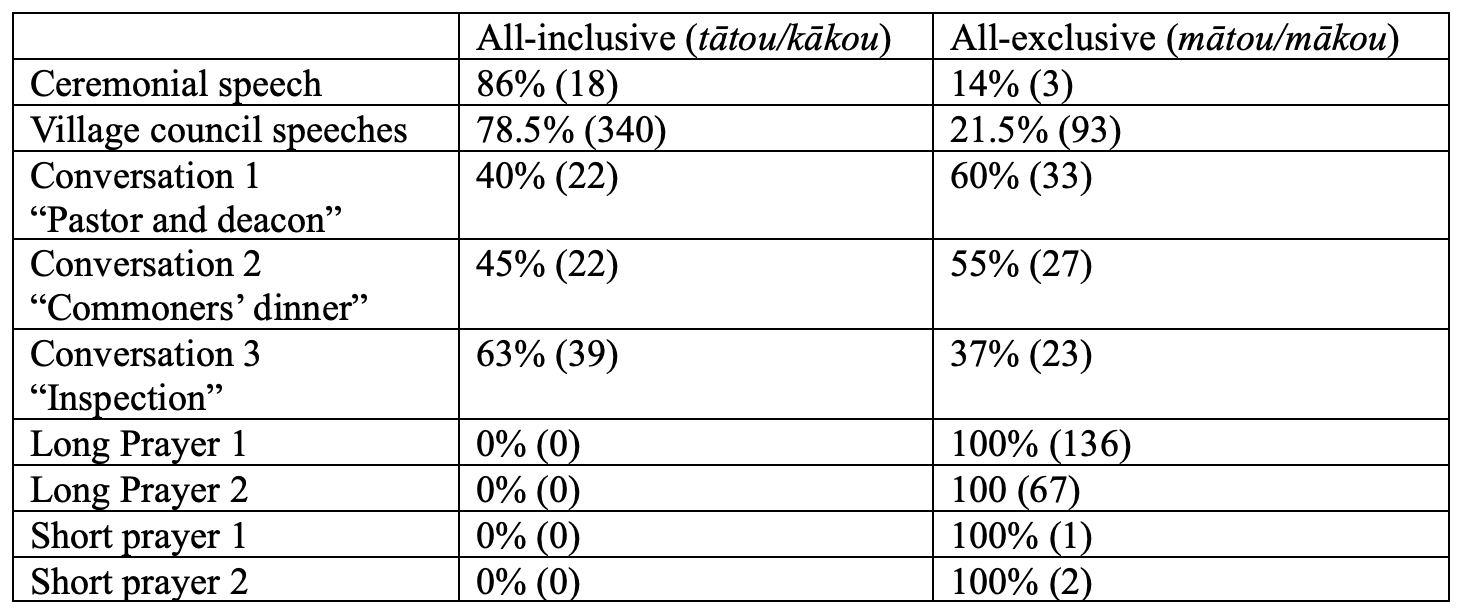
The inclusive first-person plural pronoun (kākou) abounds in a ceremonial speech (lāuga) delivered by a deacon of the Congregational Church of Samoa to the invited preacher (tofi) on behalf of the local congregation (*Ēkalēsia*)to thank him for the sermon he delivered earlier in the day. In a four and a half minutes speech by a deacon who also held an orator title, Taofiuailoa, we find eighteen cases of inclusive *tātou* and only three cases of exclusive *mākou*, which the speaker uses to refer to his own speech (mākou upu, lit. 'our-all-exc words') (see Table 3 in the Appendix). The abundance of the inclusive kākou in this context seems to work as a repeated affirmation and celebration of a shared experience that involves the speaker, who is acting on behalf of the congregation, the invited preacher, who is the primary addressee, and the stratified secondary audience constituted by (firstly) the local pastor and his wife, and (secondly) by other deacons and their wives who will soon participate in the sharing of the food they brought. The deictic kākou seems here indexical in the creative or performative sense defined by Michael Silverstein for those contexts that are made to "exist" by means of linguistic signals.
Certainly, the English indexical pronouns I/we and you (vs. he/she/it/they) perform this creative function in bounding of the personae of the speech event itself; in those languages, such as Chinook (Columbia River, North America) with 'inclusive' and 'exclusive' pronominal indexes, the boundary function becomes even more finely drawn (Silverstein, 1976, p. 34).
What this suggests is that the profuse use of the kākou by Taofiuailoa in his speech, not only presupposes the existence of multiple parties who can come together as a "plural subject," expressed as a "we-all," but it also helps constitute a collectivity of people who share goals, values, and lived experiences – a similar point was made by Saft (2017) about Hawaiian. As shown in the five "we-all-inclusive" (kākou) examples below, everyone present is collectively identified as participating in the praising of God (line 25) and sharing the hope in His love towards them (line 42-43), while being physically co-present, facing one another in an space open to public view – the "front" and not the back "of the village" – (line 29). The conclusion of the speech includes the wish for a shared healthy day for everyone (lo kākou aso 'a day that belongs to all-of-us') and a wish for a bright future ('clear skies') for our-shared by all preacher (line 85).
Examples (3)-(6) are all from deacon/orator Taofiuailoa's ceremonial speech (lāuga) in the after-service shared meal (to`ona`i). The line numbers between parentheses refer to the location of the utterance in the complete transcript.
The speaker remains the same throughout these lines.
(3) (line 25) kākou vi`ia pea le Akua.
                    we-all-Inc praise Cont Art Lord

                    "let **us-all-Inclusive** keep praising the Lord."
(4) (line 29)* kâkou fesilafa`I. i luma o le gu`u*
\ we-all-Inc meet-Rec in front of the village
\ "let us-all-inclusive meet each other in front of the village"
(5) (line 42) kākou fa`amoemoe pea i le Akua
                    we-all-Inc hope            Cont in Art Lord

                    "**let us-all-inclusive** continue to hope in the Lord"

  (line 43)    *i Loga alofa ma Loga agalelei*

                    in his love  and    his   kindness

                    "in His love and His kindness"
(6) (line 83) ia maguia lava:- (.) lo kākou aso
                    Imp health  Emph    Art we-all-Inc day

                    "May **our-all-inclusive** day be very healthy/lucky"

  (line 84)    *le lagi  e       mamā ... i Lau    Susuga*

                    Art sky Comp clear to your-Sg highness

                    "Clear skies to Your Highness"

  (line 85)    *i lo          **kākou** kofi.*

                    to Art-Inof we-all-Inc preacher

                    "**our-all-inclusive** preacher"

                    Or "the preacher of **us-all-inclusive"**
In lines 83 and 85 above, kākou is used as a possessive adjective (noun modifier) meaning 'our (inclusive of all of us).'
There are only three mātou (pronounced /mākou/) in the speech, all of them referring to the speaker, who talks about his words/speech in the plural, as customary in ceremonial speeches or in the formal speeches given in other arenas like the meetings of the village council (see below). There is ambiguity in this use of the plural. It can be interpreted as indexing that he is speaking on behalf of a group, but it can also be a way of downplaying his own actions or decisions as an individual. The first-person singular pronoun (au*) only shows up in the last line of Taofiuailoa's speech, the conventional closing expression *ia au ola! 'may I live!' where the speaker foregrounds his mortality and therefore cannot be seen as showing off.
2.4. First-person plural pronouns in the fono: tension between inclusive and exclusive
The speeches in the political-judiciary arena called fono, the meetings of the matai or titled individuals representing extended families in a Samoan community (Duranti, 1994), share some similarities with the Sunday speech described above – as indicated by the fact that the speeches in the fono are also sometimes called "lāuga" and use some of the same expressions. But the lāuga in the fono are, in fact, different because the fono is usually called when there is a problem to solve. For this reason, it is not a celebratory occasion, but an argumentative one, aimed at solving crises, finding solutions, reaching an agreement between opposing opinions (Duranti, 1981, 1994, chapter 4). While there is an effort to solidify or, in some cases, reestablish a common ground – in local terms, to reestablish the fealofani 'mutual love' among family heads – there is also an expectation that some disagreement will be aired, with the goal of reaching a resolution that won't please everyone but might be acceptable to most or all.
In these contexts, we find many all-inclusive "we" (kākou), as speakers put an effort to list and often repeat shared beliefs and commitments, but we also find a smaller but sizable number of first-person exclusive "we" (mākou). These seem a way for the speakers to distance themselves from previously shared opinions and offer advice either as individuals or as representatives of a village section or lineage.
As shown in Table 3 (see Appendix), in a fono recorded on April 7, 1979, which covered three issues and lasted almost three hours, I found a total of 340 inclusive kākou and 93 exclusive mākou. Like in the ceremonial speech mentioned above, the kākou express a recognition and reaffirmation of speakers' common belonging to the same community, as shown by the fact that a high portion (142 /340) of cases of kākou are modifiers of *nuu* 'village,' meaning **our-all-inclusive** village (pronounced /kākou guu/ with g standing for a velar nasal). It's as if people keep reminding each other that they are from the same community. The use of the inclusive kākou seems to foreground the collective, contributing to the establishment or reinforcement of a plural subject and pragmatically working as a potential buffer to soften the impact of a forthcoming disagreement.
Even though the inclusive "we" outnumbers the exclusive "we" almost four times, the number of exclusive "we" in the April 7, 1979 meeting is still notable, especially because they start to appear when members of the council offer an opinion – framed as an advice – that might not go along with what proposed by other powerful members of the council, like the Senior Orator Moe`ono, the de facto chairman of the council of title holders. In examples (7)-(9) below, Fa`aonu`nu, an orator who is lower ranking than Moe`ono and yet he is not supporting the latter's proposed punishment of two subvillages for not showing up for a meeting, keeps using thewe-all-exclusive mākou, indexing that what he is saying is not an opinion shared by all (as kākouwould indicate) but a thought coming just from him or from one of the groups he could be representing.
Example (7)-(9) from April 7, 1979, fono in Falefā, `Upolu. Speaker: the orator Fa`aonu`u.
(7) 480 `o gai o mākou māfaufauga ia
'a few little thoughts of **ours-all-exclusive'**
(8) 503 fa`apea ai lea`o so mākou leo, ...
                    'this is what **our-all-exclusive** voice'

        504      *Moe`ogo, ... silasila ā i le Akua ma Laga galuega ...*

                    'Moe`ono, ... do look at (consider) the Lord and His work'

        505     *\`a e pesi fo\`i lou lēmālie, ...*

                    'if your disagreement rages,'

        506     *\`ua kakau (o)ga \`ē lē malie*

                    'we-all don't have to agree (i.e., you don't have to agree with me/us]'

        507      *(a)uā \`o \`oe `o le kamā o le gu`u.*

                    'because you (sing.) are the father of the village'

        508  ?; *mālie!*

                    'well said!'
(9) 509 *ae ...*avaku ai gi o mākou faukuaga, Moe`ogo,
but ... I'm giving some of **ours-all-exclusive** advice, Moe`ono,
510 ... ia` e silasila i le Akua ...
'so, look at the Lord' (i.e., remember the Lord's ways)
4. Inclusive (kākou) and exclusive "we" (mākou) in conversation
The distribution of kākou vs. mākou in conversations differs from their distribution in formal speeches, whether in ceremonial occasions like the after-church Sunday gathering (to`ona`i) or in the meeting of the village council.
2.5. Inclusive (kākou) in conversation
We have seen that in formal speeches kākou is used to emphasize or bring the attention to togetherness in or through shared values (e.g., belief in God), past or ongoing shared activities (e.g., eating together), and shared life-experiences (e.g., being from the same village). In conversation, the inclusive kākou is used more broadly to refer to associations, activities, and events or mundane objects that are shared by the speaker, the addressee, and one or more others. For example, in the conversation mentioned above between a pastor and a deacon (Conversation 1 in the Appendix), kākou is used when talking about actions, opinions, and events that involve the two of them and others, as in kākou ke iloa 'we all-inclusive know,' kākou faikau 'our-all-inclusive interpretation,' kākou `Ēkalesia 'our-all-inclusive congregation.' In reported speech alone, kākou may be used to refer to a group that includes the speaker but not the current addressee.
In another conversation, recorded while an untitled man, Sala, his wife Sela (I have used pseudonyms for commoners), and their two children are having dinner and a few friends happen to stop by, the relative percentage of inclusive and exclusive is similar, with a slight increase in the all-inclusive pronoun kākou (see Conversation 2 in the Appendix), which is used for objects belonging to the family4 and invitations. In the latter use, tātou or kākou refers to a proposed or wished-for future togetherness, similar to the 'shall we dance?' mentioned by Gilbert (1989) and cited by Zahavi as an example of "an invitation to the formation of a we, one that awaits the response from the addressee" (Zahavi, 2025, p. 9). This future-oriented use of kākou is shown below in an exchange where Sela invites the friends who had stopped by to stay by asking them to be members of a group that shares the evening (afiafi), understood as 'evening meal' ("//" indicates the point of overlap by subsequent speaker).
(10) Sela; faku alii kou ke ōmai ali\i //`i`ī kākou afiafi
\ "I told you, guys, to come, guys, here (to have) our-all-inclusive evening'
        friend; *laga lea e palapalā e::-*

                    "but/because we are dirty to::-"

        Sela;    *ia` e ā lā pe //ā palapalā?*

                    "so what if you're dirty?"
(11) friend; koe ōmai fo`i kākou kāfafao
"(we)'ll come back (for) **our-all-inclusive** hanging out"
This use of kākou above is an example of a common polite invitation formulated as a command, like fai se kākou meaai* literally 'let's have our-all-inclusive food.' This is in place of a question like "would you like to eat with us?" which is not used. Writing about the Toraja, Aurora Donzelli (2019, pp. 71-74) called this type of hospitality "giving without offering." In the Samoan case, I would call it a benign imposition, a concept that is consistent with the local understanding of respect (*faaaloalo) as constituting an obligation to accept (Duranti, 1992).
A Samoan example of this use of kākou is found in (12) below, from a conversation among women who had been cleaning a house belonging to their congregation. Speaker Vita, who is the wife of the deacon-orator in the conversation mentioned above, invites younger, unmarried, and thus lower status Masa, who had been serving Vita and the other two more senior women, to eat with her and the others. Kākou `a`ai 'let's all eat' is understood as "come eat with us," a generous invitation for a stratified society like Samoa, where status differences are always on everyone's mind.
(12) From "Women of the `Ēkalesia"
Vita; *sau loa \`oe Masa \`i`ī **kākau** \`a`ai*
\ "you come now Masa over here let us-all-inclusive eat," that is, "come to eat with us-all'
2.6. Exclusive (mākou) in conversation
In conversation, the all-exclusive mākou is not used to talk about oneself, as done in formal speeches, but, more literally, to talk about some event that simply does not include the addressee or an object that does not belong to the addressee. In some cases, the use of the exclusive first-person pronoun can establish a contrast between the actions of one speaker's group or family vs. another's. This is what happened in the "Pastor and deacon" conversation mentioned above, which I recorded after a few weeks I had arrived in their village where Elinor Ochs, Martha Platt, and I carried out our research project in 1978-79. Given my still limited competence in Samoan, I was a peripheral participant during most of the conversation. In that context, the mākou was used literally and abundantly, as deacon and pastor reported and compared what each of them did the night before with their family. Their narratives included what they had done in their respective interaction with our research group. It turned out that without realizing that we had been invited by the deacon for dinner, the three of us went to visit him and his family after having eaten with the pastor's family. This fact is made known by the pastor towards the beginning of the conversation. After the deacon proudly lists the special drink they made the night before just for us (mākou kofe 'our-all-exclusive coffee'), and all the food that they had cooked (mākou māmoe 'our-all-exclusive matton, umu kalo 'baked taro,' and fa`i Sāmoa 'Samoan bananas' chopped and boiled), the pastor asks the deacon whether we, referred to as le vāega 'the party (of people),' had actually eaten anything.
Example 13. "Pastor and Deacon"
35 Pastor; ga `a`ai lā le vaega?=
"Did the group eat?"
36 Deacon; =ioe. mākou `a`ai.
"Yes. We-all-exclusive ate."
It is after the deacon responds that we did eat, but not much, that the pastor reveals that we had already eaten at his place. From this point on, it is a back and forth of mākou, with the pastor saying 'we-all-exclusive here did this,' and the deacon countering with 'we-all-exclusive there did this.' As each of the two speakers claims a special relationship with our research team, the use of exclusive mākou ends up marking a confrontation between two possible plural subjects. The evidence for the special nature of each "we" is given in terms of exclusively shared past actions such as "we-all-exclusive (mākou) ate together delicious food," "played cards," "laughed a lot," and so on.
In another conversation, among several titled men constituting an inspection committee charged with checking whether everyone's lawn in the village had been properly cleaned and cut before Christmas, the percentage of inclusive first-person plural kākou increases as they politely address one another in the course of an activity that foregrounds their positional roles as community leaders (Irvine, 1979) (see Conversation 3 in the Appendix).
The "we" in prayers
God is talked about in the third person as everyone's Lord or the Lord that everyone shares (lo tātou Matai 'our-all-inclusive Lord), and when a prayer is announced, it is something done by one person on behalf of everyone else, and the all-inclusive tātou is used, as shown below.
La; `o le ā tātou ifo ma tatalo i le Atua
\ "we-all-inclusive will now bow our heads and pray to God"
        *vala`au atu i le tamā o Nonu*

        "we call upon the father (of the family) Nonu"
\ na te faia se tātou fa`afetai
"(so that) he says **our-all-inclusive** thanksgiving (to God)"
But once the prayer – in this case a particularly long one – starts, we find a 100% of mātou and no tātou (see Appendix).
On behalf of the family or the congregation, the speaker is addressing a God that is separate from them. God is recognized as generously giving, and humans as happy to receive, but they do not form a collective subject with the deity. The pattern repeats in a second long prayer5 and in two very short prayers (see Appendix).
Concluding
I have here briefly investigated the use of first-person plural pronouns in Samoan interactions, with the hypothesis that they play a role in the constitution of something that resembles what Carr and Gilbert independently, and with subtle differences, called "plural subject." I have done it by examining verbal interactions in a language that distinguishes between inclusion and exclusion in a more explicit way than modern European languages do. The spontaneous speech that I recorded across a variety of genres and speech events minimally shows that the use of the inclusive and exclusive pronouns in Samoan vary across contexts in patterned ways. We can hypothesize that such variation is likely to play a role in the constitution of different kinds of "we," some involving positional identities, others more informal or intimate relationships.
The observations offered in this paper are offered to draw more attention to linguistic diversity and its relevance to philosophical argumentation, and, more centrally, to argue that "experience" as an object of inquiry must include language phenomena as they emerge in social encounters.
Appendix
Table 3 Percentage of Samoan inclusive vs. exclusive first-person plural pronouns in a variety of speech genres across different speech events
[^3]: I have found some cases in spoken Samoan where *māua** is conjoined with an additional third party, not included in the dual form, for example, *maua ma Luku ma Salagoa lit. Luku and I and Salanoa. The general point remains that there is no separate singular "I" or "me" in these constructions.
- The recording of spontaneous Samoan speech used for this article was part of research projects supported by the National Science Foundation in 1978-79 and in 1988, and the Australian National University in 1981 (more video recordings were made in 1999 and 2000, but they are not analyzed in this study). Some key information on the contexts of some of the recorded interactions, including the highly stratified quality of Samoan ritual and political events, are described in several previous publications, including Duranti (1994). A more in-depth ethnographic account of Samoan social life and ethos around the time of my fieldwork can be found in Bradd Shore (1982). See also Tcherkézoff (2003) for additional insights into Samoan ways of life.↩
- As shown by the transcripts in Saft (2017) and in other sources, differently from Samoan, Hawaiian has fully replaced the Proto-Polynesian *t with /k/.↩
- Examples of this inclusive kākou are found when Sela says to her two children
aumai le kākou lekiō* 'bring our-all-inclusive radio' and *e lei fufulua kākou `ipu 'our-all-inclusive dishes have not been washed,' an indirect way of reproaching them.↩ - I have not considered God included in the tātou used in the phrase tātou fa`atasi ma `oe 'we-all-inclusive together with you' uttered by Sala in his prayer (Long prayer 2 in the Appendix).↩